
The Complete Guide to Data Matching: Techniques, Tools, and Best Practices
Data matching is the process of comparing records across one or more datasets to identify entries that refer to the same real-world entity, such as a person, organization, product, or location. It is also known as record linkage or entity resolution, though each term carries slightly different technical connotations. Data matching uses deterministic rules, probabilistic scoring, fuzzy string algorithms, and increasingly machine learning to connect records even when identifiers differ, fields are incomplete, or formatting is inconsistent.
For enterprises, effective data matching is the difference between operating on fragmented, contradictory information and building a single trusted view of customers, patients, suppliers, or citizens. Poor data quality costs organizations an average of $12.9 million a year, according to Gartner, and unresolved duplicates are one of the primary drivers of that cost. This guide covers every core data matching technique, the end-to-end matching process, tool selection criteria, and industry-specific implementation guidance.
Key Takeaways
Why Does Data Matching Matter for Enterprises?
Every enterprise accumulates records across dozens of systems: CRMs, ERPs, billing platforms, marketing tools, legacy databases, and third-party feeds. The average organization now runs 957 applications, per the MuleSoft 2026 Connectivity Benchmark, and each system stores its own version of the same customers, products, and transactions, so fragmentation compounds over time.

The business consequences are direct. Duplicate customer records inflate marketing spend through redundant outreach and distort every count built on the data. Unmatched patient records create safety risks, and AHIMA research puts the duplicate rate in a typical hospital master patient index at 8 to 12 percent, which contributes to medication errors and redundant testing. In financial services, unresolved entity records weaken KYC and AML compliance and expose institutions to regulatory penalties.
Data matching solves these problems by identifying which records across systems refer to the same entity, then providing the foundation for deduplication, consolidation, and master data management. Connecting records across separately managed systems that share no primary key is the specific focus of database matching software, and without that foundation every downstream process (analytics, reporting, AI training, compliance) runs on unreliable data.
What Are the Core Data Matching Techniques?
The core data matching techniques fall into four primary categories, each suited to different data conditions and accuracy requirements. Most enterprise implementations use a hybrid approach, applying deterministic matching first for high-confidence pairs and then probabilistic or machine learning methods for ambiguous cases.
Deterministic (Exact) Matching
Deterministic matching compares records field by field against exact rules: if two records share the same Social Security Number, email, or account ID, they are a match. It is fast, transparent, and highly precise when clean unique identifiers exist, but it fails when identifiers are missing, misspelled, or formatted differently across systems.
A regional bank processing 4 million customer records found that deterministic matching on SSN and email resolved only 62 percent of true duplicates, because 38 percent of records lacked one or both identifiers. Adding probabilistic scoring to the unmatched remainder raised resolution to 94 percent.
Probabilistic Matching
Probabilistic matching, rooted in the Fellegi-Sunter model from 1969, assigns weights to each field comparison based on how much agreement or disagreement on that field shifts the probability of a true match. High-discriminating fields like date of birth receive higher weights, low-discriminating fields like sex receive lower weights, and the combined score classifies a pair as a match, non-match, or possible match for review.
This technique handles missing data and field-level inconsistencies far better than deterministic methods, and it is the standard approach in healthcare patient matching, government record linkage, and large-scale customer deduplication.
Fuzzy Matching
Fuzzy matching applies string-similarity algorithms to identify records that are close but not identical, and the fuzzy matching techniques in common use include Levenshtein distance, Jaro-Winkler similarity (optimized for short strings like names), Soundex and Metaphone for phonetic matching, and cosine similarity for token-based comparison.
It excels at catching typos, nickname variations (“Robert” versus “Bob”), transliteration differences, and address formatting inconsistencies. Matching person records across spelling variations and cultural naming conventions is the domain of fuzzy name matching software, while location records need their own parsing and postal validation, the focus of address matching software.
Accuracy depends heavily on the similarity threshold: too low and you generate false positives, too high and you miss true matches. Enterprise fuzzy matching software provides tunable thresholds with test-and-learn workflows to optimize that balance.
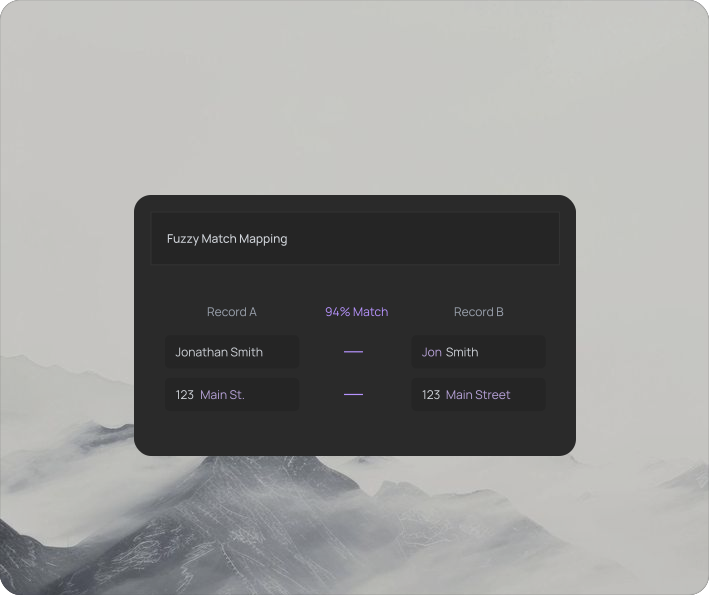
MatchLogic's fuzzy matching engine maps name variations, typos, and format inconsistencies across records, showing similarity scores for every potential match.
Machine Learning-Based Matching
Machine learning matching trains classification models on labeled pairs to learn patterns that rule-based methods miss, incorporating many features at once: string similarities, numerical distances, pattern recognition, and behavioral signals. Once trained, the model scores new pairs with a probability estimate.
The trade-off is explainability. Machine learning often achieves the highest accuracy, but its decision logic is harder to audit than deterministic or probabilistic rules, so for regulated industries a hybrid approach that uses machine learning for candidate scoring and rule-based logic for final classification usually gives the best balance.
Comparison: Data Matching Techniques
The table contrasts the four techniques across how they work, where they fit, and what to watch for.
How Does the Data Matching Process Work?
Regardless of technique, the matching pipeline follows a consistent six-stage process, and skipping or rushing any stage degrades the final accuracy.
Step 1: Data Preparation and Profiling
Before matching, source data is profiled for completeness, consistency, and format, which reveals null rates per field, format inconsistencies, and outliers that would distort match scores. Preparation then includes standardization (expanding “Street” to “St,” parsing names into components) and cleansing, and the quality of this stage directly determines matching accuracy, since standardizing input before matching converts many apparent non-matches into exact matches.

MatchLogic's profiling engine scans millions of records in seconds, revealing completeness scores, format chaos, and duplicate risk before any matching rules are configured.
Step 2: Blocking and Indexing
Comparing every record to every other record is computationally prohibitive: a dataset of 10 million records would generate roughly 50 trillion pairwise comparisons. Blocking partitions data into subsets that share an attribute, such as the first three characters of a last name or a ZIP code, so comparisons occur only within blocks, cutting the number of pairs by orders of magnitude.
The trade-off is that blocking can miss true matches where the blocking key itself contains an error, which multi-pass blocking and sorted-neighborhood algorithms mitigate. A 500-bed hospital system processing 2 million patient records used three blocking passes (last name plus DOB, SSN last four plus ZIP, phone number) and achieved 99.7 percent recall while reducing pairwise comparisons from 2 trillion to 14 million.
Step 3: Candidate Pair Generation
Within each block, the system generates candidate pairs for detailed comparison, and efficient algorithms such as sorted neighborhood with a sliding window further reduce the comparison space while maintaining high recall. The output is a list of record pairs that proceed to scoring.
Step 4: Comparison and Scoring
Each candidate pair is compared across multiple fields using the selected technique. Deterministic comparisons yield binary results, while probabilistic and fuzzy comparisons produce per-field similarity scores combined into an overall match score, with the comparison function matched to the data type: Jaro-Winkler for names, normalized edit distance for addresses, exact comparison for dates, and phonetic encoding for transliteration-prone fields.
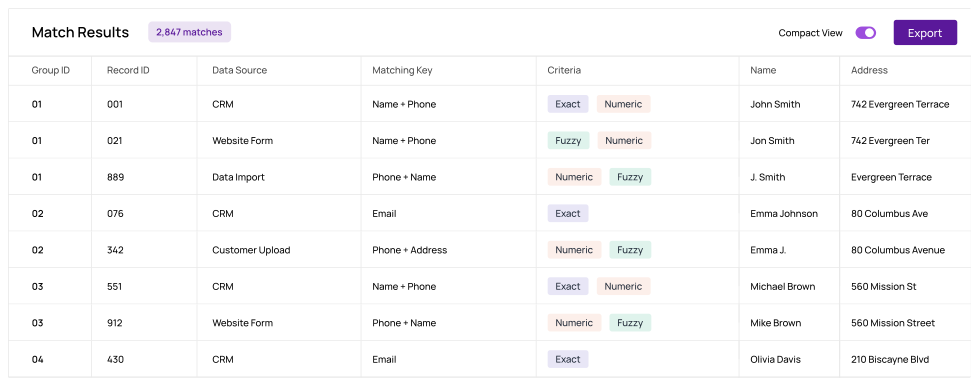
MatchLogic displays match results with per-field confidence scores, showing exactly which algorithms fired and why each pair was classified as a match.
Step 5: Classification and Manual Review
Based on the combined score, each pair is classified as a match, non-match, or possible match for human review. A threshold set too low generates false positives, and one set too high creates false negatives, so enterprise tools provide test-and-learn environments to tune thresholds against labeled validation sets. Best practice targets a review queue of 1 to 3 percent of candidate pairs, and a queue above 5 percent signals that the rules or blocking strategy need tuning.
Step 6: Merging and Survivorship
Once matches are confirmed, survivorship rules decide which field values survive into the merged golden record: most recent value, most complete value, source-system priority, or field-by-field custom logic. Survivorship matters most in merge purge operations, where incorrect merges are expensive to reverse.
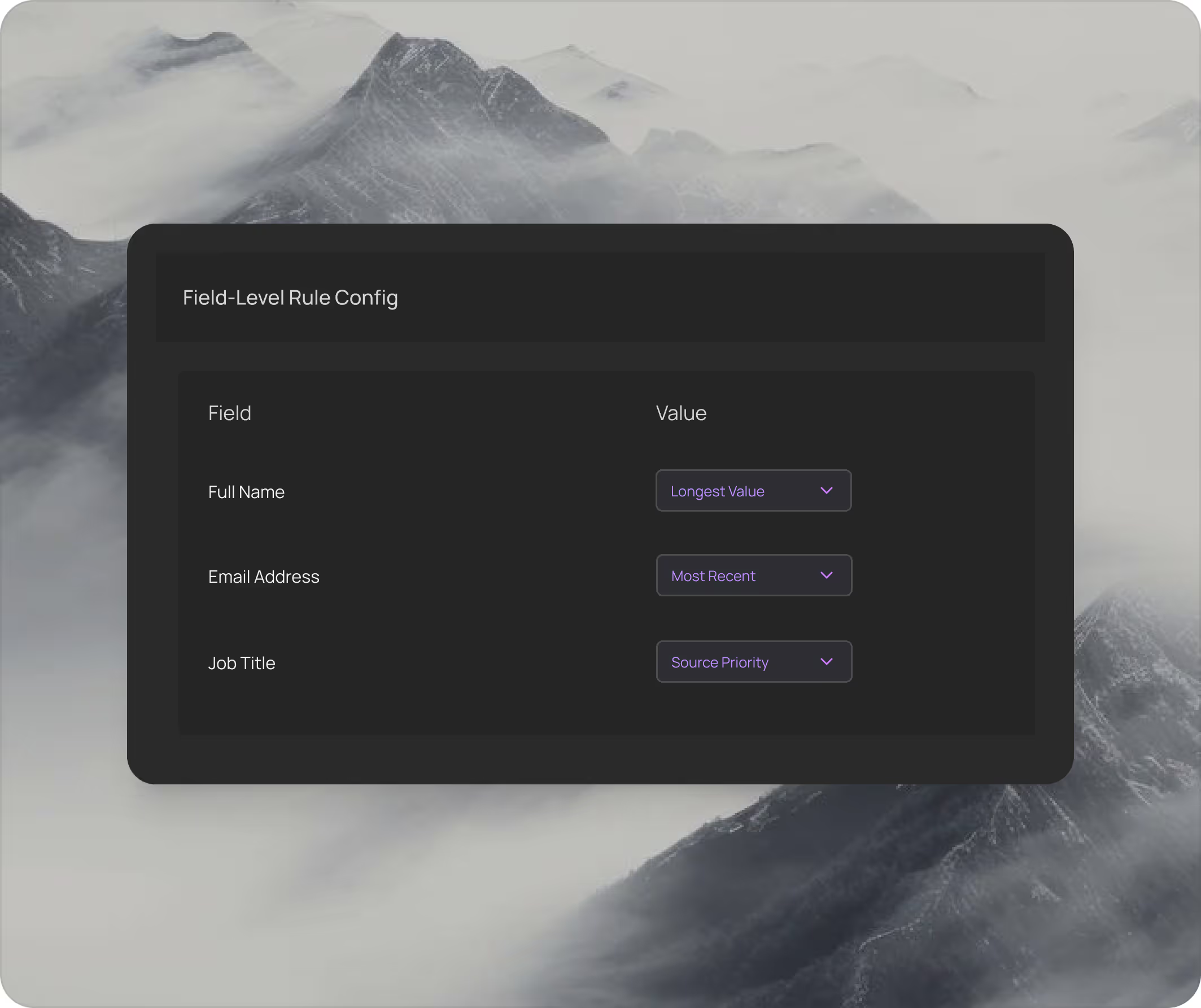
MatchLogic's survivorship engine lets you configure field-level merge rules: names use the longest value, dates use the most recent, addresses use the most complete source.
How Should You Evaluate Data Matching Tools?
The data matching software market includes enterprise platforms (Informatica, IBM, SAS), specialized matching tools, and open-source libraries. When evaluating options, weigh the criteria below.
The pipeline-integration criterion deserves extra attention. A matching tool that doesn't fit cleanly inside the broader data integration workflow forces manual exports between every stage, and that friction is where errors enter the process.
Where Is Data Matching Used Across Industries?
Healthcare: Patient Matching and EMPI
Hospitals and health systems use data matching to build Enterprise Master Patient Indexes (EMPIs) that link patient records across facilities, EHR systems, and insurance claims databases. According to a 2023 Pew Charitable Trusts study, the national patient misidentification rate ranges from 8% to 12%, contributing to an estimated $6 billion in unnecessary costs annually through duplicate tests, delayed diagnoses, and billing errors.
A 500-bed hospital system processing 2 million patient records deployed probabilistic matching with three blocking passes (name + DOB, SSN fragment + ZIP, phone number) and reduced its duplicate rate from 11.2% to 0.8% within 90 days. The system runs on-premise to comply with HIPAA's data residency provisions, processing all patient data within the hospital's secured network.
Financial Services: KYC, AML, and Fraud Detection
Banks and financial institutions use data matching for Know Your Customer (KYC) onboarding, Anti-Money Laundering (AML) screening, and fraud detection. Matching customer records against sanctions lists (OFAC, EU Sanctions) and politically exposed persons (PEP) databases requires high recall: missing a true match carries severe regulatory penalties. A Tier 2 bank processing 15 million customer records against OFAC and PEP lists used a combination of exact matching on identifiers and fuzzy matching on names, reducing false negatives by 34% while cutting false positives (and the associated manual review cost) by 22%.
Retail and E-Commerce: Customer 360
Retailers use data matching to merge customer records from point-of-sale, e-commerce, loyalty, and third-party marketing lists into a unified Customer 360 profile. Marketing teams consolidating several mailing files into one deduplicated list rely on list matching software for the merge purge workflow, because without matching the same shopper who buys in-store, online, and in-app appears as three people, inflating counts and fragmenting personalization.
Government: Benefits Administration and Fraud Prevention
Government agencies use record linkage software to link records across tax, benefits, health, and housing departments to detect fraud, ensure benefits reach eligible recipients, and improve service delivery. The Operation Safe Pilot case, which matched about 40,000 Northern California pilot records against Social Security disability records, remains a classic demonstration of cross-agency linkage.
On-Premise vs Cloud Data Matching: When Does Each Make Sense?
The deployment model has direct implications for security, compliance, performance, and total cost of ownership. MatchLogic is built as an on-premise platform because the enterprises that need the most accurate and auditable matching, those in healthcare, financial services, and government, also require that their data never leaves their secured infrastructure. The table compares the two models across the dimensions that decide the choice.
MatchLogic is built as an on-premise platform precisely because the enterprises that need the most accurate, auditable, and compliant data matching, those in healthcare, financial services, and government, also require that their data never leaves their secured infrastructure. This is not a limitation; it is a deliberate architectural choice that aligns with how regulated enterprises actually operate.
What Are the Best Practices for Enterprise Data Matching?
Start with Data Profiling, Not Matching
The most common mistake is jumping to algorithm configuration without understanding the data. Profile every source to identify completeness rates, format patterns, and duplicate distributions, because this step takes days while skipping it costs weeks of rework.
Use Multi-Pass Blocking
A single blocking key misses true matches where that key is corrupted, so use at least two and ideally three independent passes on different keys, and measure recall after each pass to confirm it is catching new true matches.
Establish Ground Truth Early
Before production matching, manually label a validation set of at least 500 record pairs (250 true matches, 250 true non-matches) and use it to tune thresholds and measure accuracy. Without ground truth, you are guessing.
Measure Precision, Recall, and F1
Precision (the share of declared matches that are correct) and recall (the share of true matches found) are both critical, and the F1 score balances them. For most enterprise use cases, target an F1 above 0.95 and monitor it over time as volumes and sources change.

MatchLogic tracks confidence score distributions over time, letting you monitor whether match quality improves or degrades as data sources evolve.
Automate Ongoing Matching
Matching is not a one-time project, because new records arrive daily. Establish automated workflows that run on ingest and batch matching on a scheduled cadence, since the value of a single project is wasted if duplicates re-accumulate within months.
Document Everything for Compliance
In regulated industries, every match decision must be traceable: the rules applied, the scores generated, the threshold used, and whether a reviewer confirmed or overrode the recommendation. This audit trail is required under HIPAA for patient matching, SOX Section 404 for financial integrity, and GDPR Article 5 for data accuracy.
How Does Data Matching Relate to Entity Resolution and Deduplication?
Data matching, entity resolution, and deduplication are closely related but distinct. Matching is the foundational operation of comparing records to determine similarity, while entity resolution builds on matching by adding clustering (grouping all records that refer to one entity) and canonicalization (creating a single best-version record). Data deduplication is a specific application of matching where the goal is to identify and merge duplicate records within a dataset.

MatchLogic's entity resolution engine builds on matching by clustering related records into unified entity profiles, connecting scattered fragments into a single view.
Think of it as a progression: matching identifies candidate pairs, entity resolution groups those pairs into clusters representing real-world entities, and deduplication applies merge/purge logic to produce clean, non-redundant records. Each step depends on the quality of the step before it.
Building a Data Matching Strategy That Scales
Data matching is not a feature checkbox; it is an ongoing discipline that determines the quality of every downstream data process. The four technique families each serve specific data conditions, and the most effective implementations combine them in hybrid workflows, with the pipeline from profiling through merging refined over decades of research and practice.
Getting each stage right takes investment in profiling, ground-truth labeling, threshold tuning, and ongoing monitoring. MatchCore provides the on-premise engine for this entire pipeline, with transparent per-field scoring and no training period, and MatchSense adds pre-trained, explainable AI entity resolution for clustering matched records into persistent identities, both inside your own secured environment.
Frequently Asked Questions
What is data matching and why do enterprises need it?
Data matching compares records across datasets to identify entries that refer to the same real-world entity, such as a customer, patient, or supplier. Enterprises need it because fragmented records across CRM, ERP, billing, and marketing systems create duplicates that inflate costs, weaken analytics, and create compliance risk.
What is the difference between deterministic and probabilistic data matching?
Deterministic matching compares fields for exact equality, such as SSN or email, and works well when clean unique identifiers exist. Probabilistic matching assigns weighted scores to field comparisons and calculates an overall match probability, which is effective when data is incomplete or lacks unique identifiers. Most enterprises use both: deterministic for high-confidence pairs, then probabilistic for the remainder.
How accurate is fuzzy matching for enterprise data?
Fuzzy matching accuracy depends on the algorithm, the similarity threshold, and the input data quality. Algorithms such as Jaro-Winkler, Levenshtein, and Soundex handle name variations, typos, and formatting differences, and with proper threshold tuning against a labeled validation set, fuzzy matching reaches high F1 scores. Combining it with probabilistic weighting across multiple fields pushes accuracy higher.
Can data matching run on-premise for regulated industries?
Yes. On-premise platforms process all data within your secured infrastructure, so sensitive records such as patient data, financial records, and government identifiers never leave your network. This addresses data-residency requirements under HIPAA, GDPR, and SOX. MatchLogic is built specifically for on-premise deployment in regulated environments.
How do you measure data matching quality?
Three metrics matter most. Precision measures the share of declared matches that are correct, recall measures the share of true matches found, and the F1 score is the harmonic mean of the two. Enterprise benchmarks target an F1 above 0.95, and these metrics should be tracked over time as data sources and volumes evolve.
What is blocking in data matching and why is it necessary?
Blocking partitions records into subsets that share a common attribute, such as ZIP code or last-name prefix, so the system compares records only within a block instead of comparing every record to every other. Without blocking, 10 million records would require roughly 50 trillion comparisons. Blocking reduces that by orders of magnitude while preserving recall, and multi-pass blocking mitigates the risk of a corrupted key.





.svg)