
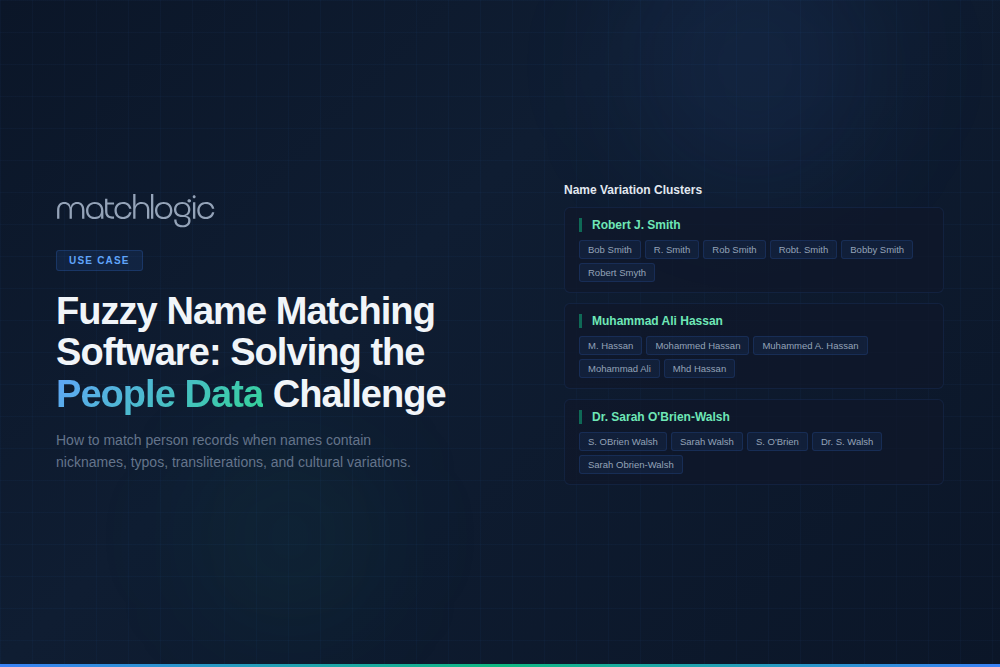
Fuzzy Name Matching Software: Solving the People Data Challenge
Fuzzy name matching software identifies when different name records refer to the same person, even when the names are spelled differently, formatted inconsistently, or use variations such as nicknames, transliterations, or cultural naming conventions. It combines string-similarity algorithms (Jaro-Winkler for character-level variants), phonetic encoding (Double Metaphone for pronunciation-based matches), nickname dictionaries (mapping “Bob” to “Robert” and “Bill” to “William”), and name parsing (splitting compound name fields into salutation, first, middle, last, and suffix). Person name data is the most variable and error-prone field type in enterprise databases, which makes it both the most important and the most challenging field to match correctly.
In a multisite study of nearly 399,000 confirmed duplicate patient records, misspellings accounted for 53 percent of first-name discrepancies and 34 percent of last-name discrepancies, according to AHIMA Journal research. These are not edge cases; they are the majority of the matching problem. Name matching is a specialized part of enterprise data matching, tuned to the way people data actually varies.
This guide covers why person names are uniquely challenging to match, the layered techniques fuzzy name matching software uses, the preprocessing steps that sharply improve accuracy, and the enterprise scenarios where name matching has the highest impact.
Why Is Person Name Matching Uniquely Challenging?
Person names present matching challenges no other field type does. Addresses have postal standards, phone numbers have digit patterns, and dates can be normalized, but names have none of these structural constraints and vary across every dimension at once.
How Does Fuzzy Name Matching Software Work?
Effective fuzzy name matching uses a multi-layer approach, addressing each challenge with the right technique. The broader category of fuzzy matching software applies similar algorithms to any string field, but names need extra layers.
Layer 1: Name Parsing and Standardization
Before any comparison, compound name fields are parsed into structured components: salutation, first name, middle name or initial, last name, and suffix. Names in “LAST, FIRST MIDDLE” format are reordered, and salutations and suffixes are extracted and stored separately. This parsing step is the most undervalued stage of name matching, because without it structural differences create false negatives. The name standardization layer defines the parsing rules and cultural naming conventions that make this step reliable.
Layer 2: Nickname Resolution
Enterprise fuzzy name matching tools maintain nickname dictionaries that map common diminutives to canonical forms: “Bob” to “Robert,” “Bill” to “William,” “Liz” to “Elizabeth,” “Dick” to “Richard.” The most extensive dictionaries cover several thousand mappings across English and multilingual variants. During preprocessing, nicknames are either resolved to their canonical form (so “Bob Smith” becomes “Robert Smith” before comparison) or flagged as a known variant, which tells the matching engine to score “Bob” and “Robert” as equivalent.
The nickname challenge extends beyond English. “Alejandro” maps to “Alexander” and “Alex.” “Sasha” maps to both “Alexander” (Russian) and “Alexandra.” Enterprise tools have to handle these cross-cultural mappings or they'll miss a meaningful share of true matches.
Layer 3: Algorithm Application
After parsing and nickname resolution, the underlying fuzzy matching techniques compare the standardized name components. The standard combination is Jaro-Winkler on first and last name fields, which catches typos and character-level variants, paired with Double Metaphone on the same fields, which catches phonetic variants and transliterations. Scores from both algorithms are combined using weighted averaging, with the algorithm that produces the higher score getting greater weight.
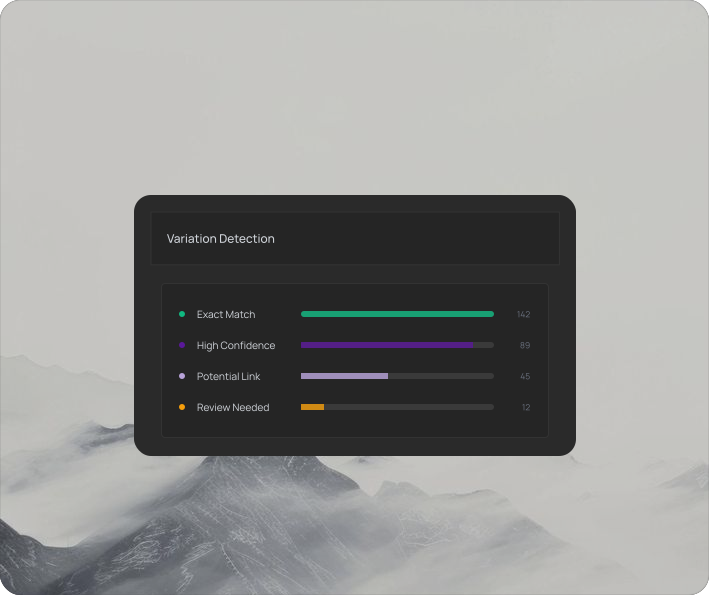
MatchLogic identifies name format variations across systems, showing exactly where spelling differences, abbreviations, and structural inconsistencies occur.
Layer 4: Multi-Field Contextual Scoring
Name matching rarely operates in isolation, because the confidence of a name match rises when combined with date of birth, address, phone, or email. A name score of 0.78, below a typical auto-merge threshold, combined with an exact DOB match and a high address matching score, can lift overall confidence to 0.94. Enterprise tools combine per-field scores into one probability using probabilistic weighting (Fellegi-Sunter) or machine learning classification.
Where Does Fuzzy Name Matching Have the Highest Enterprise Impact?
Healthcare: Patient Identity Matching (EMPI)
Patient name matching is the most safety-critical application. When “Robert J. Smith” sees his physician, “Bob Smith” gets labs at a diagnostic center, and “R.J. Smith” fills prescriptions at a pharmacy, the EMPI must recognize all three as one patient, or records fragment and drug interactions get missed.
A 500-bed hospital system processing 2 million patient records used Jaro-Winkler plus Double Metaphone with nickname resolution and multi-pass blocking and reduced its duplicate rate from 11.2 percent to 0.8 percent within 90 days, running on-premise for HIPAA compliance. In healthcare, every name matching decision must produce an auditable trail of which algorithms fired, what scores they produced, and how the match was classified.
Financial Services: KYC and AML Screening
Banks match customer names against sanctions lists such as OFAC and EU Sanctions, where missing a true match carries severe penalties. This requires high recall, so transliteration variants such as “Mohamad,” “Muhammad,” and “Mohammed” must all be caught. Institutions typically use lower thresholds (0.75 to 0.80) and accept more false positives as the cost of regulatory safety.
Government: Citizen Record Linkage
Government agencies linking citizen records across departments (tax, benefits, health, housing) face the full spectrum of name matching challenges: nicknames, cultural naming conventions in immigrant populations, legal name changes from marriage or divorce, and transliteration from non-Latin scripts. The U.S. Census Bureau's record linkage programs use multi-algorithm fuzzy name matching with phonetic encoding as a core component of their deduplication pipeline.
CRM Deduplication
Sales and marketing databases pick up name variants quickly from web forms, trade show badge scans, purchased lists, and manual entry. “Michael Chen,” “Mike Chen,” “M. Chen,” and “CHEN, MICHAEL” are the same person appearing four times. Fuzzy name matching is the first step in CRM data deduplication, identifying these duplicates so marketing campaigns target unique individuals and sales reps don't contact the same prospect from several different records.
What Should You Look For in Fuzzy Name Matching Software?
Evaluate a tool for person name matching against the criteria below. The broader fuzzy matching software criteria still apply; these capabilities sit on top of them and are specific to the structure of person-name data.
Name Parsing Quality
Can the tool parse compound name fields into structured components? Does it handle “LAST, FIRST” format, salutations, suffixes, and multi-word last names (“Van der Berg,” “De La Cruz”)?
Nickname Dictionary Depth
How extensive is the built-in nickname dictionary? Does it cover English only, or multilingual variants? Can you add custom mappings for industry- or region-specific name pairs?
Cultural Name Handling
Does it support family-name-first conventions (East Asian), patronymic naming (Icelandic), compound surnames (Hispanic), and transliteration from non-Latin scripts?
Multi-Algorithm Combination
Does it apply Jaro-Winkler, phonetic encoding, and nickname resolution in a single pass, or does it require separate passes that you have to stitch together yourself?
Contextual Multi-Field Scoring
Can name match scores be combined with other field matches (DOB, address, phone) into an overall match probability, so a moderate name match plus strong supporting fields still produces a high-confidence merge?
Solving the People Data Problem at Enterprise Scale
Person names are the most challenging field type to match because they vary across every dimension at once. No single algorithm solves all of those variations; effective name matching layers parsing and nickname resolution before any comparison, then combines several fuzzy algorithms, Jaro-Winkler for character-level variants and Double Metaphone for phonetic variants, with probabilistic weighting on top. Within the wider toolkit of data matching techniques, name matching is the most demanding application; it depends on combinations rather than any single algorithm.
MatchCore runs this full pipeline on a single on-premise platform, with transparent per-field scoring and no training period: parsing compound fields, resolving nicknames from an extensible dictionary, and applying multiple fuzzy algorithms per comparison. When name scores must combine with other signals to resolve one person across many systems, MatchSense adds pre-trained, explainable AI entity resolution on the same footprint, and it is deterministic rather than generative, so every decision stays logged and reproducible.
Frequently Asked Questions
What is fuzzy name matching software?
Fuzzy name matching software identifies when different name records refer to the same person by combining string-similarity algorithms such as Jaro-Winkler, phonetic encoding such as Double Metaphone, nickname dictionaries, and name parsing. It handles typos, nicknames, transliterations, and cultural conventions that exact matching misses entirely.
Why is person name matching harder than matching other field types?
Names vary in ways other fields do not: nicknames have no character similarity to canonical forms, cultural conventions reverse field order, transliterations produce multiple valid spellings, and compound fields mix components that should be compared separately. No single algorithm addresses all of these variations at once.
How accurate is fuzzy name matching for enterprise data?
With proper preprocessing and multi-algorithm comparison, fuzzy name matching reaches high F1 scores, though the exact figure varies by dataset and language mix. Accuracy depends heavily on preprocessing: a study of nearly 399,000 duplicate patient records found that misspellings, which preprocessing catches, drove 53 percent of first-name discrepancies.
What is a nickname dictionary in name matching?
A nickname dictionary maps diminutives to canonical names, such as Bob to Robert and Liz to Elizabeth, so the engine treats them as equivalent. Strong tools include thousands of mappings across multiple languages and let you add custom entries, because nicknames have no character similarity for algorithms to detect.
How does fuzzy name matching handle multicultural names?
It parses names according to cultural structure, supports family-name-first and patronymic conventions, recognizes compound surnames, and applies phonetic encoding plus transliteration handling for names from non-Latin scripts. Coverage of the specific cultures in your data is a key evaluation point, since no single rule set fits every naming system.
Can fuzzy name matching run on-premise for regulated industries?
Yes. Person name data is PII in every jurisdiction, so on-premise platforms such as MatchCore process all name matching inside your secured infrastructure with full audit trails. This supports HIPAA requirements for patient matching and KYC and AML requirements for sanctions screening.
What is the difference between name matching and entity resolution?
Name matching compares name fields to decide whether they refer to the same person. Entity resolution combines name scores with other fields and applies clustering and canonicalization to produce one unified record per person across systems. Name matching is a component; entity resolution is the broader outcome.





.svg)