
Data Matching Techniques: A Technical Breakdown for Data Engineers
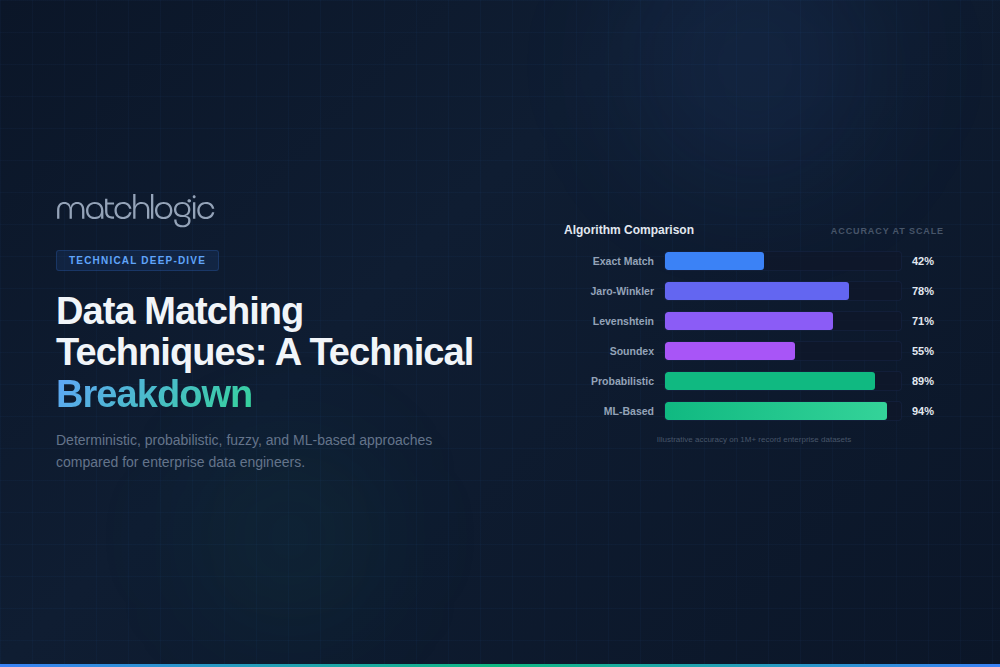
Data matching techniques are the algorithms and methods used to compare records across datasets and determine whether they refer to the same real-world entity. The four primary categories are deterministic (exact-rule) matching, probabilistic (weighted-score) matching, fuzzy (string-similarity) matching, and machine learning-based matching. Each technique differs in accuracy, computational cost, transparency, and the data conditions it handles best.
Choosing the right technique depends on the quality, completeness, and volume of your data. Poor data quality costs organizations an average of $12.9 million a year, according to Gartner, and the wrong matching approach contributes directly through missed duplicates and false merges. For the complete end-to-end process, see our data matching guide.
This article breaks down each technique at the algorithm level, compares them directly, and shows how enterprise teams combine them in hybrid workflows. A dataset with reliable unique identifiers favors deterministic matching, while inconsistent spellings and missing fields call for probabilistic or fuzzy approaches.

What Is Deterministic Matching?
Deterministic matching (also called exact or rule-based matching) compares records against explicit rules. If a field in one record equals the same field in another, the records match, and rules can combine fields (“if SSN matches AND last name matches, declare a match”). The logic is binary: a rule either fires or it does not.
Its main advantages are speed and transparency. Deterministic rules execute in microseconds per comparison and create an audit trail that a compliance officer can read without statistical training. When the rules are well designed, they also produce very few false positives.
The limitation is recall. A regional bank processing 4 million customer records found that matching on SSN and email resolved only 62 percent of true duplicates, because 38 percent of records lacked one or both identifiers. For those records the method returned nothing: it could neither confirm nor rule out a match, because it had no basis for comparison.
The duplicates that later passes identify are then merged through the survivorship rules that data deduplication governs.
What Is Probabilistic Matching?
Probabilistic matching, formalized by Fellegi and Sunter in 1969, assigns agreement and disagreement weights to each field comparison. The weights derive from two probabilities: the chance that field values agree when records truly match (the m-probability), and the chance they agree when records do not match (the u-probability).
Agreement on a rare value (an unusual surname such as “Wojciechowski”) carries a higher weight than agreement on a common one (“Smith”), because a rare match is stronger evidence. The combined weighted score produces a match likelihood: scores above an upper threshold are matches, scores below a lower threshold are non-matches, and scores in between are flagged for manual review.
Probabilistic matching handles missing data gracefully, since a null field contributes zero weight rather than failing the comparison outright. This makes it the standard approach for healthcare patient matching, government records, and any scenario with incomplete data. The same probabilistic logic underpins record linkage software when datasets share no common identifier.
What Is Fuzzy Matching and Which Algorithms Are Used?
Fuzzy matching uses string-similarity algorithms to identify records that are similar but not identical. Unlike deterministic matching, which requires exact equality, fuzzy matching produces a continuous similarity score between 0 and 1 for each field comparison. The algorithms that generate those scores, and the contexts where each one fits, are the subject of fuzzy matching techniques.
Algorithm Comparison: Levenshtein, Jaro-Winkler, Soundex, and Cosine
No single fuzzy algorithm is best for every field type, since each one models a different kind of string variation. That is why address matching software runs Levenshtein on street strings while applying Jaro-Winkler to contact names in parallel. The table below compares the four most common algorithms by how they work, where they perform best, and their main weakness.

What Is Machine Learning-Based Matching?
Machine learning matching trains a classifier on labeled record pairs (match versus non-match) to learn how field-level similarity features interact. Where probabilistic matching uses predefined weights, an ML model learns the weights, and the non-linear interactions between them, from training data.
The strongest approaches use gradient-boosted trees (XGBoost, LightGBM) or transformer-based models that capture semantic similarity, recognizing that “IBM” and “International Business Machines” denote the same entity. In published entity-matching benchmarks, deep learning methods reach the highest F1 scores on clean structured datasets, though accuracy varies by data type and degrades on noisy data (Mudgal et al., SIGMOD 2018).
The trade-off is threefold. ML models need labeled training data, often thousands of balanced match and non-match pairs; their decisions are harder to explain than deterministic or probabilistic rules; and they require retraining as data distributions shift. For regulated industries where every match must be auditable under HIPAA, SOX, or GDPR, opaque ML approaches face real compliance obstacles.
This is the gap MatchSense closes. MatchSense is pre-trained AI entity resolution that runs on-premise and returns an explainable reason for every match, so teams get machine-learning recall without giving up the auditability regulated environments require.
MatchSense is deterministic, not generative, and is not a large language model, so the same input always produces the same output. For exact-rule and fuzzy matching with fully transparent scoring and no training period, MatchCore handles the deterministic and probabilistic passes, while MatchSense handles the AI-driven resolution of the hardest records.
How Should You Combine Techniques in a Hybrid Workflow?
The most effective enterprise implementations do not pick one technique; they layer them. A typical hybrid workflow runs in three passes, each handling the records the previous pass could not resolve.
Pass 1: Deterministic (High-Confidence Exact Matches)
Apply deterministic rules on strong identifiers (SSN, email, account number) to resolve the easiest matches instantly, with no review required. A typical pass clears 50 to 70 percent of true duplicates.
Pass 2: Probabilistic and Fuzzy (Moderate-Confidence Matches)
For records left unresolved, apply probabilistic scoring with fuzzy comparison functions on names, addresses, phone numbers, and dates. Records above the upper threshold merge automatically, and records between thresholds go to review. This pass typically resolves another 20 to 35 percent.
Pass 3: Machine Learning for Edge Cases
For the remaining ambiguous pairs, often 5 to 10 percent of candidates, apply an ML model trained on the organization's own data patterns. The model catches cases where no single field is decisive but the combination of weak signals indicates a match, feeding a review queue with confidence scores and feature explanations.
This layered approach maximizes accuracy while preserving transparency: explainable rules resolve the bulk of matches, and ML is reserved for the cases rules cannot settle.
How Do You Measure Matching Accuracy?
Matching accuracy is measured with three metrics borrowed from information retrieval: precision, recall, and the F1 score. Precision is the share of declared matches that are correct, recall is the share of true matches the system actually found, and F1 is their harmonic mean, a single number that balances the two.
A high-precision, low-recall configuration merges only the obvious duplicates and misses harder ones, while high recall with low precision over-merges distinct records. The right balance depends on cost: in healthcare, a false merge of two patients is more dangerous than a missed duplicate, so precision is weighted higher. Thresholds are the control that moves a configuration along this precision-recall curve.
How Do You Tune Match Thresholds?
Thresholds set the score above which a pair is auto-merged and below which it is rejected, with a review band in between. Start by labeling a representative sample of pairs, then choose thresholds that hit your target precision on that sample before applying them to the full dataset.
Raising the upper threshold increases precision and shrinks the auto-merge set, while lowering it increases recall but sends more borderline pairs through. Most enterprise teams tune per entity type and per field, because the score distribution for company names differs from the distribution for personal names. Reviewing the pairs that fall in the manual-review band is the fastest way to calibrate.
Real-Time Versus Batch Matching
Matching runs in two modes: batch, which processes large volumes on a schedule, and real-time, which matches a single record the moment it is created or queried. Real-time matching through an API prevents duplicates at the point of entry, while batch matching cleans accumulated records overnight.
Batch suits migrations, periodic deduplication, and nightly consolidation. Real-time suits customer onboarding, fraud checks, and any workflow where a duplicate must be caught before it is saved. Many teams run both: a nightly batch job for maintenance and a real-time API for new records.
How Does Blocking Affect Technique Selection?
Blocking (partitioning records into subsets so the system avoids comparing every record to every other) is not a matching technique, but it determines which techniques are computationally feasible. At 10 million records, the O(n squared) comparison space is roughly 50 trillion pairs, and without blocking only the simplest deterministic rules can run in reasonable time.
Effective blocking removes the vast majority of non-candidate pairs while retaining nearly all true matches. The blocking key interacts with technique choice: blocking on last name plus ZIP code works for deterministic and probabilistic matching, but phonetic blocking (grouping by Soundex code) is needed so fuzzy matching can catch name variants that cross blocks.
Choosing the Right Technique for Your Data
There is no universally best data matching technique; the right choice depends on data quality, completeness, volume, and your regulatory environment. Data profiling tools are the standard first step for assessing quality and completeness before any technique is selected.
For most enterprise datasets, a hybrid approach that layers deterministic, probabilistic, fuzzy, and optionally ML techniques in sequence delivers the highest accuracy with the strongest auditability. When matching is extended with clustering and canonicalization to produce one unified record per entity, the discipline becomes entity resolution; our entity resolution guide covers that progression.
MatchLogic supports all four technique categories on a single on-premise platform, with configurable thresholds per entity type and per field. Every match decision is logged in full: which algorithms fired, what scores they produced, and which threshold classified the pair.
Frequently Asked Questions
What are the four main data matching techniques?
The four main techniques are deterministic (exact-rule matching on identifiers), probabilistic (weighted-score matching based on the Fellegi-Sunter model), fuzzy (string-similarity algorithms like Jaro-Winkler and Levenshtein), and machine learning-based (trained classifiers that learn matching patterns from labeled data). Enterprise implementations typically combine all four in hybrid workflows.
Which fuzzy matching algorithm is best for person names?
Jaro-Winkler is generally the best algorithm for person names because its prefix bonus rewards strings that share the same first characters (capturing that "Robert" and "Roberto" are likely the same person). For phonetic name variants ("Catherine" vs. "Katherine"), Soundex or Double Metaphone is more effective. Most enterprise tools apply both in parallel.
How much labeled data does ML-based matching require?
ML-based matching typically requires at least 1,000 labeled record pairs (balanced between matches and non-matches) for acceptable accuracy. Larger training sets (5,000+ pairs) produce more reliable models, especially for complex data with multiple entity types. Active learning approaches can reduce labeling effort by focusing human review on the most informative pairs.
Can matching techniques run on-premise?
Yes. On-premise platforms like MatchLogic execute all matching techniques (deterministic, probabilistic, fuzzy, and ML) within your secured infrastructure. Match scores, algorithms, and audit trails are generated and stored locally, ensuring sensitive data never leaves your network.





.svg)