
Every ERP migration, platform consolidation, and legacy system retirement forces a decision: clean the data first, or import the mess. matchlogic matches and deduplicates records across your old and new systems so the data arrives clean on the other side.

.avif)
.avif)
.avif)
.avif)
.avif)
We were six weeks from go-live on our new ERP and realized our vendor and customer data had never been reconciled across the legacy systems. matchlogic ran against all three sources and gave us a clean, deduplicated dataset in days, not the months our SI was quoting.

You're consolidating three ERPs into one. Or retiring a legacy CRM. Or moving from on-prem to cloud. The new platform promises a fresh start, but fresh starts require clean data. If you migrate 2.5 million records without matching them first, the new system starts its life with the same duplicates, the same conflicts, and the same reporting gaps the old systems had. matchlogic profiles, matches, and deduplicates records across every source before a single row moves to the target.
Three legacy systems each have their own customer and vendor records. Some overlap. Some are unique to one system. Without matching before migration, every overlapping record gets imported as a separate entry. On day one of the new ERP, you have more duplicates than any of the legacy systems had individually, because you've now combined the fragmentation from all of them into one place. The new system is dirtier than any of the old ones.

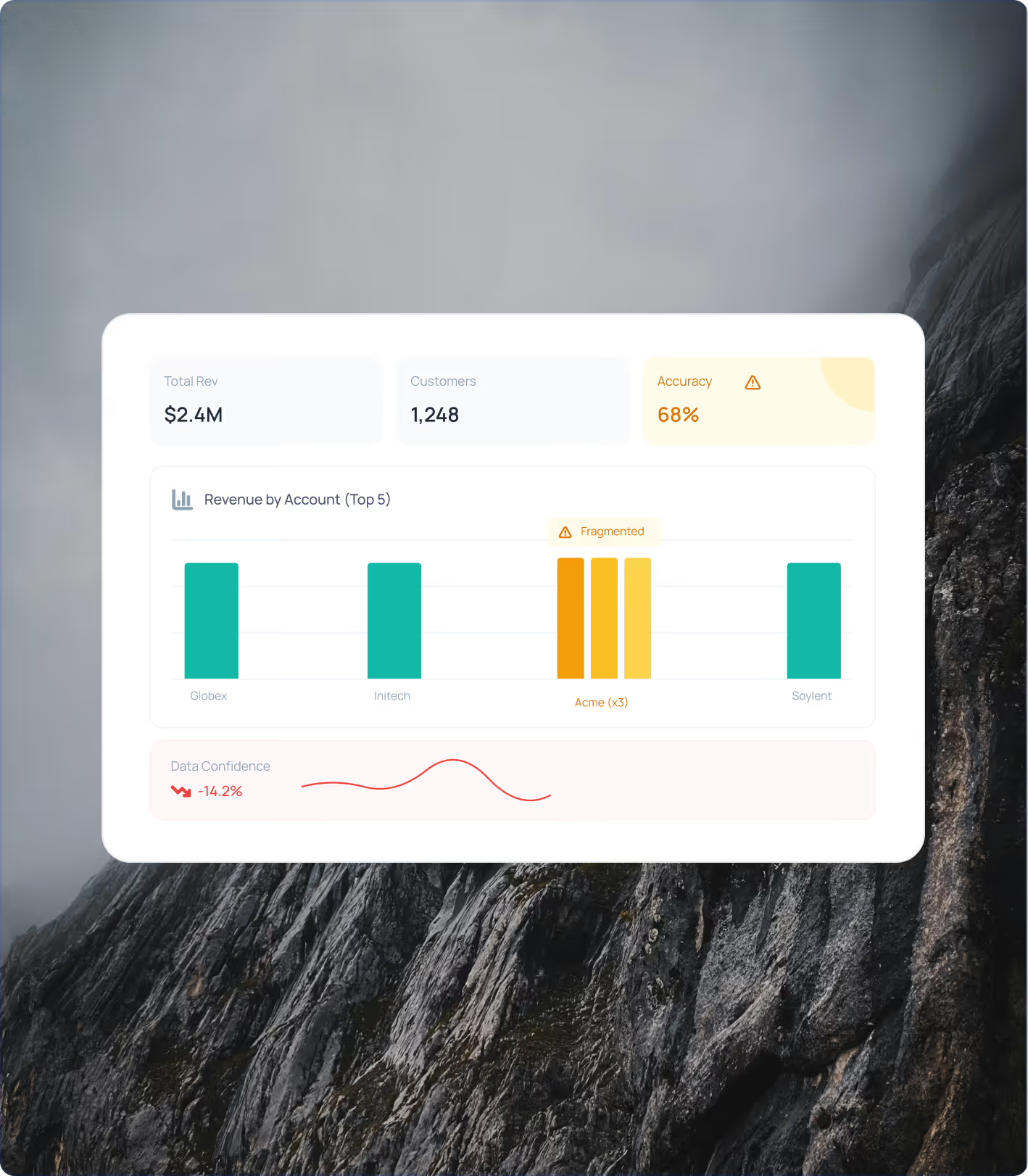
Two reps call the same account because it exists under two different company names. Territory assignments overlap when the CRM can't tell that 'Johnson & Johnson' and 'J&J Inc.' are the same buyer. Pipeline reports show phantom opportunities because a single deal is logged against duplicate contact records. Revenue forecasting suffers when the data underneath it has no integrity.

Every dashboard built on top of duplicated customer records shows the wrong numbers. Customer count, average order value, lifetime value, churn rate: all of these metrics shift when records that should be merged are counted separately. Leadership makes decisions on data that overstates the customer base and understates per-customer revenue.

Regulations like GDPR and CCPA require organizations to honor data subject requests across every system. If a customer exists as three separate records, a deletion request might only remove one. Incomplete compliance exposes the organization to fines and audit findings. Duplicate records are a direct liability when regulators come looking.

The new ERP connects to downstream systems through APIs and data feeds. Those integrations assume clean, deduplicated master data. When a customer record exists three times in the new system, downstream processes break in unpredictable ways: order management routes to the wrong account, billing sends invoices to outdated addresses, support tickets open against phantom customer profiles. Every integration point becomes a potential failure point when the underlying data has duplicates.

Regulatory reporting depends on accurate, complete, unduplicated records. When customer records are fragmented across the new system, GDPR data subject access requests miss entries. CCPA deletion requests leave orphaned records behind. Financial reporting aggregates the same transactions under different entity IDs. Auditors flag the discrepancies. The new system that was supposed to improve compliance posture has made it worse because the data it ingested was never reconciled.

Migration consultants will tell you to cleanse data during the extract-transform-load process. But cleansing is only half the problem. Standardizing addresses and fixing formatting errors does nothing about the fact that the same entity exists in three legacy systems under three different IDs, three different name spellings, and three different address formats.
matchlogic sits between your legacy sources and your target system. Load customer, vendor, or product data from every source into a single matching project. The platform profiles the data first, showing completeness gaps, format inconsistencies, and duplicate patterns across all sources before matching begins. Then it runs configurable fuzzy matching across every record pair, scoring matches on name similarity, address proximity, ID overlap, and whatever additional fields carry signal in your data.
Every match result is transparent. You see exactly which fields contributed, at what weight, and with what confidence score. High-confidence matches auto-merge. Gray-zone matches go to a review queue. Non-matches pass through untouched. When the matched, deduplicated dataset loads into the target system, every record has a lineage trail back to its source systems.
Your migration team gets clean data. Your auditors get documentation. Your users get a system they can trust from day one.

matchlogic scans each legacy dataset for completeness, uniqueness, format consistency, and anomalies. You see exactly where the data quality gaps are across all sources before making any matching decisions. No surprises during go-live.

Load data from SAP, Oracle, Salesforce, legacy mainframes, or flat file exports into one project. matchlogic matches across all sources at once, handling millions of records with the throughput migration timelines demand.

Each deduplicated record carries a complete lineage trail: which source systems it came from, which fields survived the merge, and what confidence score drove the decision. Migration auditors and data governance teams get the documentation they need.

Run matchlogic as a standalone desktop tool for one-time migration projects, deploy on a server for team access during extended migration windows, or integrate via API directly into your ETL pipeline. No infrastructure overhaul required.
Watch how matchlogic profiles, matches, and deduplicates records across multiple source systems in a 3-minute walkthrough. Bring a sample extract from your legacy systems and we'll run it live.
Schedule a Demo
Entity resolution shows exactly how your records connect to real-world entities. You'll see which fragments belong together, where identity variations hide, and how records cluster. Visual entity maps highlight relationships across all your systems before any data changes, giving you full control over identity unification.
matchlogic resolves 10 million records in under 8 minutes, linking fragments and clustering related entities at scale. The engine analyzes every field, calculates match confidence, groups related records, and generates visual entity maps without performance issues.
Most companies discover 30-40% entity fragmentation they never knew existed. Resolution catches nicknames hiding as formal names, typos creating false duplicates, and company abbreviations splitting single entities. These variations cost real money in duplicate processes.
Deduplication removes exact duplicates within one dataset. Entity resolution links related records across multiple systems to real-world entities - even when names, formats, and identifiers vary. You get unified profiles showing the complete picture of each customer, vendor, or contact.
Yes - see exactly how records will cluster before any data changes. Visual previews show entity groups with confidence scores highlighted. Review field-by-field evidence, adjust matching rules, and approve results. Nothing changes until you confirm the resolution output.
Entity resolution creates unified customer identities for GDPR right-to-access requests, KYC verification, and AML screening. Track which records belong to each entity, prove proper identity management for audits, and maintain evidence trails showing how identities were resolved.

.svg)