
Fuzzy Matching Techniques: Algorithms, Scoring, and Real-World Applications
Fuzzy matching techniques are string-similarity algorithms that measure how closely two text values resemble each other, producing a numerical score rather than a binary match or no-match result. The five primary categories are edit-distance algorithms (Levenshtein, Damerau-Levenshtein), character-transposition algorithms (Jaro, Jaro-Winkler), phonetic algorithms (Soundex, Metaphone, Double Metaphone), token-based algorithms (Jaccard, cosine similarity, TF-IDF), and hybrid approaches (Monge-Elkan, SoftTF-IDF). Each category suits different data types and error patterns, and enterprise systems apply several in parallel to maximize accuracy.
Choosing the right technique for each field type is one of the most consequential decisions in a data matching project. Levenshtein distance penalizes “Robert” versus “Bob” severely, while Jaro-Winkler handles it through a prefix bonus, yet Jaro-Winkler performs poorly on long address strings where Levenshtein or token-based methods fit better. This guide gives algorithm-by-algorithm breakdowns with scoring examples, a decision framework for field-type assignment, and real-world scenarios.
Fuzzy matching is one branch of a broader set of data matching techniques that spans deterministic, probabilistic, and machine learning approaches.
What Are Edit-Distance Fuzzy Matching Techniques?
Edit-distance algorithms measure how many single-character operations (insertions, deletions, substitutions) are needed to transform one string into another. The fewer the operations, the more similar the strings.
Levenshtein Distance
Levenshtein distance counts the minimum insertions, deletions, and substitutions required to convert one string into another, normalized to a 0 to 1 scale by dividing by the length of the longer string. It is the most widely known fuzzy matching algorithm.
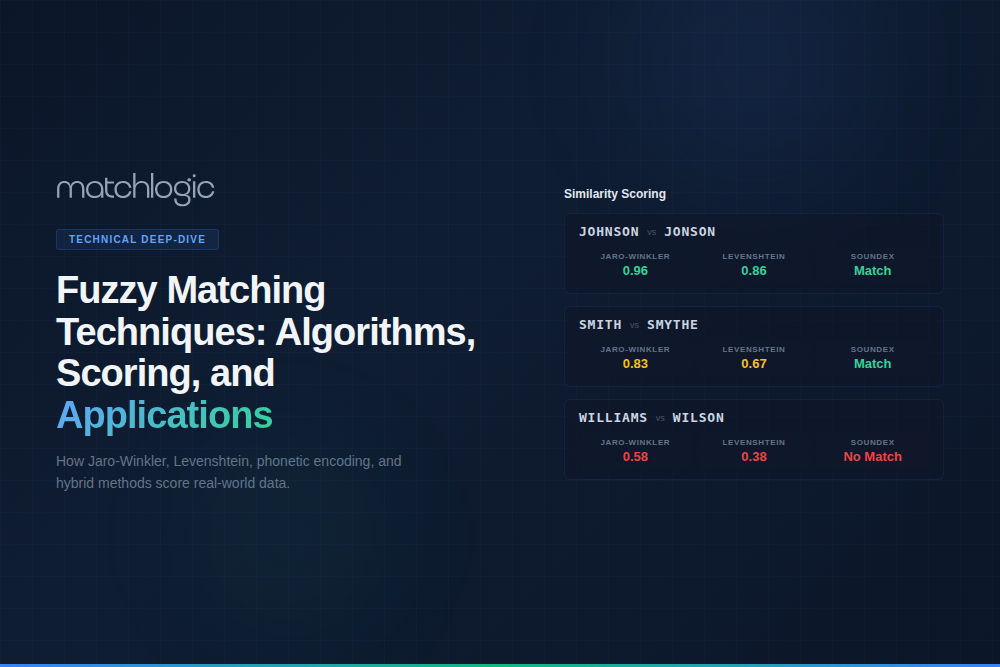
Scoring example: “MAIN STREET” versus “MAIN ST” needs four deletions, giving a normalized similarity near 0.64, while “SMITH” versus “SMYTH” needs one substitution for a similarity of 0.80. Levenshtein works well for addresses, product codes, and other fields where character-level edits represent real data quality issues, but it performs poorly on names where semantic variants such as “Robert” and “Bob” carry high edit distances.
On address fields specifically, address matching software leans on Levenshtein once each component has been parsed and standardized. It struggles with names, though, where a semantic variant like Robert versus Bob carries a large edit distance despite referring to the same person.
Damerau-Levenshtein Distance
Damerau-Levenshtein extends Levenshtein by counting a transposition (swapping two adjacent characters) as one operation instead of two, which better models typing errors. “RECIEVE” versus “RECEIVE” is distance 1 under Damerau-Levenshtein, versus distance 2 under standard Levenshtein.
What Are Character-Transposition Fuzzy Matching Techniques?
Character-transposition algorithms look at how many characters two strings share and how those characters are arranged, which makes them a strong fit for short strings such as names.
Jaro Similarity
Jaro similarity measures the proportion of matching characters within a defined window and the number of transpositions, producing scores between 0 and 1. It is effective for short strings because it does not penalize length differences as heavily as edit-distance methods.
Jaro-Winkler Similarity
Jaro-Winkler extends Jaro with a prefix bonus: strings sharing the same first one to four characters receive a score boost, reflecting that misspellings and variants tend to share prefixes. “ROBERT” and “ROBERTO” share a six-character prefix and earn a significant bonus.
Scoring example: “MARTHA” versus “MARHTA” scores about 0.961 on Jaro-Winkler, while “ROBERT” versus “BOB” scores about 0.43 on Levenshtein and only 0.39 on Jaro-Winkler, confirming that neither handles nickname variants. For nicknames, phonetic algorithms or reference dictionaries are required. In fuzzy name matching software, enterprise tools maintain nickname dictionaries that map “Bob” to “Robert” before algorithmic comparison.
What Are Phonetic Fuzzy Matching Techniques?
Phonetic algorithms compare how strings sound rather than how they're spelled, which makes them good at catching spelling variants and transliterations of the same name.
Soundex
Soundex encodes a string into a four-character code based on how it sounds in English. The first letter stays, the consonants after it map to digits, and vowels and repeated digits drop out. “Smith” and “Smyth” both encode to S530, and “Catherine” and “Katherine” both encode to C365.
Soundex is binary: two strings either land on the same code (a match) or different codes (a non-match), with no granular score in between. That makes it most useful as a blocking key or as a supporting signal alongside character-based methods. Its weakness is false positives, since phonetically close but genuinely different names can collide on the same code.
Metaphone and Double Metaphone
Metaphone improves on Soundex with richer phonetic rules covering silent letters, consonant clusters, and vowel sounds. Double Metaphone extends this further by generating a primary and an alternate encoding per string, capturing names with two plausible pronunciations such as “Schmidt.”
Double Metaphone is the standard phonetic algorithm in enterprise fuzzy matching tools because it handles a broader range of name origins than Soundex. It is still most effective for English-language data, and multilingual matching requires language-specific phonetic models.
What Are Token-Based Fuzzy Matching Techniques?
Token-based algorithms treat a string as a set or bag of words rather than a sequence of characters, which makes them resilient to word reordering in fields like company names and addresses.
Jaccard Similarity
Jaccard similarity measures the overlap between two sets of tokens (words or n-grams). The score is the size of the intersection divided by the size of the union. "John Robert Smith" and "Robert Smith John" have a Jaccard similarity of 1.0 because they contain the same token set, despite different ordering. This makes Jaccard ideal for fields where word order varies (company names, addresses with reordered components).
Cosine Similarity
Cosine similarity treats strings as vectors (using token frequency counts or TF-IDF weights) and measures the cosine of the angle between them. Like Jaccard, it is insensitive to word order, but unlike Jaccard, it accounts for token frequency. "IBM Corp" vs. "International Business Machines Corporation" scores poorly on character-based methods but can achieve high cosine similarity when token-level comparison is used with an abbreviation expansion dictionary.
N-Gram Similarity
N-gram methods break strings into overlapping character sequences of length n (bigrams for n=2, trigrams for n=3) and measure the overlap. "NIGHT" produces bigrams [NI, IG, GH, HT] and "NACHT" produces [NA, AC, CH, HT]. The shared bigram "HT" produces a low similarity score, reflecting that these strings are quite different despite a shared ending. N-gram similarity is useful for catch-all fuzzy comparison when the nature of variations is unpredictable.
Which Fuzzy Matching Technique Should You Use for Each Field Type?
How Do You Tune Fuzzy Matching Thresholds?
The similarity threshold sets the boundary between matches and non-matches, balancing precision against recall. There is no universal correct value, because it depends on data quality, match volume, and tolerance for manual review.
Best practice is to build a labeled validation set of at least 500 record pairs, run matching at several thresholds (0.80, 0.85, 0.90, 0.95), and measure precision and recall at each to find the point that maximizes F1 for your data. As a directional rule, lowering the threshold raises recall but increases false positives, so the right setting comes from the precision-recall curve on your own labeled set rather than a fixed number. MatchLogic's threshold-tuning interface plots this curve in real time so you can see the immediate impact of each adjustment.
Why Does Standardization Reduce the Need for Fuzzy Matching?
Every format variation you can remove with standardization before comparison is a comparison that no longer needs fuzzy logic at all. When “123 North Main Street” and “123 N. Main St.” are both standardized to “123 N MAIN ST” first, the match is simply exact. The fuzzy engine isn't involved for that field, and overall match confidence rises because the field now returns a certain result instead of a probabilistic one.
That's why the pipeline order matters: profile the data first to see what's actually in it, standardize next to strip out format noise, then match. The data profiling tools that open that sequence tell you which fields are inconsistent enough to need standardization in the first place. With the noise gone, the fuzzy algorithms can focus on what they're actually for, the real typos and genuine name variants that need similarity scoring.
This matters most right before a merge. Skipping standardization is the most common cause of avoidable false positives, and those false positives do their worst damage downstream, in the data deduplication step where merge and survivorship rules act on the match results.
Where Are Fuzzy Matching Techniques Applied in Enterprise Scenarios?
The choice of algorithm and threshold shifts with the use case, because the cost of a false positive and the cost of a false negative aren't equal across industries.
Healthcare: Patient Name Matching
Patient name matching pairs Jaro-Winkler for character-level variants with Double Metaphone for transliterated names common in multilingual populations. A 500-bed hospital system matching 2 million patient records used this combination with multi-pass blocking (name plus DOB, SSN fragment plus ZIP) and reduced its duplicate rate from 11.2 percent to 0.8 percent. For fuzzy matching software selection in healthcare, auditability of match decisions is the primary requirement.
Financial Services: Sanctions List Screening
KYC and AML screening matches customer names against sanctions lists such as OFAC, EU Sanctions, and PEP databases. Those lists share no common identifier with your customer records, so screening against them is fundamentally a record linkage problem, and it demands high recall, because missing a true match against a sanctioned entity carries severe regulatory penalties. Financial institutions usually run Jaro-Winkler with Soundex at lower-than-normal thresholds, accepting more false positives to drive false negatives down. The heavier manual review burden is the accepted price of regulatory safety.
Retail: Product Catalog Deduplication
Product matching uses Levenshtein for SKU and model-number comparisons, where single-character errors are common, alongside cosine similarity for product descriptions, where word order and phrasing vary. Picture a retailer with hundreds of thousands of SKUs spread across a dozen regional catalogs: that same pairing surfaces the products listed as duplicates under different codes, and clearing them cuts inventory management overhead substantially.
Matching the Right Algorithm to the Right Data
Matching the Right Algorithm to the Right Data
Fuzzy matching is not a single technique; it is a family of algorithms, each suited to different data types and error patterns. The most effective implementations assign algorithms per field type (Jaro-Winkler for names, Levenshtein for addresses, cosine for company names, phonetic for transliterated names) and apply them in parallel within one pipeline.
MatchCore supports all five algorithm categories on a single on-premise platform, with per-field algorithm assignment, visual threshold tuning, and integrated standardization, and it needs no training period because the algorithms and thresholds are configured rather than learned. When records resist string similarity alone, MatchSense adds pre-trained, explainable AI entity resolution on the same footprint, and every score contribution stays logged and traceable for each decision.
Frequently Asked Questions
What are the main categories of fuzzy matching techniques?
The five categories are edit-distance (Levenshtein, Damerau-Levenshtein), character-transposition (Jaro, Jaro-Winkler), phonetic (Soundex, Metaphone, Double Metaphone), token-based (Jaccard, cosine similarity, TF-IDF), and hybrid (Monge-Elkan, SoftTF-IDF). Enterprise tools apply several categories per comparison for maximum accuracy.
Which fuzzy matching technique is best for matching person names?
Jaro-Winkler is the primary algorithm for person names because its prefix bonus captures common variants. Double Metaphone is applied as a secondary technique for phonetic and transliterated names. For nickname resolution such as Bob to Robert, reference dictionaries are needed alongside algorithmic comparison.
What is the difference between Levenshtein and Jaro-Winkler?
Levenshtein counts the character edits needed to turn one string into another, which fits addresses and codes. Jaro-Winkler measures transpositions with a shared-prefix bonus, which fits names. Levenshtein penalizes nickname variants heavily, while Jaro-Winkler rewards shared prefixes, so the two suit different field types.
What is the difference between Soundex and Double Metaphone?
Soundex produces a single four-character phonetic code and a binary match, so it is coarse but useful for blocking. Double Metaphone uses richer pronunciation rules and generates a primary and an alternate code, handling a broader range of name origins, which is why it is the standard phonetic method in enterprise tools.
How do you choose a fuzzy matching threshold?
Create a labeled validation set of at least 500 record pairs, run matching at several thresholds, and measure precision and recall at each to pick the point that maximizes F1 for your data. Lowering the threshold raises recall but adds false positives, so the curve on your own data should guide the choice.
Does standardization reduce the need for fuzzy matching?
Yes. Every format variation removed by standardization before comparison converts a fuzzy match into an exact one, which raises overall confidence and lets fuzzy algorithms focus on genuine variants. Standardization should always precede matching in the pipeline.
Do fuzzy matching techniques need training data?
No. Fuzzy matching applies fixed string-similarity algorithms and configurable thresholds, so it requires no labeled training data or training period. Machine learning matching is the approach that needs labeled pairs; fuzzy techniques work as soon as they are configured.
How do token-based techniques handle company name variations?
Token-based methods such as Jaccard and cosine similarity compare sets of words rather than characters, so they tolerate reordered and abbreviated company names. Paired with an abbreviation dictionary, cosine similarity can match IBM Corp to International Business Machines Corporation that character methods would miss.





.svg)