
Maria Garcia in the benefits system. M. Garcia-Lopez in the tax database. Marie Garcia in the education records. Maria G. Lopez in the licensing portal. Mary Garcia in child services. She is one person receiving services from five programs, but your systems cannot connect her records. MatchLogic identifies and links citizen records across agency databases so you get one accurate view of every individual.

.avif)
.avif)
.avif)
.avif)
.avif)
We had citizen records spread across multiple program databases with no reliable way to connect them. MatchLogic gave us a matching process we could run ourselves without sending data to an outside vendor.

When the same citizen exists as multiple records across agency systems, benefits get duplicated, eligibility determinations are incomplete, audit responses take weeks instead of hours, and program integrity teams cannot verify who received what. MatchLogic links citizen identities across benefits databases, tax systems, education records, licensing portals, and case management platforms so every agency works from the same accurate population.
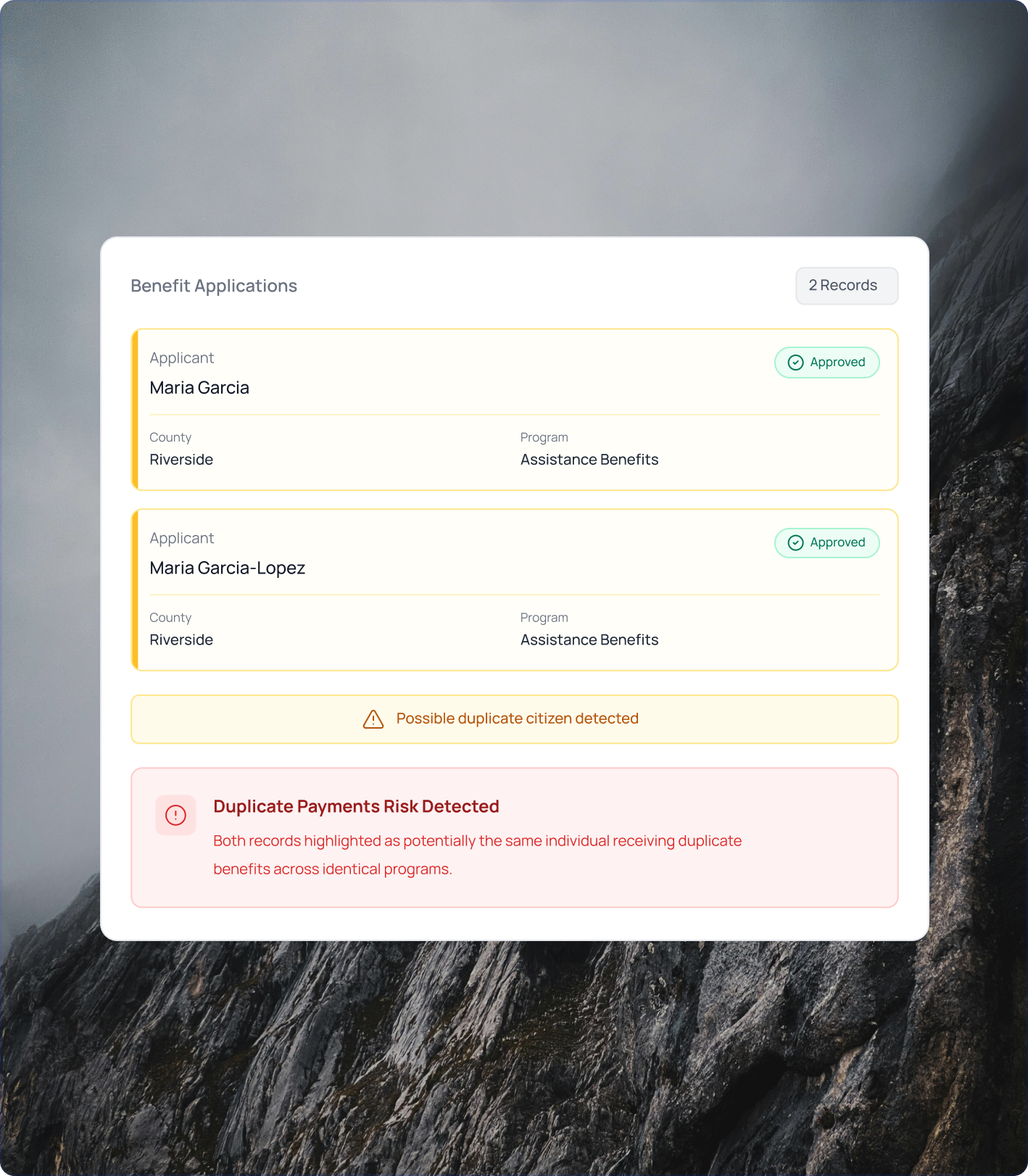
A citizen applies for benefits in two counties under slightly different names. One application lists 'Maria Garcia' and the other lists 'Maria Garcia-Lopez.' The system treats them as two different people. Both applications are approved. The agency is now paying duplicate benefits to the same individual. This is not necessarily fraud. It is a data quality problem that looks like fraud to auditors and legislators. MatchLogic identifies that these records belong to the same person before payments are issued, so program integrity teams can intervene at the right point.
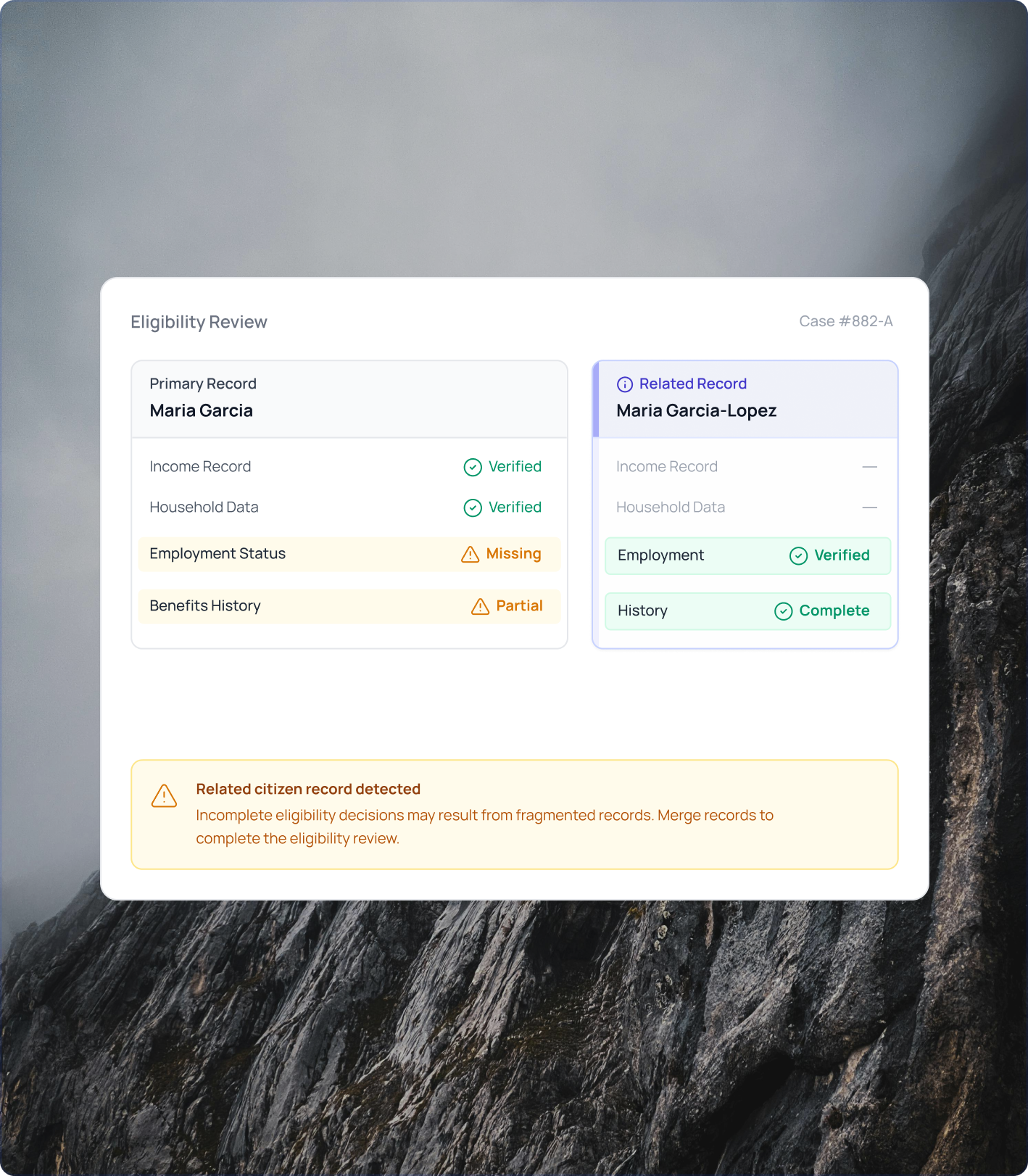
Eligibility determinations depend on a complete picture of a citizen's circumstances: income, household size, existing benefits, employment status. When records are fragmented across systems, caseworkers see partial information. A citizen who qualifies for additional services does not receive them because the system does not connect their records. Or a citizen who should be flagged for income verification is missed because their employment record is under a different name variation. MatchLogic links all records for a citizen across programs so eligibility decisions are made on complete data.
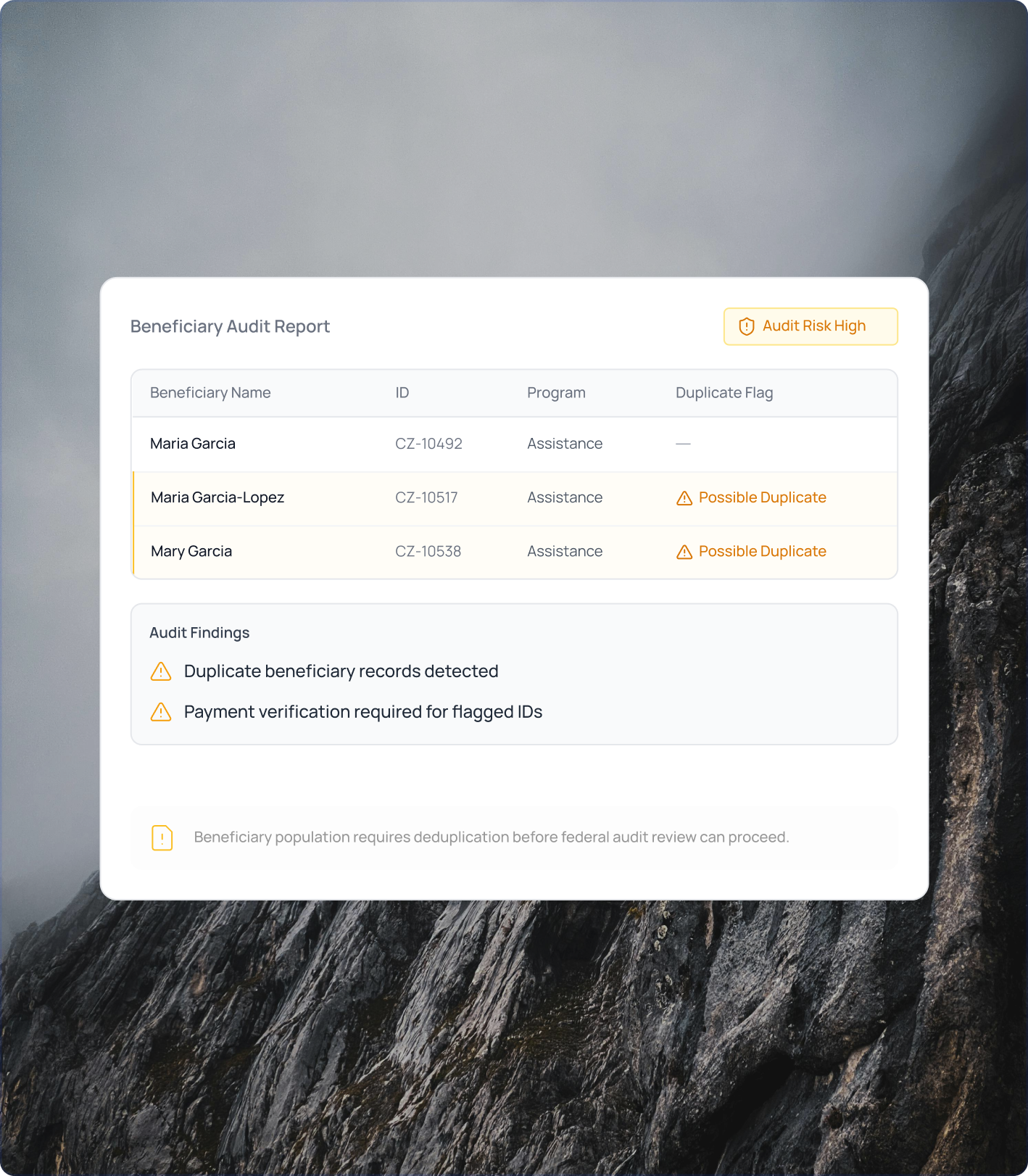
Federal and state auditors ask a straightforward question: can you account for every dollar distributed and every citizen who received services? When your agency cannot produce a clean, deduplicated list of beneficiaries, the audit finding writes itself. Duplicate records mean duplicate payments mean questioned costs. The time your staff spends responding to audit findings, pulling manual samples, and reconciling records is time not spent on program delivery. MatchLogic produces a matched and deduplicated citizen population that auditors can verify.
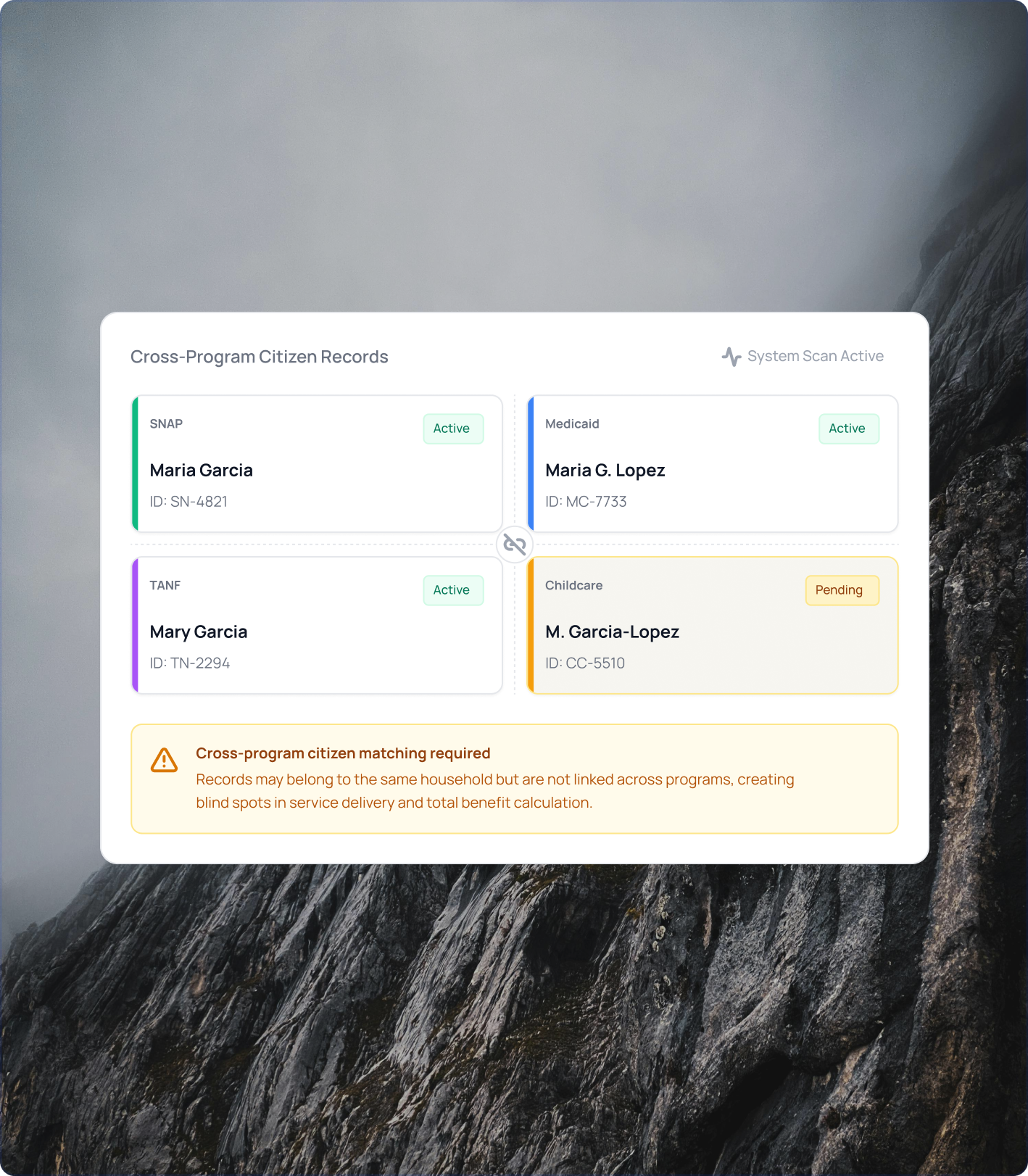
A state agency administers SNAP, Medicaid, TANF, and childcare assistance through separate systems. Each system has its own citizen database. A family receiving all four benefits exists as separate records in each platform. Nobody has a unified view. When leadership needs to understand how many citizens the agency serves, how many receive multiple benefits, or how program participation overlaps, the answer requires a matching project that links records across all four systems. MatchLogic performs this cross-program matching and delivers the linked population with confidence scores.
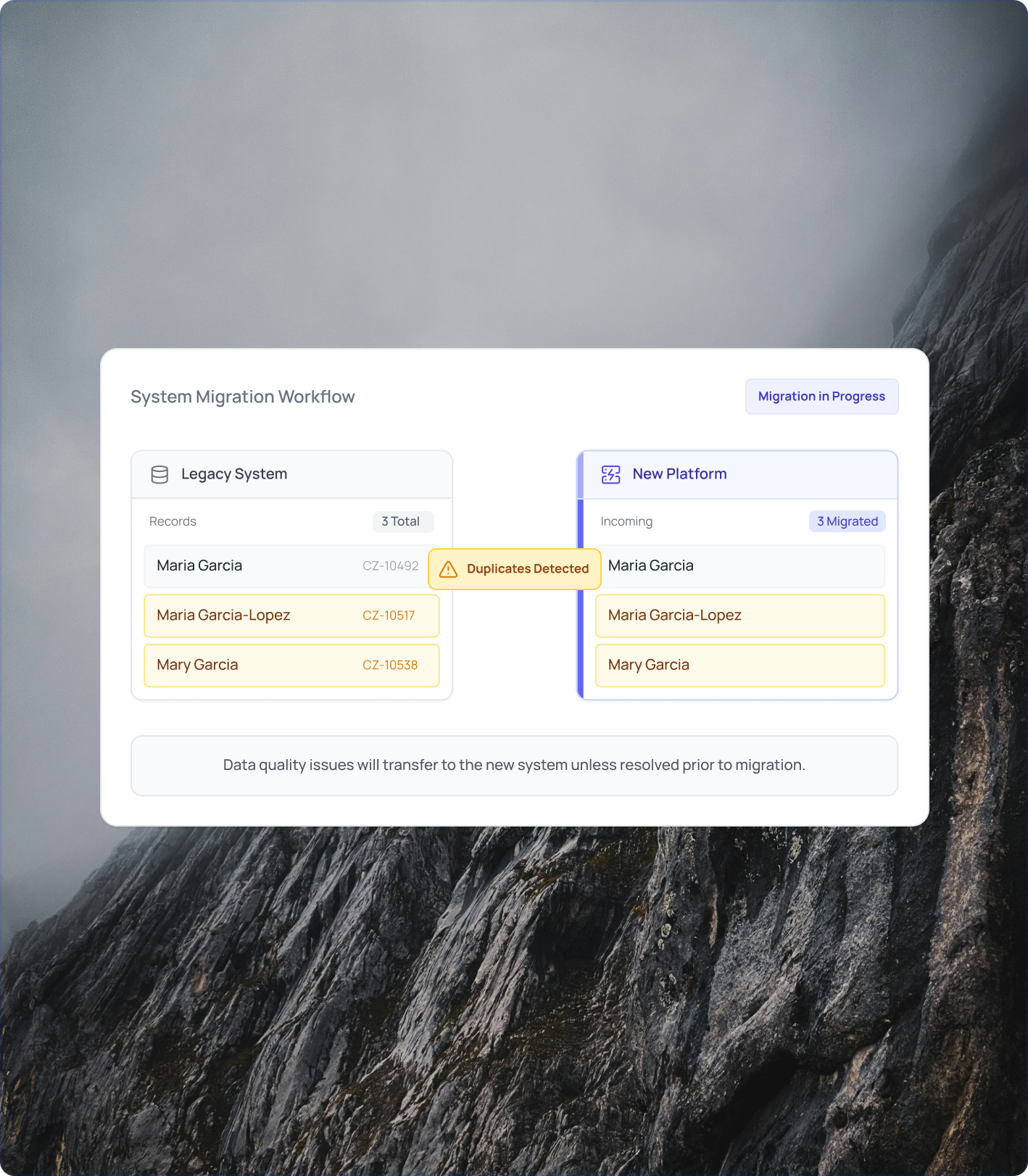
Agencies modernize systems regularly. A legacy case management platform is replaced by a new one. The data migration moves millions of citizen records into the new system. But if duplicate and fragmented records are not resolved before the migration, every data quality problem in the old system transfers directly into the new one. The new platform starts with built-in inaccuracies. MatchLogic cleans and deduplicates citizen records before they enter the new system, so the modernization project starts with a reliable foundation.
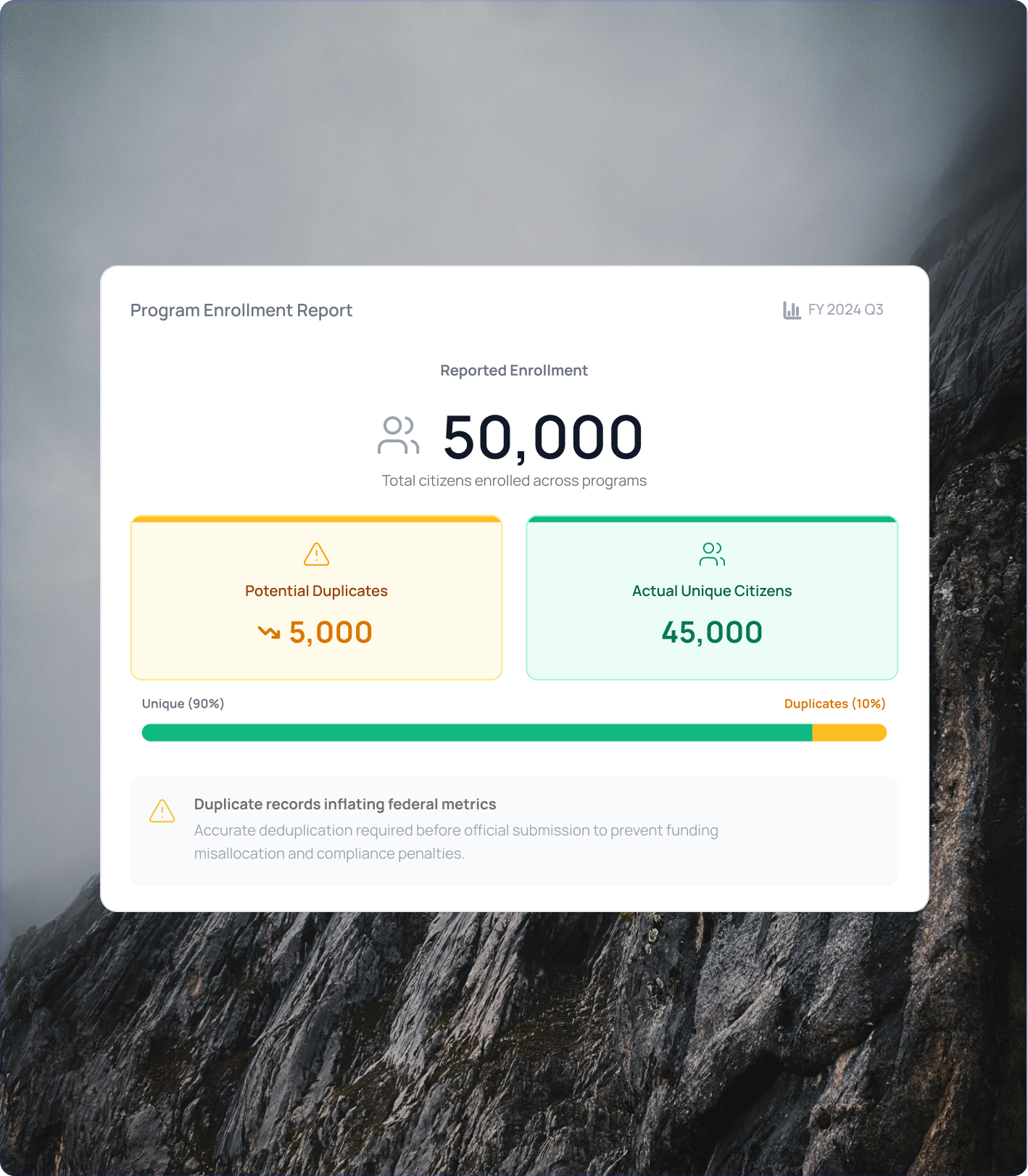
Federal reporting requirements demand accurate counts: how many citizens received benefits, how many were enrolled, how many met outcome targets. Duplicate records inflate every count. If 50,000 citizens are enrolled but 5,000 are duplicates, your reported enrollment of 50,000 is wrong. Performance metrics calculated on inflated numbers misrepresent program outcomes. MatchLogic deduplicates your citizen population before reporting data is compiled, so the numbers submitted to federal agencies reflect the actual served population.

Government databases were built in different decades, by different vendors, with different data models. The benefits system uses one name format. The tax system uses another. The education database stores SSN differently than the licensing portal. There is no common identifier across all systems, and the data entry quality varies from agency to agency.M&A data integration has a unique constraint that other matching scenarios don't: speed. The board, investors, and integration team need answers fast. How many shared customers do we actually have? Where are the vendor overlaps? How much of the projected synergy is real?
MatchLogic handles all of it. Export citizen data from each system as flat files. Load them into MatchLogic. The platform compares first name, last name, date of birth, SSN (full or partial), case number, address, and any other available field simultaneously. It catches the name variations that make government data uniquely challenging: hyphenated surnames, maiden-to-married name changes, transliterated names from non-English-speaking populations, nicknames on informal records, and abbreviations entered by caseworkers under time pressure.
Every match result includes a confidence score and a field-by-field breakdown. Your team reviews the results, sets the acceptance threshold, and decides which links to approve. You control the process from start to finish.

Citizen data is subject to federal and state privacy regulations. MatchLogic runs as a desktop application or on-premises server. No data leaves your network. No cloud uploads. No third-party access. Your IT security team and your data governance office can verify the architecture before deployment begins.

Government data includes hyphenated surnames, transliterated names from immigrant populations, maiden-to-married name changes, nicknames entered by caseworkers, and abbreviations used in legacy systems. MatchLogic's algorithms handle phonetic similarity, nickname conversion, character transposition, and multilingual name patterns that standard matching tools miss.

Before you build match rules, you need to know which fields are reliable. MatchLogic's data profiling scans every column for completeness, format consistency, and uniqueness. If SSN is only 60% populated in the education database, you know not to depend on it as a primary match field for that source. This prevents false matches and missed matches caused by building rules on unreliable fields.

Government matching projects require documentation. MatchLogic logs every match decision: which fields were compared, which algorithms were applied, what the field-level scores were, what threshold was used, and whether the match was accepted or rejected. This audit trail is exportable and reviewable, which is exactly what program integrity teams and auditors need.
Bring a sample dataset from one of your agency systems. We will walk through the matching process, show you the confidence scores and field-level breakdowns, and demonstrate how the audit trail works. Your data stays in your environment throughout.
Book a Demo
No. MatchLogic deploys as a desktop applicationor on-premises server. Your citizen data stays in your environment. There is nocloud upload, no external data transmission, and no third-party data access.This is how most government agencies need to operate, and MatchLogic was builtto support it.
Yes. Government databases are built by differentvendors in different decades with different data models. MatchLogic works withflat file exports (CSV, Excel, or delimited text) from any system. You do notneed to standardize formats before loading. The platform normalizes nameformats, date formats, SSN conventions, and address structures during thematching process.
Government dataincludes some of the most complex name variations of any industry: hyphenatedsurnames, maiden and married name combinations, transliterated names fromnon-English-speaking populations, nicknames entered by caseworkers, andabbreviations from legacy data entry. MatchLogic handles phonetic similarities,nickname-to-formal name conversions, character transpositions, and multilingualtransliteration patterns. These are the specific variations that cause standardmatching tools to miss links.
Yes. Every match decision is logged with thefields compared, algorithms used, field-level scores, thresholds applied, andacceptance or rejection status. This entire log is exportable as a file yourauditors and program integrity officers can review independently. You can alsoproduce summary reports showing match rates, confidence distributions, andexception counts.
Yes. Many agencies start with a one-time projectto clean and link records across systems, then move to recurring runs as newdata enters. The desktop license handles project-based work. The server licensesupports team access and scheduled runs. The API option supports embeddingmatching into your data pipelines for continuous operation.
MatchLogic starts at $13,000 per year for adesktop license. Server deployments for team access and recurring matchingstart at $45,000 per year. API access for pipeline integration starts at$85,000 per year. All options are typically 90% less than enterprise matchingplatforms from IBM or Informatica. Government procurement teams can purchasethrough standard contract vehicles.

.svg)