
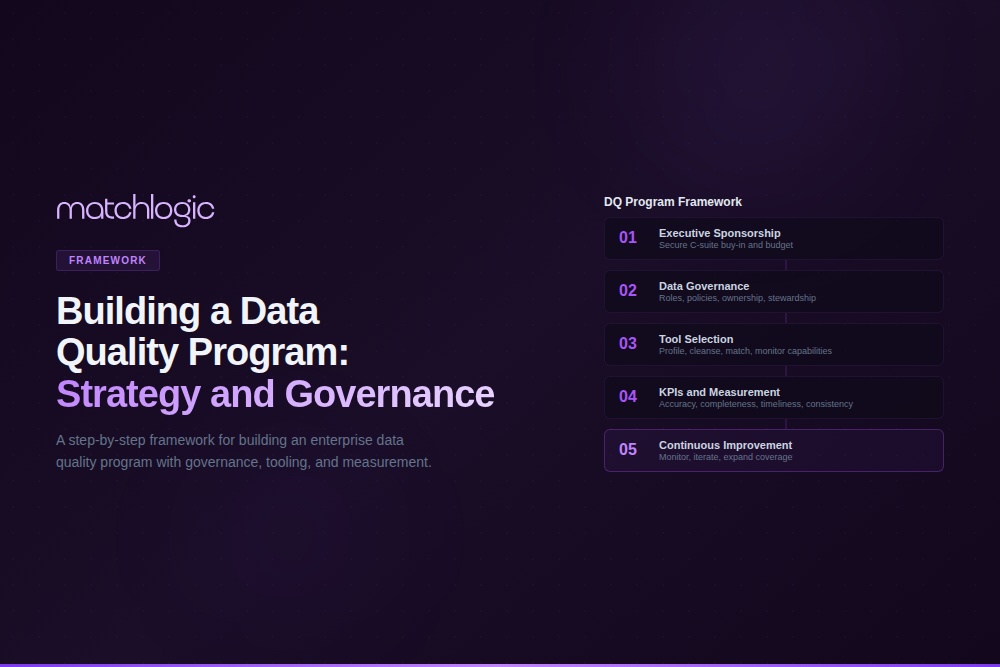
Building a Data Quality Program: Strategy, Governance, and Tool Selection
A data quality program is an ongoing organizational initiative that combines governance policies, operational processes, and technology tools to ensure enterprise data remains accurate, complete, consistent, and fit for its intended purpose. Unlike a one-time data cleanup project, a program sustains quality improvements over time, prevents new quality issues from forming, and scales as the organization's data estate grows. According to Gartner, poor data quality costs organizations an average of $12.9 million per year, yet only 3% of companies'data meets basic quality standards, according to Harvard Business Reviewresearch.
Vertical context matters — for healthcare-specific governance see data quality in healthcare, which walks through EMPI, patient matching, and HIPAA-specific constraints.
Measuring data accuracy is how most programs quantify whether their governance is actually moving the needle.
One of the most common triggers for a data quality program is a failed or risky migration — our catalog of data migration problems maps directly onto the governance gaps most programs are built to close.
This guide provides a practical framework for building an enterprise data quality program from the ground up. It covers the organizational structure, governance model, capability requirements, tool selection criteria, maturity assessment, and phased implementation roadmap that enterprise data teams need to move from reactive cleanup to proactive quality management.
[INTERNALLINK: Cluster 6 Pillar, anchor text: "data integration steps"]
Why Do Data Quality Projects Fail While Programs Succeed?
Most organizations start their data quality journey with a project: clean the CRM before a migration, deduplicate the customer database before a marketing campaign, fix address formatting before a regulatory filing. The project completes, the immediate problem is resolved, and the team disbands. Within 12 to 18 months, data quality has degraded back to its pre-project state. New duplicates form. Format drift returns. The organization runs another project.
This cycle is expensive and unsustainable. According to DAMA International's DMBOK2 framework, data quality management is a continuous function, not a periodic event. A program provides the permanent organizational structure, the standing team, the ongoing monitoring, and the institutional knowledge required to maintain quality gains over time.
The distinction matters operationally. A project has a defined start and end date, a fixed scope, and a temporary team. A program has ongoing funding, permanent staff, evolving scope, and metrics that are reported to leadership on a regular cadence. The organizations that treat data quality as a program spend less per year on data quality than those that run repeated projects, because prevention is cheaper than remediation.
What Are the Six Core Capabilities of a Data Quality Program?
Every data quality program requires six operational capabilities. These are not optional modules to be adopted incrementally; they are interdependent functions that must work together. Profiling without cleansing identifies problems but does not fix them. Matching without standardization produces lower accuracy. Deduplication without monitoring allows duplicates to re-accumulate.
1. Data Profiling
The ability to analyze source data and produce quantitative metrics on completeness, uniqueness, consistency, validity, and distribution patterns. Profiling is the diagnostic capability that tells you what is wrong, where it is wrong, and how severe the problem is. Without profiling, every other capability operates blind.
2. Data Cleansing
The ability to detect and correct errors in data values: misspellings, invalid entries, out-of-range values, and formatting errors. Cleansing operates at the field level, fixing individual values that fail validation rules. For example, converting "Calfornia" to "California" or removing non-numeric characters from a phone number field.
3. Data Standardization
The ability to convert data values into a consistent format across all records and systems. Standardization operates at the pattern level: converting all state names to two-letter abbreviations, all dates to ISO 8601 format, all phone numbers to E.164 format. Standardization is a prerequisite for accurate matching.
4. Data Matching
The ability to compare records and determine whether they refer to the same real-world entity. Matching uses deterministic (exact) and probabilistic (fuzzy) algorithms to identify candidate pairs and score their similarity. This capability is the technical foundation for deduplication, entity resolution, and record linkage.
5. Data Deduplication
The ability to identify duplicate records, apply survivorship rules (which values to keep from each duplicate), and merge records into a single golden record. Deduplication depends on matching accuracy; if the matching step misses a duplicate, deduplication cannot fix it.
6. Data Quality Monitoring
The ability to continuously track quality metrics over time and alert when metrics fall below acceptable thresholds. Monitoring closes the loop: it detects new quality problems as they form, before they propagate through downstream systems. Without monitoring, every improvement is temporary.
data matching guide data deduplication guide data cleansing guide data standardization guide
Data Quality Maturity Model: Where Is Your Organization?
The following maturity model provides measurable criteria at each level. Use it to assess your current state, identify the gaps between your current level and your target level, and plan the specific investments required to advance.
MatchLogic addresses all eight criteria in the table above. Its profiling engine produces column-level quality metrics across datasets of any size. Its matching engine supports configurable fuzzy algorithms with transparent confidence scoring. Its on-premise deployment model satisfies data residency requirements for regulated industries. And its API enables integration with existing ETL pipelines, CRMs, and data warehouses for both batch and real-time processing.
How to Implement a Data Quality Program in Four Phases
A phased approach reduces organizational risk and builds credibility through early wins. Each phase has defined deliverables, success criteria, and a timeline. The total implementation spans 12 to 18 months for a mid-size enterprise.
Phase 1: Assess and Baseline (Months 1-3)
Profile all critical data assets. Establish baseline quality metrics for each dataset: duplicate rate, completeness rate, format consistency, referential integrity. Identify the top 3 to 5 datasets with the highest business impact and the worst quality scores. Assign data owners for each critical dataset. Deliverable: Data Quality Assessment Report with baseline metrics and prioritized remediation targets.
Phase 2: Remediate and Quick-Win (Months 4-6)
Execute deduplication and standardization on the top-priority datasets identified in Phase 1. Deploy matching and deduplication on the primary customer database. Measure the improvement: if the baseline duplicate rate was 18%, the post-remediation target should be below 5%. Calculate and report the business impact (cost savings from reduced duplicates, fewer compliance violations, improved campaign response rates). Deliverable: Remediated datasets with before/after quality metrics; business impact report.
Phase 3: Operationalize and Scale (Months 7-12)
Stand up ongoing monitoring for all remediated datasets. Embed data quality checks into data entry workflows (real-time duplicate detection, format validation). Extend profiling and deduplication to additional entity types (vendors, products, locations). Train federated data stewards in each business unit. Deliverable: Operational monitoring dashboards; data quality policies and standards documentation; trained steward network.
Phase 4: Optimize and Mature (Months 13-18)
Implement cross-system entity resolution across all major data-producing applications. Automate quality measurement and reporting. Tie data quality metrics to executive KPIs. Conduct the first annual program review: compare current metrics to Phase 1 baselines, calculate program ROI, and plan Year 2 priorities. Deliverable: Annual Data Quality Program Review; ROI analysis; Year 2 roadmap.
Why Is a Data Quality Program Essential for AI Readiness?
AI and machine learning models are only as reliable as the data they consume. An organization that deploys predictive analytics, recommendation engines, or generative AI applications on data that contains duplicates, inconsistencies, and errors will produce outputs that are confidently wrong. The AI does not know the data is flawed; it treats every input as ground truth.
A data quality program provides the foundation for AI readiness in three specific ways. First, it ensures training data is clean: deduplicated, standardized, and validated before it enters the model training pipeline. Second, it ensures inference data (the live data the model operates on) meets the same quality standards as the training data, preventing model drift caused by input quality degradation. Third, it provides the monitoring infrastructure to detect when data quality changes affect model performance.
Organizations that skip the data quality program and go straight to AI deployment consistently report lower model accuracy, higher false positive rates, and longer time-to-value on AI investments. The data quality program is not a prerequisite to check off before AI; it is an ongoing companion that ensures AI delivers reliable results over time.
Data Quality Is Not a Project. It Is a Capability.
The organizations that build lasting data quality programs share three characteristics: executive sponsorship that treats data quality as a strategic investment rather than an IT cost center, a dedicated team with clear authority to set and enforce standards, and technology that automates the six core capabilities (profiling, cleansing, standardization, matching, deduplication, monitoring) across all critical data assets.
The return on this investment is measurable: lower remediation costs, fewer compliance violations, more accurate analytics, and the data foundation required for AI-driven decision making. The organizations that do not invest in a sustained program will continue the expensive cycle of one-time cleanups, temporary improvements, and inevitable quality decay.
Frequently Asked Questions
What is the difference between a data quality project and a data quality program?
A data quality project has a defined scope, timeline, and end date. It fixes a specific problem (e.g., deduplicating the CRM before migration) and the team disbands when complete. A data quality program is an ongoing organizational function with permanent staffing, continuous monitoring, and evolving scope. Programs sustain quality improvements; projects produce temporary fixes that degrade within 12 to 18 months.
How much does it cost to build an enterprise data quality program?
Costs vary by organization size and data complexity. A mid-size enterprise (5,000 to 20,000 employees, 10 to 20 data-producing systems) should budget for data quality tooling ($100K to $500K annually depending on vendor and deployment model), dedicated staff (2 to 5 FTEs for the COE), and federated steward time (0.1 to 0.2 FTE per business unit). The program typically pays for itself within 12 to 18 months through reduced remediation costs and compliance savings.
What frameworks should guide a data quality program?
DAMA International's DMBOK2 provides the most widely referenced framework for data quality management. ISO 8000 defines international standards for data quality. The DAMA Data Quality Dimensions (accuracy, completeness, consistency, timeliness, validity, uniqueness) provide the measurement categories. Industry-specific frameworks like BCBS 239 (financial services) and HIPAA (healthcare) add regulatory requirements on top of the general framework.
How do you measure the ROI of a data quality program?
Measure the cost of poor data quality before the program (remediation labor, compliance fines, duplicate processing costs, lost revenue from bad customer data) and compare to the same costs after the program is operational. Common ROI metrics include reduction in duplicate records (percentage and dollar impact), reduction in compliance violations, improvement in campaign response rates, and reduction in time spent on manual data fixes.
What is a data quality maturity model?
A data quality maturity model defines progressive levels of capability, from reactive (fixing problems after they cause damage) to optimized (preventing problems through automated, embedded quality controls). Each level has specific criteria across dimensions like governance, profiling, matching, monitoring, and business impact measurement. Organizations use the model to assess their current state and plan investments to advance to the next level.
Should data quality tools be deployed on-premise or in the cloud?
The deployment model depends on data sensitivity and regulatory requirements. Organizations in regulated industries (healthcare, financial services, government) often require on-premise deployment to maintain data residency and prevent sensitive data from leaving their controlled infrastructure. Cloud deployment offers faster implementation and lower upfront costs but may create compliance barriers. Hybrid models that process sensitive data on-premise and less-sensitive data in the cloud offer a middle path.





.svg)