
Data Cleansing: The Enterprise Guide to Identifying and Fixing Dirty Data
Data cleansing (also called data cleaning or data scrubbing) is the process of identifying and correcting inaccurate, incomplete, improperly formatted, or duplicate records in a dataset. It includes removing invalid characters, standardizing formats, filling missing values, parsing compound fields, correcting known errors, and preparing data for downstream processes like matching, deduplication, analytics, and AI training. Data cleansing is not a one-time event; it is an ongoing discipline embedded in data pipelines to prevent quality from degrading over time.
For enterprises, dirty data is not abstract. Bad data is pervasive enough that business stakeholders, not data teams, are the first to spot data quality problems 74 percent of the time, Monte Carlo’s 2023 State of Data Quality survey found, which means errors from format inconsistencies, invalid values, and incomplete fields reach reports and decisions before anyone cleanses them.
This guide covers the types of dirty data, the cleansing process, the relationship between cleansing and matching accuracy, tool evaluation, and best practices for building repeatable workflows.
What Types of Dirty Data Exist in Enterprise Systems?
Dirty data is not a single problem; it is a category of problems, and understanding the specific issues in your systems is essential for configuring the right cleansing rules. The table lays out the six common types.
How Does the Data Cleansing Process Work?
Enterprise data cleansing follows a four-stage pipeline: profile, standardize, validate, and monitor. Each stage addresses different quality dimensions and produces measurable improvements.
Stage 1: Profile and Diagnose
Profiling is the diagnostic step, scanning every field to measure completeness, consistency, validity, and uniqueness. It should happen before you write a single cleansing rule, because without it you are guessing at what needs fixing, and the profiling techniques that drive good rule design are the focus of the data profiling tools guide. Profiling 1 million records in seconds reveals completeness scores, format chaos, and pattern anomalies before any cleansing begins.

MatchLogic profiles 1 million records in under 5 seconds, revealing completeness scores, format chaos, and pattern anomalies before any cleansing begins.
Stage 2: Standardize and Transform
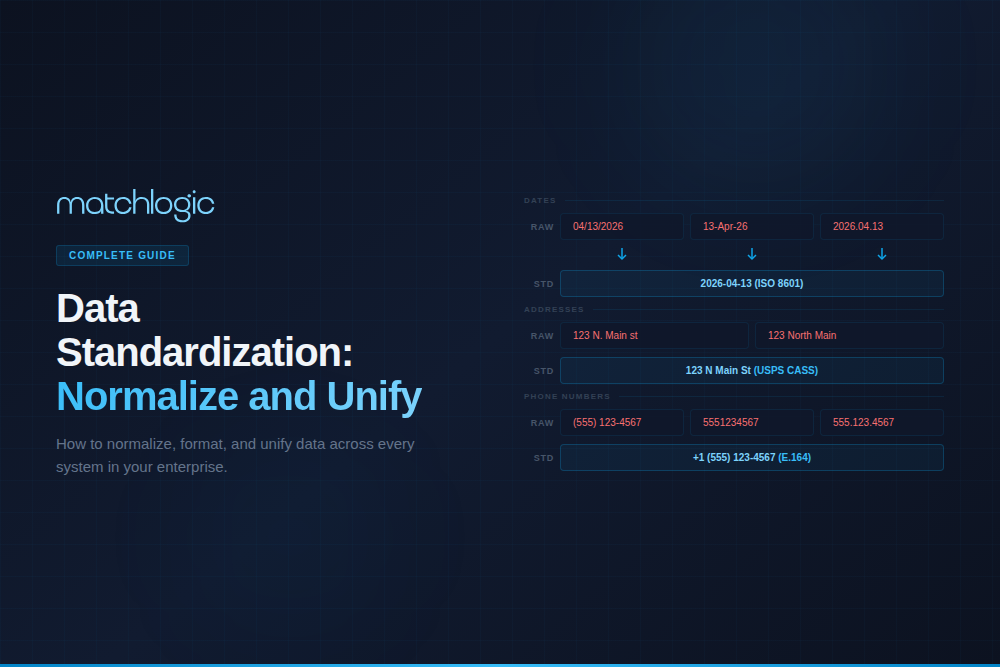
Standardization converts data into uniform formats using defined rules: “Street” becomes “St,” phone numbers reformat to a consistent pattern, dates convert to ISO 8601, name components parse from compound fields, and abbreviations expand or contract consistently. It is a discipline in its own right, detailed in the data standardization guide.
This stage has the single largest impact on downstream matching accuracy. When “123 North Main Street” and “123 N. Main St.” are standardized to the same format before comparison, the match becomes exact rather than fuzzy, which removes uncertainty and substantially lifts deduplication accuracy.
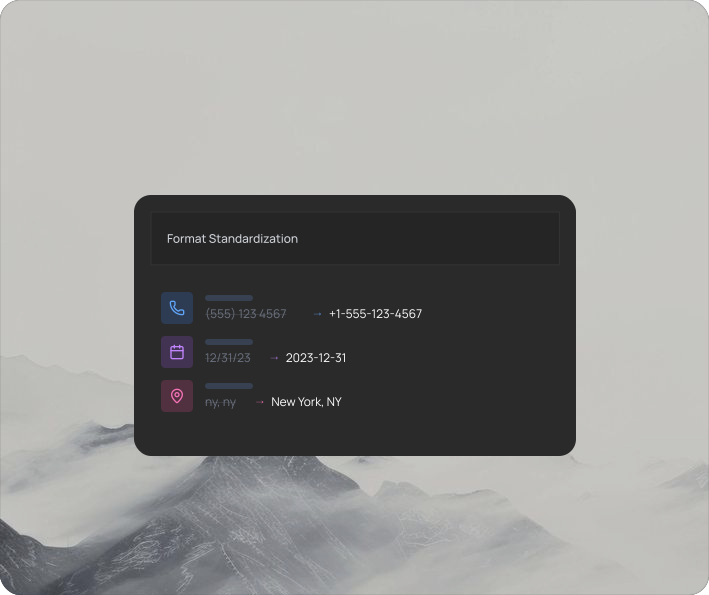
MatchLogic's standardization engine transforms inconsistent formats into uniform patterns: phone numbers, dates, addresses, and abbreviations all follow your defined standards.
Stage 3: Validate and Correct
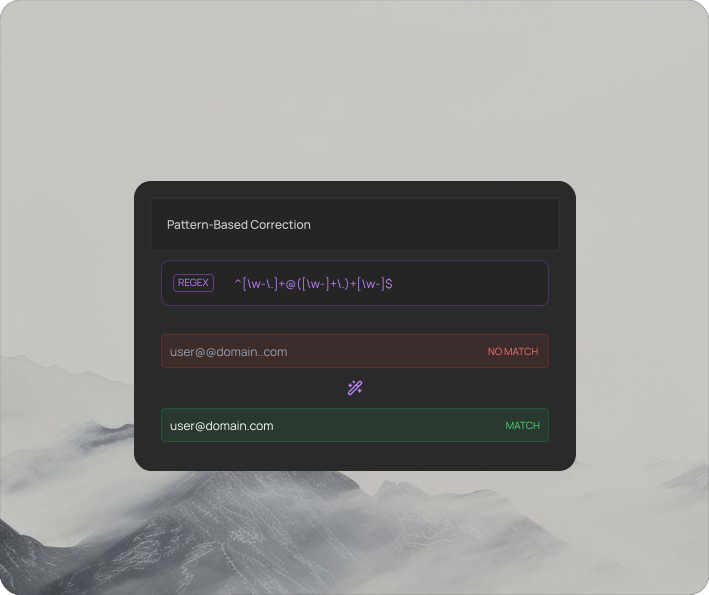
Validation applies pattern rules and business logic to flag values that are syntactically or semantically incorrect: email must contain an @ and a valid domain, phone must have the right digit count for its country, ZIP must match known ranges, and dates must fall within reasonable bounds. Values that fail are auto-corrected when the fix is unambiguous, such as adding a missing country code, or flagged for manual review.
Stage 4: Monitor and Maintain
Cleansing is a pipeline, not a project, because quality degrades continuously as new records enter, existing records go stale, and upstream systems introduce new variations. Embed cleansing rules via API so every new record is standardized and validated at the point of entry, schedule periodic profiling scans to detect drift, and set threshold alerts that fire when completeness drops or format violations spike.
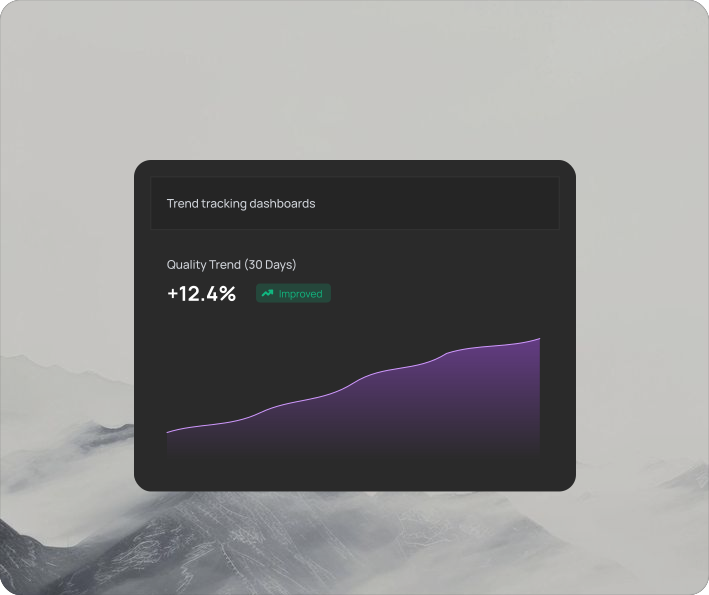
MatchLogic tracks quality scores over time, alerting you when duplicates spike, completeness drops, or format violations re-emerge.
Why Does Data Cleansing Improve Matching and Deduplication Accuracy?
Cleansing and matching are sequential stages in the same pipeline, and the quality of cleansing directly determines matching accuracy. When “McDonald's” appears as “McDonalds,” “McDnlds,” and “McDonald's Corp,” a matching algorithm must rely on fuzzy comparison, which introduces uncertainty, since lower thresholds catch more true matches but increase false positives.
Standardize those names first, expanding abbreviations, removing punctuation, applying a canonical format, and many fuzzy matches become exact matches with the uncertainty gone. Cleansing reduces the burden on matching by eliminating variation that is not meaningful, which is why standardized data should flow from the cleansing engine into the data matching engine, and matched groups into data deduplication and merge purge, without exports or pipeline breaks.
How Should You Evaluate Data Cleansing Software?
When evaluating cleansing tools, assess them against the criteria below, and weigh the dedicated data scrubbing software options against integrated platforms. The table summarizes what to look for.
What Are the Best Practices for Enterprise Data Cleansing?
Always Profile Before You Cleanse
Run profiling on every dataset before configuring cleansing rules. Profiling reveals the actual completeness rates, format variations, and validation failures, and writing rules without it means writing rules on assumptions that are almost always wrong.
Standardize Before You Match
Run all standardization and format conversion before passing data to matching or deduplication. Cleansed data matches more accurately because format variation is eliminated before comparison, and this single practice produces the largest accuracy gain of any step in the pipeline.
Preview Every Transformation
Never apply cleansing rules blindly to production data. Preview before-and-after results on a sample, verify the transformations are correct, then apply, so an irreversible mistake is caught before it touches the live dataset.

MatchLogic shows original and cleaned values side by side before any changes commit, preventing irreversible data quality mistakes.
Automate Cleansing in Your Pipelines
Embed cleansing rules in your ETL and ELT pipelines via API so every new record is standardized and validated at the point of entry, and schedule periodic batch scans to catch records that entered through channels without real-time cleansing. The goal is zero-touch quality maintenance.
Monitor Quality Metrics Continuously
Track completeness, format consistency, and validation pass rates as KPIs. A drop in completeness after cleanup means new sources are introducing dirty records, and a decline in format consistency means new entry points are bypassing your standardization rules, so catch drift early before it compounds.
Clean Data Is the Foundation of Every Enterprise Data Initiative
Data cleansing is not a standalone project; it is the first stage of every data quality pipeline. Profiling reveals the problems. Standardization fixes the formats. Validation catches the errors. Monitoring prevents regression. Without cleansing, every downstream process (matching, deduplication, entity resolution, analytics, AI/ML) operates on unreliable input and produces unreliable output.
The most effective enterprise implementations treat cleansing as a continuous pipeline, not a periodic event. Automated cleansing at the point of data entry, integrated profiling to detect drift, and preview-before-apply safeguards to prevent mistakes create a data quality foundation that scales with the organization.
MatchLogic provides the on-premise infrastructure for enterprise data cleansing: profiling that diagnoses quality issues in seconds, standardization rules that transform messy data into uniform formats, vocabulary governance that eliminates noise terms at scale, and API-driven automation that keeps data clean permanently. For organizations where data residency is non-negotiable, all processing occurs within your secured infrastructure.
Clean Data Is the Foundation of Every Enterprise Data Initiative
Data cleansing is not a standalone project; it is the first stage of every data quality pipeline. Profiling reveals the problems, standardization fixes the formats, validation catches the errors, and monitoring prevents regression. Without cleansing, every downstream process operates on unreliable input and produces unreliable output.
MatchCore provides the on-premise engine for enterprise data preparation: profiling that diagnoses quality issues in seconds, transparent standardization rules that transform messy data into uniform formats, vocabulary governance that removes noise terms at scale, and API-driven automation that keeps data clean permanently. Cleansing is rule-based data preparation, not AI, and the standardized output it produces is exactly what feeds accurate matching and the AI entity resolution in MatchSense downstream, all inside your secured infrastructure.
Frequently Asked Questions
What is data cleansing and how does it differ from data matching?
Data cleansing identifies and corrects inaccurate, incomplete, and inconsistent records by fixing formats, removing invalid values, standardizing patterns, and parsing compound fields. Data matching compares records to find duplicates or links between entities. Cleansing prepares data for matching, and matching identifies relationships within cleansed data, so they are sequential stages in the same quality pipeline.
What is the difference between data cleansing, data scrubbing, and data washing?
These terms are functionally synonymous in enterprise practice, though some vendors draw distinctions. Data cleansing is the most widely used term, data scrubbing emphasizes removing errors and noise, and data washing is less common and sometimes refers specifically to address hygiene. The distinctions between cleansing, scrubbing, and washing are detailed in a dedicated definitions breakdown.
What is the difference between data cleansing and data standardization?
Standardization is one step within cleansing. Cleansing is the broad discipline of correcting inaccurate, incomplete, and inconsistent data, while standardization specifically converts values into a single consistent format, such as one date pattern or one address style. Every standardization task is cleansing, but cleansing also covers validation, correction, parsing, and de-duplication preparation beyond formatting.
Does data cleansing improve matching accuracy?
Yes, significantly. Standardizing data before matching eliminates format variations that cause false negatives, so when “123 North Main Street” and “123 N. Main St.” are standardized to the same format, the match becomes exact rather than fuzzy. This is the single largest lever on deduplication accuracy in enterprise datasets.
Can data cleansing run on-premise for regulated industries?
Yes. On-premise cleansing platforms process all data within your secured infrastructure. MatchLogic is built for on-premise deployment, so PII, PHI, and regulated financial data never leave your network, and all transformations, validation results, and audit trails are generated and stored locally.
How often should you run data cleansing?
Continuously, not periodically. The most effective approach embeds cleansing at the point of data entry so every new record is standardized and validated on arrival, then runs scheduled batch scans weekly or monthly to catch records that bypassed real-time checks. Treating cleansing as a one-time project guarantees quality drifts back within months.
How do you prevent data quality from degrading after cleansing?
Embed cleansing rules in your pipelines via API so every new record is standardized and validated at entry, schedule periodic profiling scans to detect drift, and set threshold alerts for completeness drops or format-violation spikes. Treating data quality as a continuous process rather than a one-time project is what keeps it from regressing.
What should I look for in enterprise data cleansing software?
Prioritize transformation breadth (formatting, parsing, validation, vocabulary governance), preview-before-apply safeguards, API-driven pipeline integration, built-in profiling, enterprise scale at 10M+ records, and on-premise deployment for regulated data. The tool should integrate with your matching and deduplication workflows so there are no pipeline breaks between quality stages.





.svg)