
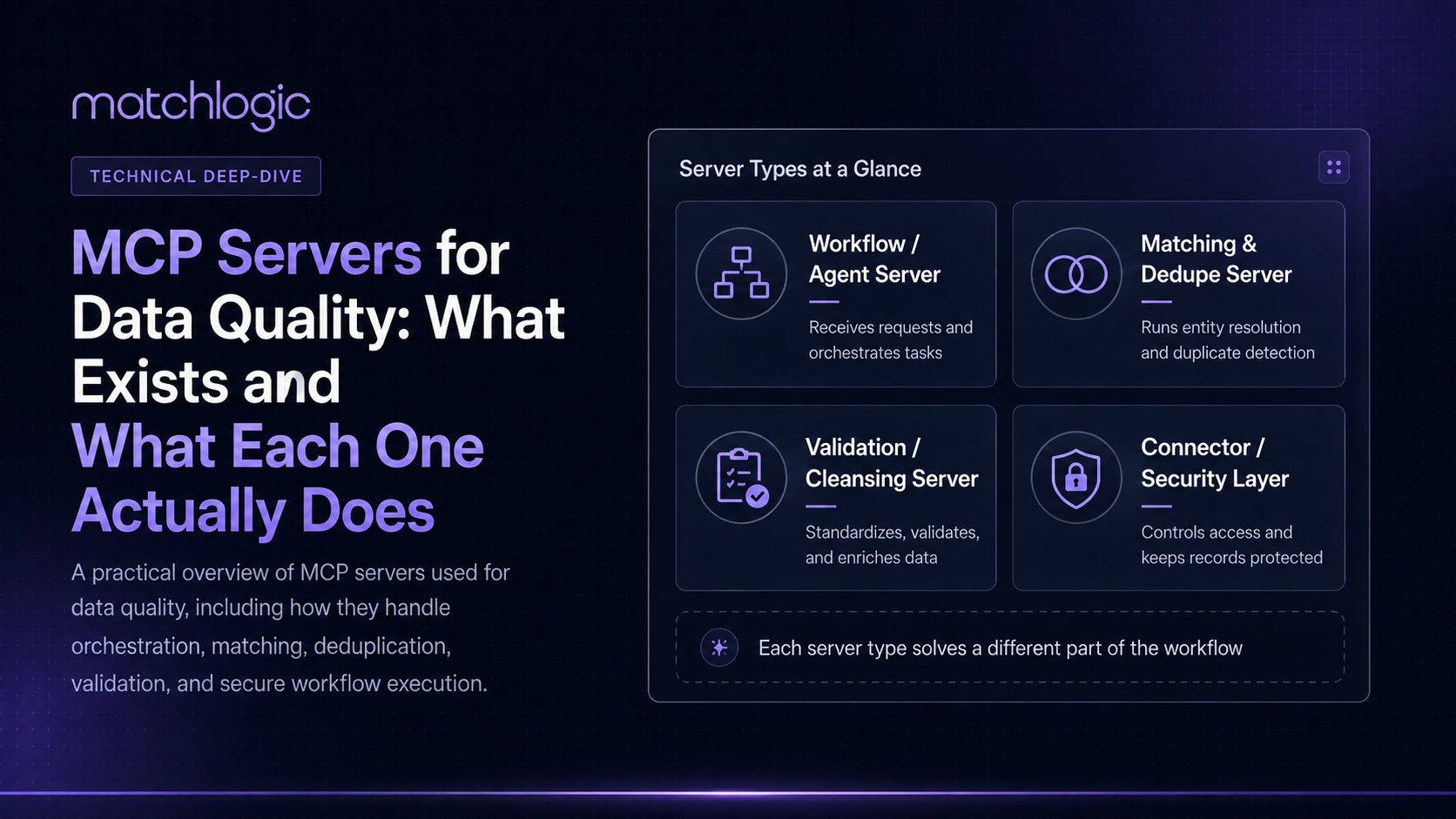
MCP Servers for Data Quality: What Exists and What Each One Actually Does
An MCP server for data quality is any implementation of the Model Context Protocol that connects an AI assistant to a data quality tool, and as of mid 2026 they are close to standard across the category. What each one does varies enormously: some answer questions about metadata, some monitor results, some assist configuration, and a small minority operate workflows. Mapping those differences matters more than counting the checkboxes.
The variation is invisible in vendor language, because every implementation earns the same AI-ready label. This blog maps the field by tool category and server class, with particular attention to data matching and deduplication platforms, where the gap between the label and the capability is widest.
Which Tool Categories Ship MCP Servers?
Four categories account for most of the servers now published. The table maps what their implementations typically expose.
The pattern across the table is consistent. Reading and assisting are common, and operating is rare, because operation forces the hard design questions of approval, logging, and data access that read-only servers never face.
Why Does the Same Checkbox Mean Different Things?
Because MCP standardizes the connection, not the capability. The protocol defines how an assistant discovers and calls tools; it says nothing about whether those tools read a metrics table or execute a matching run.
The three-class taxonomy sorts the field faster than any feature list: documentation assistants, configuration assistants, and workflow operators, defined in our guide to agentic entity resolution. Every server in the table above lands in one of the three.
A buyer who asks only whether a tool has an MCP server will shortlist four products that share nothing operationally. A buyer who asks which class it is compares like with like.
How Should a Buyer Cut Through the Label?
One demo request settles it. Ask the connected assistant to run a small matching or quality pass on sample data and watch what happens next.
Through a documentation server, nothing can execute and the assistant explains instead. Through a read-heavy configuration server, you get information about existing results but no new run; through a workflow operator, a proposal appears with a confirmation step in front of it.
The observation takes minutes and cannot be faked, because the tool surface either includes execution or it does not.
What Questions Belong in an RFP?
Five questions turn the classification into procurement language.
1. Which class is the server?
Ask the vendor to state whether the server documents, configures, or operates, using whatever terms they prefer, and demonstrate it live. The demo request above verifies the answer.
2. What crosses the protocol?
Request a sample tool-call payload for the most sensitive operation offered. Instructions, identifiers, and status are the expected contents; record data is a finding.
3. Where does execution run?
For operators: identify the executing environment and whether it can sit inside your infrastructure. For read-heavy servers, ask where the queried metadata lives instead.
4. What stands between proposal and change?
For any server that can execute, require a described approval model. Propose-and-confirm with named ownership is the answer that survives an audit.
5. What is logged?
Require per-action logging: proposals, confirmations, and tool calls as discrete attributable events. Ask to see the log from the demo you just ran.
Where Do Matching Platforms Stand?
Matching and deduplication is the least served category in the map, which is consequential because it is also the category that changes records. Where servers exist they mostly assist integration work, so data deduplication and matching operations remain manual or scheduler-bound in most stacks.
MatchCore is the exception the map predicts should be rare: a workflow-class server through which any LLM proposes and orchestrates cleansing and matching runs, with a human confirming each one and the model never accessing the records. The architecture behind that design is covered in our walkthrough of the MCP server for entity resolution and data matching.
A retail chain evaluating the category shows the method in practice. Its data team, responsible for 4.5 million customer and loyalty-transaction records covering roughly 260,000 unique customers, ran the demo request against three shortlisted tools and reclassified two of them from AI-ready to documentation-assist within a single evaluation call.
Conclusion
The MCP server field across data quality tooling is broad, real, and unevenly capable. Most implementations read and assist, a minority operate, and the AI-ready label covers all of them equally.
Buyers do not need to track the field vendor by vendor to get this right. Classify by the three server classes, verify with the demo request, and put the five RFP questions in writing; the map takes care of itself from there.
Frequently Asked Questions
Which data quality tools have MCP servers?
As of mid 2026, MCP servers are close to standard across observability platforms, data catalogs, and pipeline tools, and they are appearing in matching and deduplication platforms. Capability varies more than coverage: most servers read metadata or assist configuration, while workflow operation remains rare.
Are all data quality MCP servers the same?
No. They fall into three classes: documentation assistants that answer questions from vendor docs, configuration assistants that read metadata and help with setup, and workflow operators that propose and run actual operations under human approval. The class determines what the AI can do for you.
How do I test what a vendor's MCP server can do?
Ask the connected assistant to run a small matching or quality pass on sample data during the demo. Nothing executing means a documentation or read-only server; a workflow proposal with a confirmation step means an operator. The test takes minutes.
Do MCP servers for data quality access my data?
Read-heavy servers access metadata such as test results and lineage, which itself deserves review. Workflow operators vary by design: in a control-plane implementation the model directs runs while the records stay inside the platform's environment, verifiable by inspecting tool-call payloads.
Is there an MCP server that runs deduplication workflows?
Workflow-class servers in the matching and deduplication category are rare as of mid 2026. MatchCore ships one: any LLM proposes and orchestrates cleansing and matching workflows, a human confirms each run, and the model never accesses the records.