MCP Server for Entity Resolution and Data Matching

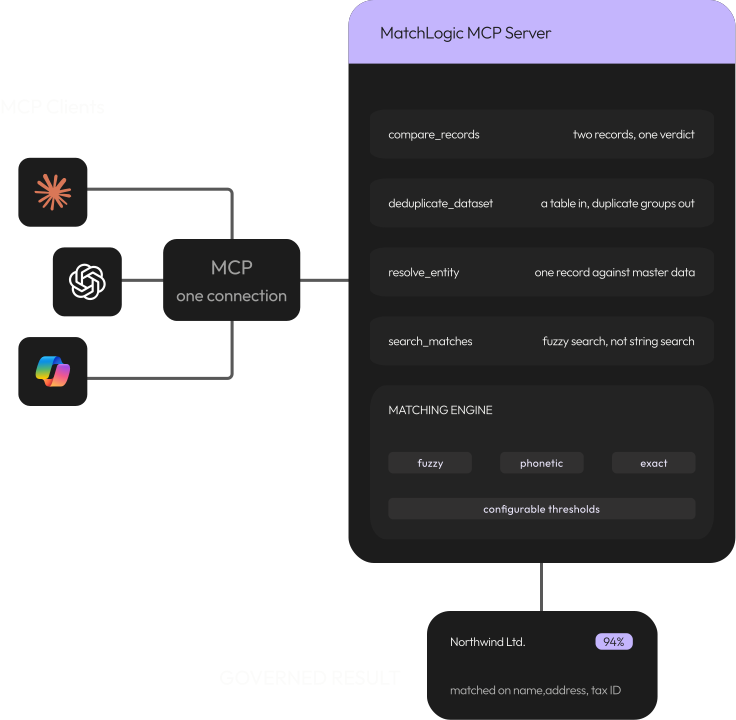
The MatchLogic MCP Server lets AI agents match, deduplicate, and resolve entity records through the Model Context Protocol, with all matching running inside your own environment. Any MCP-compatible agent, including Claude, ChatGPT, and Microsoft Copilot Studio, can call MatchLogic's matching engine as a tool: checking whether two records are the same supplier, deduplicating a contact list before a campaign, or resolving an account against master data before acting on it.
What is an MCP server for data matching?

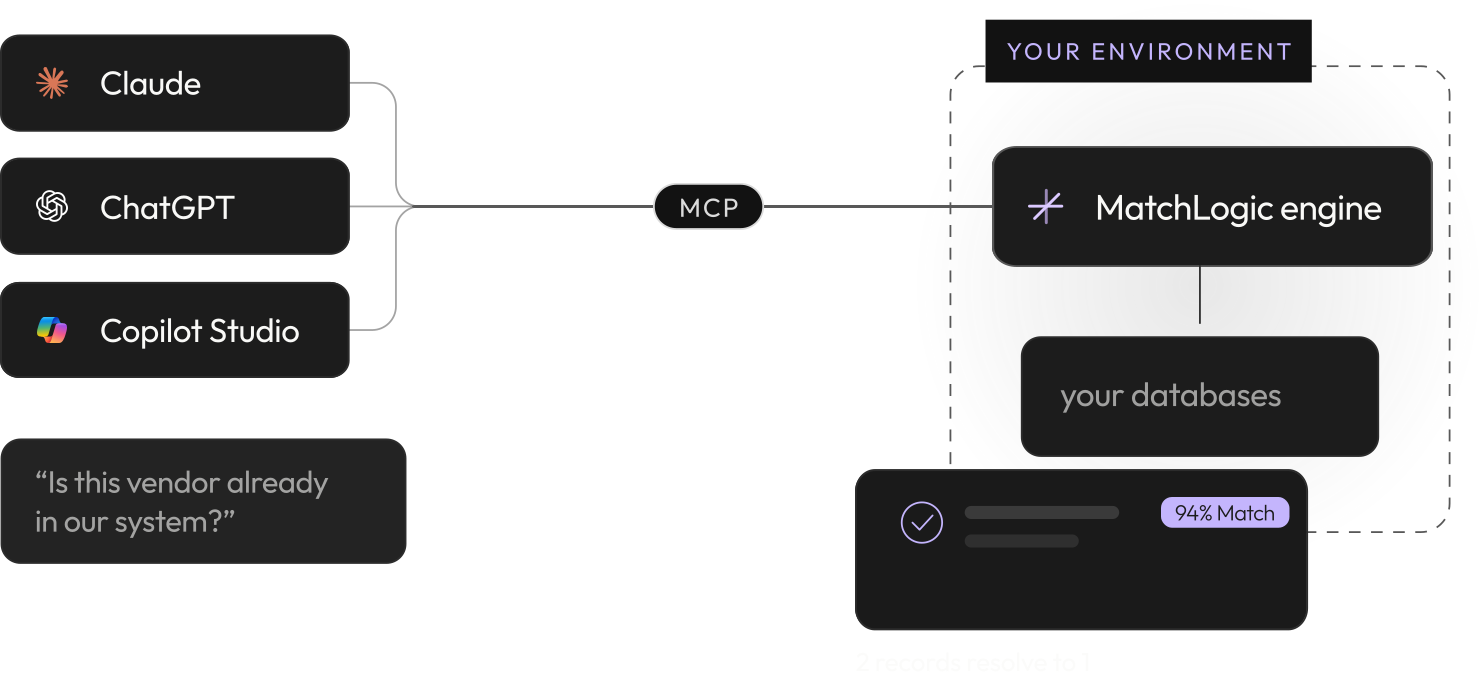
An MCP server for data matching exposes a matching engine's capabilities, such as fuzzy matching, deduplication, and entity resolution, as standardized tools that AI agents can discover and call.A golden record is the single best version of an entity, drawn from the strongest fields across every system. The AI decides which records describe the same entity; survivorship rules you control decide which of their values to keep.

MCP (Model Context Protocol) is an open standard introduced by Anthropic in November 2024 and since adopted across major AI platforms, including OpenAI and Microsoft.You write the field-level rules: trust this source over that one, prefer the most complete value, favor the most recent, or apply your own logic. The rules then run across every resolved entity without manual work.

Instead of building a separate integration for every agent framework, you connect MatchLogic once over MCP, and every compatible agent, copilot, and workflow can use the same matching tools with the same permissions and the same audit trail.

Why do AI agents need entity resolution?

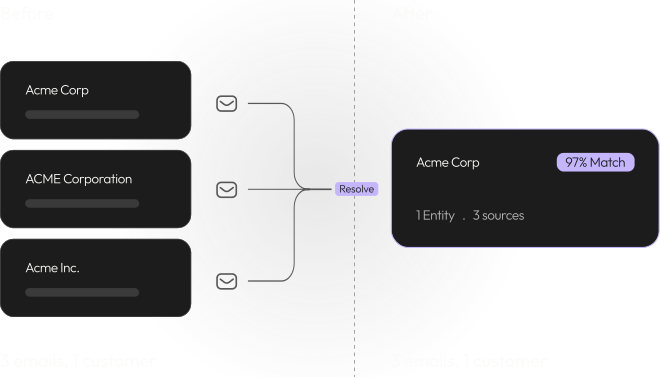
AI agents fail on duplicate and fragmented data in a way traditional software does not: they act on it. An agent that sees "Acme Corp", "ACME Corporation", and "Acme Inc." as three different companies will email the same customer three times, approve a supplier that was blocked under a different spelling, or report pipeline numbers that double count accounts. Poor data quality already costs organizations an average of $12.9 million per year, according to Gartner, and agents compound the problem by making decisions at machine speed and at scale.An MCP server for data matching exposes a matching engine's capabilities, such as fuzzy matching, deduplication, and entity resolution, as standardized tools that AI agents can discover and call.A golden record is the single best version of an entity, drawn from the strongest fields across every system. The AI decides which records describe the same entity; survivorship rules you control decide which of their values to keep.

Entity resolution is the trust layer that fixes this. It gives every agent one accurate answer to the question that underpins almost every business action: which of these records refer to the same real-world supplier, customer, contact, or product. With the MatchLogic MCP Server, agents get that answer from a governed matching engine instead of guessing from raw CRM or ERP data.

What can AI agents do with the MatchLogic MCP Server?

The MCP server exposes MatchLogic’s core matching capabilities as callable tools. In practice, connected agents can:

Compare records on demand.
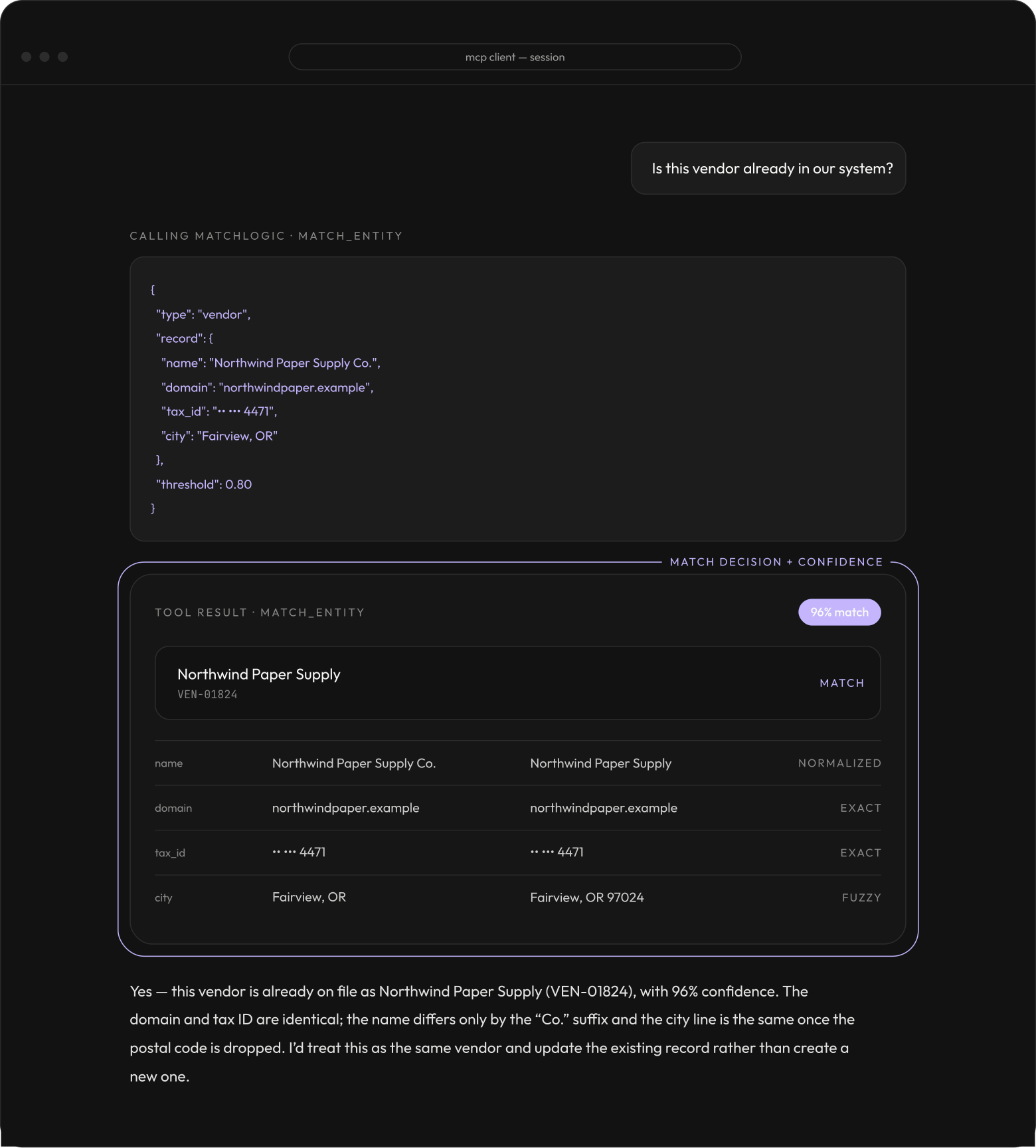
An agent passes two or more records and receives a match decision with a confidence score and a plain-language explanation of which fields matched and how. Useful inside approval flows, onboarding checks, and support workflows.
Deduplicate datasets.
An agent points MatchLogic at a table, file, or query result and receives duplicate groups ranked by confidence. Useful before campaign sends, data migrations, and reporting runs.
Resolve an entity against master data.
An agent submits a single record, such as a new vendor from an invoice, and receives the best existing match from your supplier, customer, contact, or product data, or confirmation that no match exists. Useful for preventing duplicate creation at the point of entry.
Search matched data with natural language.
An agent can ask questions like "do we already have this supplier under another name" and get an answer grounded in MatchLogic's fuzzy matching rather than exact string search.

How does it work?

Deploy the MCP server alongside MatchLogic.

It runs on the same on-premise infrastructure as your existing MatchLogic installation. There is no separate cloud service to stand up.

Register the endpoint with your agent platform.

Add the MatchLogic MCP Server as a connector in Claude, ChatGPT, Copilot Studio, or any custom MCP client, with the credentials and permissions you choose.

Agents discover and call the tools.

Connected agents see the available matching tools automatically and call them as part of their workflows, passing records or dataset references.

MatchLogic runs the match and returns governed results.

The same fuzzy and exact matching engine you already trust processes the request locally and returns decisions, confidence scores, and explanations, all captured in the audit log.
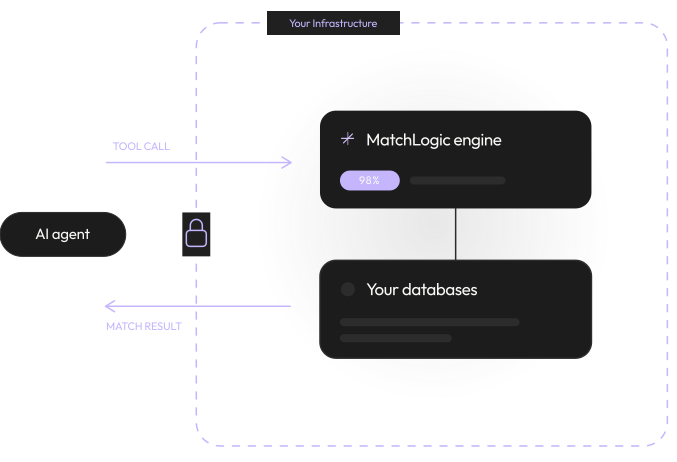
Does your data leave your environment?

Matching runs entirely on your infrastructure. MatchLogic does not send your datasets to any external service, and the MCP server does not require your data to be uploaded anywhere.

The only data in transit is what your agent explicitly includes in a tool call and the result it receives, which stays inside the agent platform you already govern.

For organizations in finance, healthcare, and the public sector, this is the difference between adopting agentic workflows and waiting on the sidelines: the matching layer meets the same residency and security requirements as the rest of your stack.

Who is the MatchLogic
MCP Server for?

Data and operations teams already running MatchLogic

who want matching and deduplication available inside the copilots their business users already work in, instead of only inside the MatchLogic interface.

AI platform teams building agents

that create, update, or act on customer, supplier, contact, or product records and need those agents grounded in resolved entities rather than raw source data.

Organizations with on-premise or data residency requirements

that rule out cloud-only entity resolution services.

One honest boundary

MatchLogic is a data matching and entity resolution engine, not a full master data management platform.

If you need multidomain governance, survivorship rules, and hierarchy management delivered as a suite, that is the MDM category, and MatchLogic works alongside those systems as the matching layer. If your problem is duplicates and unresolved entities, MatchLogic solves it directly, at a fraction of the footprint of an MDM program.

How does MCP compare to other ways
of giving agents matching capabilities?

MatchLogic MCP Server Custom API integration Manual export and review
Setup effort Connect once, works across MCP clients Separate build per agent framework None, but repeated per task
Agent platform coverage Claude, ChatGPT, Copilot Studio, custom MCP clients Only the frameworks you build for Not agent-accessible
Where matching runs Your infrastructure Your infrastructure Analyst desktops, spreadsheets
Match quality MatchLogic fuzzy and exact engine MatchLogic engine, if integrated correctly Eyeballing and exact filters
Auditability Every tool call logged centrally Depends on each integration Minimal
Maintenance Maintained by MatchLogic Maintained by your team, per framework Ongoing manual effort

Watch MatchSense resolve your data in minutes

Every demo starts with your data. Bring a sample file and we will walk through profiling, cleansing, AI resolution, and golden record assembly live. You will see how the engine handles your specific identity challenges, with no slide decks and no hypothetical scenarios.

Schedule a Demo

Frequently Asked Questions

What is AI entity resolution?

AI entity resolution links records that point to the same real-world person or company, even when names, formats, and identifiers differ, using a pre-trained engine rather than hand-written rules. MatchSense groups records into entities automatically and gets sharper as it processes more data.

How is it different from traditional data matching?

Traditional matching depends on rules and thresholds someone sets and maintains by hand. AI entity resolution runs on a pre-trained engine that groups records on its own, learns from new data, and corrects earlier work over time. MatchSense is accurate from the first run, with no rule-building phase.

Does MatchSense rely on generative AI or large language models?

No. The engine does one job, entity resolution. It runs no language model and generates no text, so it cannot hallucinate, and identical inputs always produce identical, explainable results.

Is there training data or a setup period?

No. The engine comes pre-trained on global name, nickname, and address libraries and is accurate on the first run. There is no labeled dataset to build and no training phase to sit through.

Where does my data go during resolution?

It stays on your infrastructure. The engine runs and learns locally, and nothing is sent to an outside service, which keeps MatchSense suitable for HIPAA, GDPR, and government data.

Can it catch fraud and fake identities?

Yes. The engine resolves the relationships between entities and watches feature statistics, so it surfaces linked entities and flags anomalies, such as one identifier shared by many records, a frequent sign of fabricated data.