
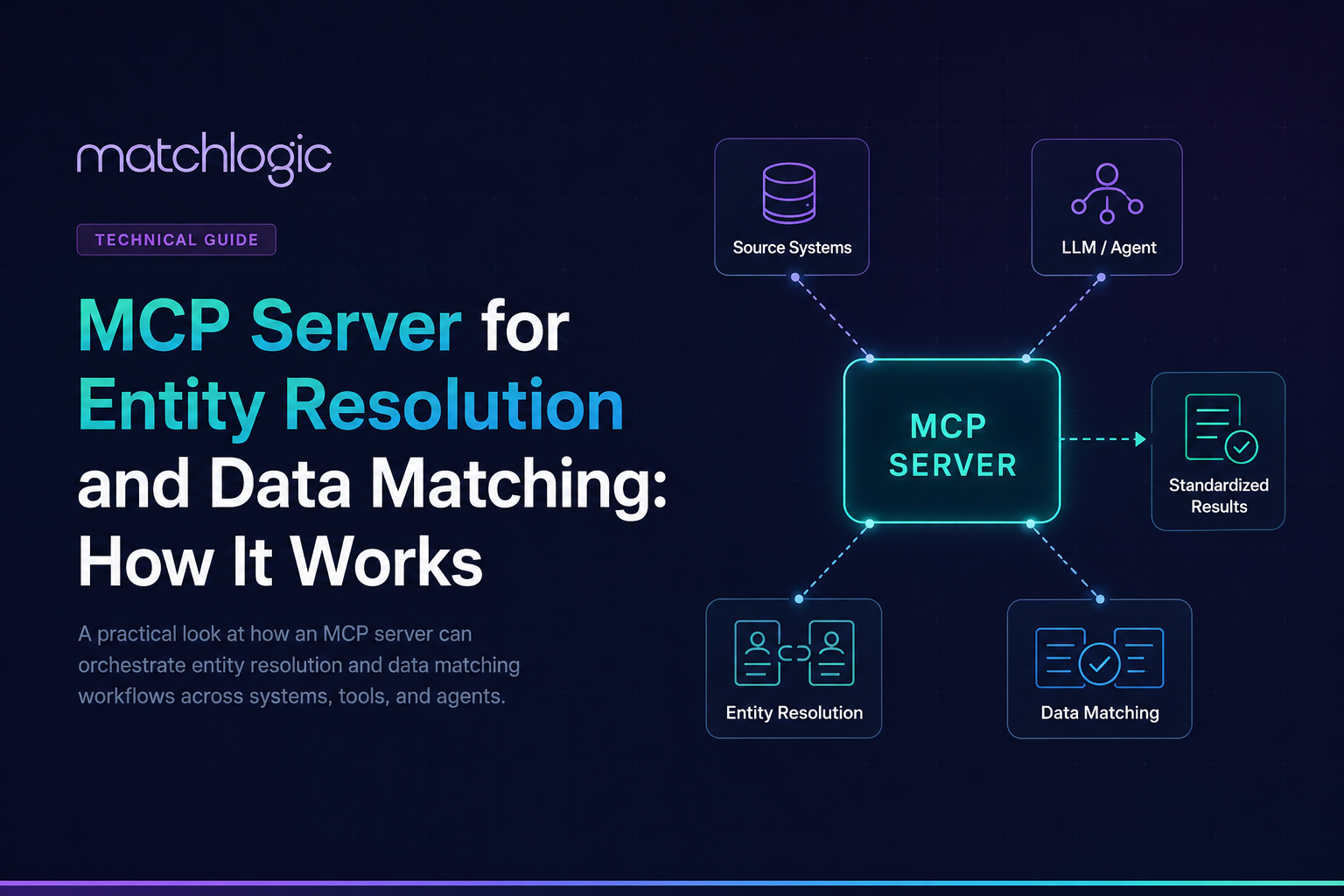
MCP Server for Entity Resolution and Data Matching: How It Works
An MCP server for entity resolution and data matching is a standardized interface, built on the open Model Context Protocol, that lets an AI assistant operate a matching platform through structured tool calls. The connected LLM proposes and orchestrates cleansing and matching workflows, a human confirms execution, and the platform's engine does the work. The model directs operations without ever touching the underlying records.
That last property is the entire point. Every conversation about AI agents and enterprise data eventually arrives at the same issue: what the model gets to see. A workflow-class MCP server answers it architecturally rather than contractually.
This article explains how the pattern works, what an agent can and cannot do through it, and where it fits in entity resolution and matching operations. It also covers the approval model and the deployment questions that decide whether the pattern survives contact with a regulated environment.
What Is the Model Context Protocol?
The Model Context Protocol (MCP) is an open standard, introduced by Anthropic in November 2024, that defines how AI applications connect to external tools, systems, and data sources. It replaces one-off integrations with a single client-server pattern: any MCP-compatible assistant can discover and call the tools that any MCP server publishes.
An MCP server for a data matching platform publishes operations as tools: start a cleansing job, execute a match definition, check a run's status, retrieve a result summary. An MCP client such as Claude Desktop, Claude Code, or an agent framework connects to the server, lists those tools, and invokes them as structured JSON-RPC calls.
The protocol itself carries instructions and results, not database contents, unless a server chooses to expose them. That choice is where implementations diverge, and it is the single most important thing to evaluate before connecting an agent to anything that holds customer records.
Why Would You Connect an LLM to a Data Matching Platform?
Because operating matching software is specialist work, and an agent removes the operational bottleneck without removing the specialist's control.
In most enterprises, data matching runs depend on one or two people who know the tool: which cleansing steps precede which match definitions, which thresholds apply to which sources, what a failed run means. When those people are unavailable, matching work queues behind them. An agent that can propose and sequence those workflows turns that operating knowledge into something the wider team can invoke in plain language.
The second reason is orchestration. Matching is rarely a single job; it is a chain that moves from profiling through cleansing and standardization to matching and review. An LLM is well suited to sequencing that chain and reporting what happened at each step.
What Can an Agent Do Through MatchLogic's MCP Server?
MatchCore ships an MCP server that lets any LLM of the customer's choice propose and orchestrate data cleansing and matching workflows from end to end. The operating rule is fixed: the AI proposes, you confirm. No workflow executes without human sign-off, and the connected model never gets access to the data itself.
Two boundaries define the design. The first is the approval gate: the agent can assemble and sequence work, but execution waits for confirmation, which keeps a human decision in front of every change to the records. The second is the data wall: tool calls operate the workflows, while the records stay inside the engine's environment.
This MCP layer is separate from the AI assistance built into the platform itself. MatchCore's own recommendation features run on a custom language model that operates completely offline, behind the customer's firewall. The MCP server is the inverse pattern: the customer brings an external model of their own choosing, and the architecture keeps that model away from the records.
How Does an Agent-Operated Matching Workflow Run?
The sequence below is the same whether the request comes from a data steward in a chat window or from an agent framework running on a schedule.
Step 1: Connect a client
You register the MatchCore MCP server with an MCP-compatible client: Claude Desktop, Claude Code, or an agent framework your team already runs. The client performs discovery and receives the list of tools the server exposes.
Step 2: Describe the outcome
An operator states the goal in plain language: deduplicate the July supplier file against the vendor master, applying the standard cleansing plan first. The agent maps that request onto the available tools.
Step 3: The agent proposes a plan
The model assembles the workflow: which cleansing steps, which match definition, which sources, in what order. The proposal is presented for review before anything runs.
Step 4: You confirm
A human approves, edits, or rejects the plan. Only after confirmation does the engine begin executing, which makes the approval itself part of the operational record.
Step 5: The engine executes and reports
MatchCore runs the confirmed workflow inside its own environment and returns status and results through the protocol. The agent summarizes outcomes and can propose follow-up work, which again waits for sign-off.
Which Class of MCP Server Are You Evaluating?
MCP servers in the data quality category are not one thing. Three distinct classes exist, and vendors rarely label which one they ship.
As of mid 2026, most MCP servers published in the matching and entity resolution category sit in the first two classes: useful for the developer writing integration code, inert for the team running matching operations. MatchCore's server is a workflow operator, which is why the approval gate and the data wall matter so much; a documentation assistant needs neither.
The distinction is easy to test during evaluation. Ask the connected assistant to run a data deduplication pass on a sample file and observe whether anything can actually happen, and what approval stands in the way when it does.
How Does This Hold Up in a Regulated Environment?
Consider a European property and casualty insurer whose data team maintains 3.4 million records across policy administration, claims, and endorsement history: roughly 200,000 unique policyholders once transactional volume is accounted for. DORA obligations cover its ICT operations and GDPR governs every record it holds. Neither framework tolerates an external model reading policyholder data, so the architecture has to make that impossible rather than merely unlikely.
In this setup, the insurer's nightly deduplication and weekly vendor matching run as agent-proposed workflows. An operator reviews each proposal and confirms it, the engine executes on-premise, and the connected model works with workflow controls rather than records.
The approval gate does double duty here. Every proposal, confirmation, and tool call is a logged event, which gives an auditor a complete answer to the question regulated teams raise first about agentic systems: who authorized this change, and what exactly the AI touched.
For environments where even the control conversation cannot leave the network, the choice of LLM closes the loop. A self-hosted model keeps agent, protocol, and platform inside the same boundary.
Conclusion
An MCP server for entity resolution and data matching turns a specialist-operated platform into something any team can direct through an agent, without surrendering the two things enterprises cannot surrender: approval over changes and custody of the data. The pattern is young and the vendor field is uneven, so the class of server you evaluate matters more than the checkbox on the feature page.
MatchCore's implementation draws both lines explicitly. The AI proposes, you confirm, and the model never reaches the records; matching keeps its human owner while losing its operational bottleneck.
Frequently Asked Questions
What is an MCP server for entity resolution?
An MCP server for entity resolution is an implementation of the open Model Context Protocol that exposes a matching platform's operations as tools an AI assistant can call. It lets an LLM propose and orchestrate cleansing, matching, and resolution workflows while the platform executes them. The class of server determines whether the AI can operate workflows or only answer questions about the product.
Can an LLM see my data through an MCP server?
Only if the server is designed to expose it, which is why this question belongs in every evaluation. In MatchCore's design the connected model operates workflows but never gets access to the records; execution and data stay inside the platform's on-premise environment.
Do agent-driven matching workflows run without human approval?
No. In MatchLogic's model the AI proposes and a human confirms: workflows are assembled by the agent but execute only after sign-off. The confirmation step also creates an audit trail of every agent-initiated action.
Which LLMs can connect to MatchCore's MCP server?
Any LLM of your choice that works with the Model Context Protocol, through clients such as Claude Desktop, Claude Code, or an agent framework. A self-hosted model keeps the entire loop inside your network for isolated environments.
What is the difference between a documentation MCP server and a workflow MCP server?
A documentation MCP server helps developers by answering questions and generating code from vendor docs; it changes nothing inside the platform. A workflow MCP server operates the platform itself, proposing and sequencing cleansing and matching runs for human confirmation. Most MCP servers in the data matching category today are the first kind.





.svg)