
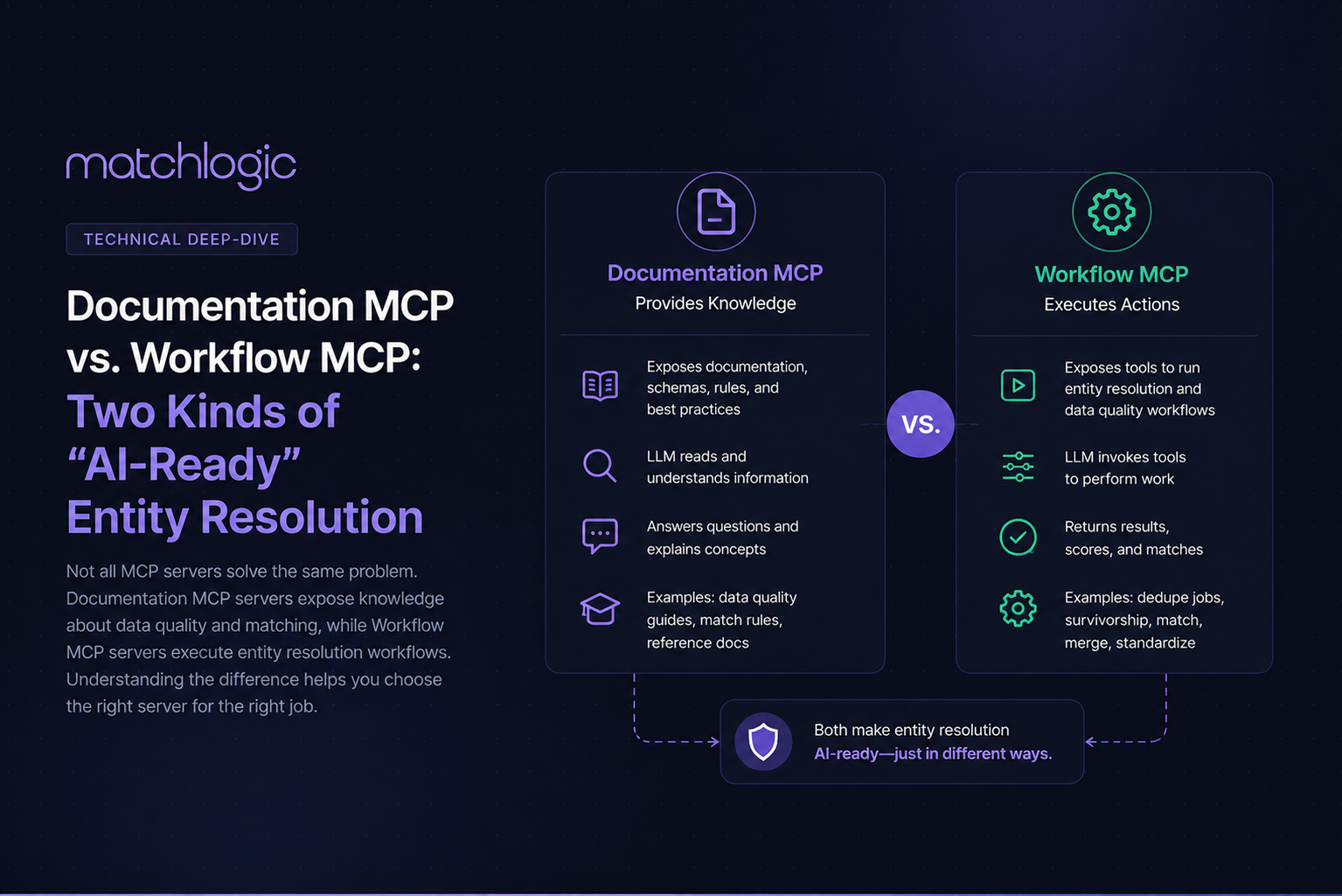
Documentation MCP vs. Workflow MCP: Two Kinds of "AI-Ready" Entity Resolution
Agentic entity resolution is the use of an AI agent, connected through the Model Context Protocol (MCP), to direct entity resolution and matching work: the agent proposes and sequences workflows while the platform executes and reports. Vendors increasingly describe their tools as AI-ready because they ship an MCP server. The label hides a real split: some servers let an agent operate the platform, and others only let it read the documentation.
The two kinds are not versions of the same feature. They serve different users and change different things in production.
This blog defines both classes, shows how to tell them apart during an evaluation, and explains where each fits in an entity resolution program.
What Does "Agentic Entity Resolution" Mean?
Agentic entity resolution means an AI agent directs entity resolution and data matching operations rather than a human clicking through the tool: the agent translates a plain-language goal into a sequenced workflow the platform can execute. The Model Context Protocol, an open standard introduced by Anthropic in November 2024, made this practical by giving assistants a uniform way to discover and call a platform's tools.
The term is already stretched. Because any MCP server earns the AI-ready badge, a tool whose server only answers documentation questions gets described in the same words as one whose server runs production matching workflows.
For a buyer, the difference decides whether the feature affects operations or only onboarding. That is worth establishing before it shapes a shortlist.
What Is a Documentation MCP Server?
A documentation MCP server gives an AI assistant structured access to a vendor's documentation, SDK references, and sample material, typically served from pre-fetched content. Connected to a client such as Claude Desktop or an agent framework, it answers product questions, generates integration code, and diagnoses error codes without the developer searching the docs manually.
This is genuinely useful. Integration work moves faster when the assistant answers from current, official material instead of guessing from training data, and the pattern carries no data risk because the server never connects to the customer's deployment at all.
The limit is equally clear. Nothing the assistant does through a documentation server touches the platform: no job starts and no record moves. It makes the manual work easier; it does not remove the manual work.
What Is a Workflow MCP Server?
A workflow MCP server exposes the platform's operations themselves as tools: start a cleansing job, execute a match definition, retrieve a run's results. An agent connected to it can assemble and sequence real matching work, which is why design boundaries matter far more in this class.
Two boundaries separate a defensible workflow server from a risky one. The first is an approval gate: the agent proposes, a human confirms, and nothing executes without sign-off. The second is a data wall: tool calls operate workflows while the records stay inside the platform's environment, out of the model's reach.
Under those boundaries, an operations team can hand routine data deduplication and matching runs to an agent while keeping a person in front of every change. Without them, an operating agent becomes an unaudited actor inside a production system.
How Do Documentation and Workflow MCP Servers Compare?
The table below is the comparison to run any vendor claim through. Every row is checkable in a demo.
Neither class is a subset of the other, and shipping one says nothing about shipping the second. A vendor can offer excellent documentation assistance and no operational agent surface, or the reverse.
Why Do Vendors Ship Documentation Servers First?
Because it is the safe first step, and for defensible reasons. A documentation server can be published openly, requires no authentication into customer systems, and cannot damage anything; it delivers developer value from day one at near-zero risk.
Workflow servers are harder to build responsibly. They require an execution boundary, an approval model, logging that survives an audit, and a clear answer to the data-access question, and each of those is a design decision with consequences.
The honest read for buyers: a documentation-first roadmap is not a red flag, but it is not agent operations either. As of mid 2026, most MCP servers in the entity resolution category are documentation or configuration assistants, so evaluate the class that matches the outcome you are buying.
What Questions Separate the Two in an Evaluation?
Five questions settle the classification in under an hour of vendor time.
1. Can the assistant execute anything?
Ask the connected assistant to run a small matching pass on a sample file. Through a documentation server nothing can happen; through a workflow server a proposal should appear, followed by a confirmation step.
2. What does a tool call carry?
Ask the vendor to show the payload of a tool call. Workflow controls, identifiers, and status information are expected; record contents crossing the protocol should prompt hard follow-up questions.
3. Where does execution happen?
The engine, not the model, should do the work, and the environment where it runs decides your compliance posture. For regulated deployments, execution inside your own infrastructure is the defensible answer.
4. What stands between a proposal and a change?
A workflow server without an approval gate treats the agent as a trusted operator. Look for a propose-and-confirm model in which human sign-off precedes every executed change.
5. What gets logged?
Every proposal, confirmation, and tool call should be a recorded event. That log is what turns agent operations from an auditor's objection into an auditor's evidence.
Where Does MatchLogic Sit?
MatchCore ships a workflow-class MCP server: any LLM of the customer's choice proposes and orchestrates cleansing and matching workflows, and a human confirms before anything executes. The connected model never gets access to the data; execution stays inside the customer's on-premise environment.
The pattern matters most where the records are sensitive. A retail bank's KYC operations team maintaining 5.2 million customer and account-history records, roughly 290,000 unique customers once transactional volume is separated, cannot let an external model read a single row; a workflow server with an approval gate and a data wall lets that team use agent operations anyway.
A full walkthrough of the architecture, including the five-step run sequence, is in our guide to the MCP server for entity resolution and data matching.
Conclusion
The AI-ready label on entity resolution tools now covers two features that share a protocol and almost nothing else. A documentation MCP server improves the developer's week; a workflow MCP server changes how matching operations run, and it is the only class where approval gates and data boundaries deserve scrutiny.
Buyers reach the truth about agentic entity resolution with one request: ask the agent to do something. What happens next tells you which kind of AI-ready you are looking at.
Frequently Asked Questions
What is agentic entity resolution?
Agentic entity resolution is the use of an AI agent, connected to a matching platform through the Model Context Protocol, to direct entity resolution work: the agent proposes and sequences workflows while the platform executes them. In a well-designed implementation, a human confirms each run and the model never accesses the underlying records.
How can I tell if a vendor's MCP server is documentation-only?
Ask the connected assistant to run a small matching or deduplication pass on a sample file. If nothing can execute, the server is a documentation or configuration assistant; if a workflow proposal appears with a confirmation step, it is a workflow operator. The test takes minutes in any demo.
Is a documentation MCP server useful at all?
Yes, for developers. It answers product questions, generates integration code, and explains errors from official documentation, which speeds up implementation work. It has no effect on how matching operations run because it never touches the platform itself.
Can a workflow MCP server change my data without approval?
It depends entirely on the design, which is why the approval model belongs in every evaluation. In MatchCore's implementation the AI proposes and a human confirms: no workflow executes without sign-off, and the connected model never gets access to the records.
Do I need both kinds of MCP server?
They solve different problems, so the answer depends on the outcome you are buying. A documentation server shortens integration projects; a workflow server changes day-to-day matching operations. Evaluate each against its own job rather than treating either as proof of the other.





.svg)