
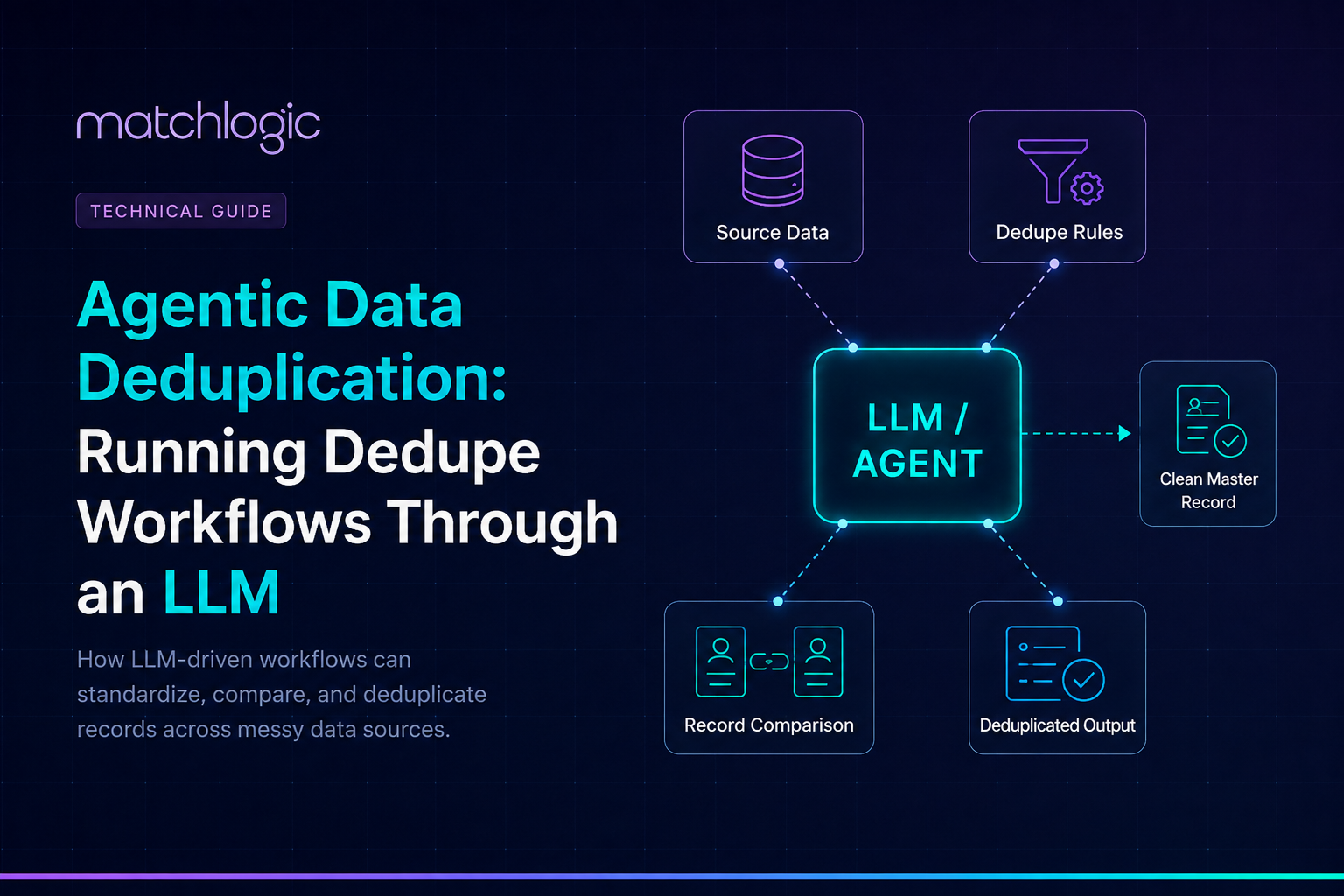
Agentic Data Deduplication: Running Dedupe Workflows Through an LLM
Agentic data deduplication is the practice of letting an AI agent, connected through the Model Context Protocol, propose and sequence deduplication workflows that a matching platform executes. The agent handles orchestration: choosing cleansing steps, selecting a match definition, and lining up the run; a human confirms before execution, and the model never accesses the records. It turns deduplication from a specialist-operated task into a directed conversation.
Deduplication earns the first spot in most agent rollouts for a practical reason. It is the most repetitive job in the data deduplication and matching stack, and repetition is what agents absorb best.
This blog covers how an agent-operated dedupe run works, which decisions must stay human, and what the operating models look like side by side.
What Makes Deduplication the Natural First Agentic Workflow?
A production dedupe run follows the same shape every time: prepare the sources, apply cleansing, execute a match definition, review the results, act on the confirmed duplicates. The inputs are known, the outputs are measurable, and the playbook already exists in most teams as a runbook or a scheduler configuration.
That shape is what makes the work delegable. An agent does not need to invent a data matching strategy; it needs to map a plain-language request onto an established sequence and adapt the details, such as which sources are in scope this week or which cleansing plan fits a new file.
The contrast with a fixed scheduler matters here. A scheduler repeats one configuration until someone edits it, while an agent can propose a different configuration when the request or the data changes, and then wait for approval.
How Does an Agent-Operated Dedupe Run Work?
The sequence has four moves, and the third one is the control point.
1. Describe the outcome
An operator states the goal: deduplicate this quarter's customer extract against the master, flag cross-system duplicates, hold merges for review. No clicking through the tool and no rule syntax are required at this step.
2. The agent proposes the workflow
The model maps the request onto the platform's tools and assembles a plan: sources, data cleansing steps, the match definition, and the order of execution. The proposal is explicit enough to review line by line.
3. A human confirms
The operator approves, edits, or rejects the plan before anything runs. The AI proposes, you confirm; that rule holds for the first run and for every run after it.
4. The engine executes and reports
The platform runs the confirmed workflow inside its own environment and returns status and result summaries through the protocol. Follow-up proposals, such as a second pass with a tightened threshold, queue behind the same approval gate.
Which Decisions Should the Agent Never Make Alone?
Three categories stay human regardless of how routine the runs become. Merge and survivorship decisions change records permanently, threshold changes alter what counts as a duplicate across every future run, and match definition changes rewrite the logic of the operation itself.
The approval gate exists precisely for these. An agent can draft any of them as a proposal, and the person who owns data quality decides whether the change happens.
This is also the honest answer to the fully unattended alternative. An agent that merges records while nobody watches is efficient right up until an auditor asks who authorized a specific merge, and no one can answer.
How Do the Three Operating Models Compare?
Most teams run one of three models today. The table separates them on the dimensions that decide cost and control.
The models are not exclusive. A common pattern keeps the scheduler for the stable nightly run and adds agent operation for everything that used to interrupt the specialist: ad-hoc requests, new files, and one-off investigations.
What Does This Look Like in Practice?
Consider an industrial distributor whose systems hold 1.9 million supplier and purchase-history records: roughly 95,000 unique suppliers once transaction and document history is separated from the master. Procurement wants cross-system duplicates surfaced before a vendor consolidation project, and the two people who know the matching tool are committed elsewhere.
With an agent connected through the platform's MCP server, a procurement analyst describes the goal, reviews the proposed workflow, and confirms it. The engine executes on-premise, and the analyst receives result summaries without the model ever touching a supplier record; the full architecture behind that separation is covered in our guide to the MCP server for entity resolution and data matching.
The specialist's role shifts rather than disappears. They review the higher-stakes proposals, own threshold and survivorship decisions, and stop being the queue that every routine run waits behind.
Conclusion
Agentic data deduplication changes who can direct dedupe work, not who controls it. The agent absorbs the orchestration, the platform keeps the execution and the data, and the human keeps every decision that changes records.
As of mid 2026, that combination is rare in practice: most deduplication tooling offers either manual operation or fixed scheduling. Teams evaluating the agentic model should test the approval gate and the data wall before anything else, because those two boundaries are what make the rest safe.
Frequently Asked Questions
What is agentic data deduplication?
Agentic data deduplication is the use of an AI agent, connected to a matching platform through the Model Context Protocol, to propose and sequence deduplication workflows. The platform executes each confirmed run inside its own environment, and the model never accesses the records. A human approval stands in front of every execution.
Can an LLM merge or delete my records?
Not in a propose-and-confirm design. The agent can draft a merge proposal, but execution waits for human sign-off, and survivorship and threshold decisions stay with the person who owns data quality. Systems that let agents change records unattended trade that control away for convenience.
Do I need an MCP server to automate deduplication?
No. Schedulers have automated fixed dedupe runs for years. An MCP server adds what schedulers lack: plain-language direction, adaptive workflow proposals when sources or requirements change, and an explicit approval step with a logged trail.
What does the LLM see during a dedupe run?
In a control-plane design, the model works with workflow instructions, identifiers, and status information. The records being deduplicated stay inside the platform's environment, which is what makes the pattern usable on regulated data.
Is agentic deduplication safe for regulated data?
It can be, if two boundaries hold: a data wall that keeps records away from the model, and an approval gate that keeps a human in front of every change. On-premise execution and logged tool calls complete the picture for frameworks such as GDPR, HIPAA, SOX, and DORA.





.svg)