
Name Standardization: Parsing, Formatting, and Matching People Data
Key Takeaways
- ✓Name standardization is the process of parsing full name strings into components (title, first, middle, last, suffix), resolving nicknames to legal names, and normalizing cultural name patterns for accurate matching.
- ✓Unstandardized names are the single largest source of false negatives in person-matching projects, responsible for 25% to 40% of missed matches in cross-system record linkage.
- ✓Enterprise name standardization requires nickname dictionaries (mapping 2,000+ common variants), cultural pattern recognition (Eastern vs. Western name order), and phonetic encoding (Soundex, Double Metaphone).
- ✓Standardizing names before fuzzy matching improves Jaro-Winkler similarity scores by an average of 0.15 to 0.25 points, often pushing true matches above classification thresholds.
- ✓Name standardization must preserve original values alongside standardized forms for audit, compliance, and rollback purposes.
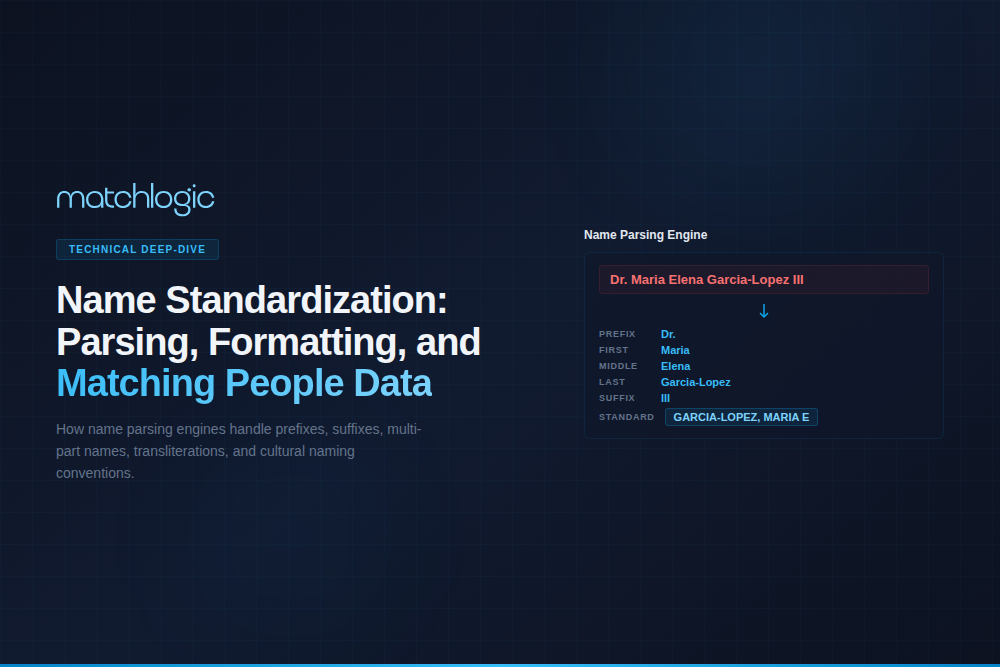
Name standardization is the process of decomposing raw name strings into discrete components (title, first name, middle name, last name, suffix, nickname), resolving variations to canonical forms, and normalizing cultural naming patterns so that downstream matching algorithms can compare person records accurately. data standardization guide Without standardization, "Robert J. Smith Jr." and "Bob Smith" are treated as two different people by every matching algorithm, even though they refer to the same individual.
Name data is the most inconsistent field type in enterprise databases. A single person's name can appear in dozens of formats across systems: "SMITH, ROBERT J" in an ERP, "Bob Smith" in a CRM, "Dr. Robert James Smith Jr." in an HR system, and "R. Smith" on a purchase order. According to research by Peter Christen ("Data Matching," Springer, 2012), name variation is the primary contributor to false negatives in person-matching projects, responsible for 25% to 40% of missed matches in cross-system record linkage.
What Are the Core Components of Name Standardization?
Component 1: Name Parsing
Parsing decomposes a raw name string into labeled fields. The input "Dr. Robert James Smith Jr." becomes: title ("Dr."), first name ("Robert"), middle name ("James"), last name ("Smith"), suffix ("Jr."). This sounds simple for English names, but parsing complexity increases dramatically with real-world data.
Multi-word last names ("de la Cruz," "Van Der Berg," "O'Brien-Martinez") require prefix recognition and hyphen handling. Inverted formats ("Smith, Robert J.") require comma-based reordering. Free-text fields containing both name and non-name data ("Robert Smith c/o Acme Corp") require entity separation. Enterprise-grade parsers maintain configurable prefix, suffix, and title dictionaries with 500+ entries covering common and uncommon patterns.
Component 2: Nickname Resolution
Nickname resolution maps informal name variants to their legal or canonical forms. "Bob" maps to "Robert." "Liz" maps to "Elizabeth." "Bill" maps to "William." A production-quality nickname dictionary contains 2,000 to 5,000 mapping pairs covering English and multilingual variants.
The challenge is ambiguity. "Pat" could be "Patricia" or "Patrick." "Alex" could be "Alexander," "Alexandra," or "Alexis." "Chris" maps to at least four legal names. Enterprise systems handle this by storing all possible canonical forms and using additional fields (gender, title, middle name) to disambiguate. When disambiguation is not possible, the system retains the original value and flags it for downstream probabilistic matching rather than forcing an incorrect resolution.
Component 3: Cultural Name Pattern Recognition
Western naming conventions (given name followed by family name) do not apply globally. Chinese, Japanese, and Korean names place the family name first. Icelandic names use patronymic conventions ("Jonsdottir" means "Jon's daughter") rather than inherited surnames. Hispanic naming conventions include both paternal and maternal surnames ("Garcia Lopez"). Arabic names may include honorifics, tribal names, and generational identifiers that do not map to Western name components.
Enterprise standardization tools must detect the cultural origin of a name and apply the appropriate parsing rules. Applying Western parsing logic to "Tanaka Yuki" produces first name "Tanaka" and last name "Yuki," which is reversed. A culturally aware parser recognizes Japanese name patterns and correctly assigns family name "Tanaka" and given name "Yuki." This capability is not optional for any organization operating across Asian, Middle Eastern, or Latin American markets.
Component 4: Phonetic Encoding
Phonetic encoding converts names into codes that represent their pronunciation, so that names that sound alike but are spelled differently ("Smith" and "Smyth," "Schmidt" and "Schmitt") can be identified as potential matches. Common algorithms include Soundex (the oldest, assigns a letter + 3-digit code), NYSIIS (New York State Identification and Intelligence System, more accurate for American English), and Double Metaphone (handles multiple cultural origins, produces primary and alternate codes). fuzzy name matching software
Phonetic encoding is most valuable as a blocking strategy for matching, not as a matching algorithm itself. By grouping records that share a phonetic code, the matching engine reduces the comparison space without eliminating records that are spelled differently but refer to the same person. This is particularly effective for names with common misspellings ("Thomson" vs. "Thompson") or transliteration variants ("Mohammad" vs. "Muhammad" vs. "Mohammed").
How Do Name Standardization Techniques Compare?
| Technique | What It Does | Best For | Limitation | Matching Impact |
|---|---|---|---|---|
| Parsing | Splits full name into title, first, middle, last, suffix | Structured field-by-field comparison | Cannot resolve nicknames or spelling variants | +10-15% recall |
| Nickname Resolution | Maps informal names to canonical forms (Bob to Robert) | CRM dedup, patient matching | Ambiguous nicknames require disambiguation | +8-12% recall |
| Cultural Pattern Recognition | Applies culture-specific parsing (Eastern name order, patronymics) | Multi-national databases, global operations | Requires cultural origin detection | +5-15% recall (multi-national) |
| Phonetic Encoding | Converts names to pronunciation-based codes | Blocking for fuzzy matching; misspelling detection | Loses precision with short names; culturally biased | Reduces comparison space by 80-95% |
| Case and Punctuation Normalization | Converts to consistent casing; removes extraneous characters | Pre-processing for all matching algorithms | Can destroy valid data (O'Brien apostrophe) | +3-5% precision |
Enterprise Scenario: Name Standardization for a Health System EMPI
A 12-hospital health system in the southeastern United States built an Enterprise Master Patient Index (EMPI) to consolidate patient records across four EHR systems (Epic, Cerner, Meditech, and a legacy MUMPS-based system). The combined dataset contained 4.6 million patient records. Initial matching without standardization identified 380,000 potential duplicate pairs, but manual review of a 500-pair sample revealed a 34% false negative rate, primarily due to name variations.
The health system implemented a four-layer name standardization pipeline: parsing (separating titles, suffixes, and compound names), nickname resolution (using a 3,200-pair dictionary customized for the patient population, including regional nicknames like "Bubba" and "Junior"), case normalization, and Double Metaphone encoding for blocking. Post-standardization matching identified 612,000 duplicate pairs with a false positive rate of 2.1%, down from 11.4% pre-standardization.
The net result: 232,000 additional true matches that the pre-standardization run missed entirely. For a health system, each undetected duplicate represents a patient whose medication history, allergy records, and prior diagnoses may not be visible to the treating clinician. The ONC (Office of the National Coordinator for Health IT) estimates that patient identification errors contribute to 7% to 10% of adverse events in hospital settings. address standardization
What Are the Best Practices for Enterprise Name Standardization?
First, standardize incrementally. Apply parsing first, then nickname resolution, then phonetic encoding. Measure the match rate improvement after each step. This allows you to quantify the value of each technique and identify diminishing returns. In most enterprise datasets, parsing alone delivers the largest improvement; nickname resolution delivers the second largest.
Second, build and maintain a domain-specific nickname dictionary. The default dictionaries shipped with most tools cover common English nicknames but miss regional, cultural, and industry-specific variants. Healthcare datasets frequently contain names like "Junior" (used as a given name, not a suffix in some Southern U.S. populations) and "Baby" (used as a placeholder in neonatal records). These require custom handling.
Third, never overwrite original name data. Store standardized values in separate fields. When a compliance auditor, a patient, or a data steward questions why "Robert" was changed to "Bob" (or vice versa), the system must produce both the original value and the transformation rule that was applied. This is a HIPAA requirement for patient data and a best practice for all enterprise data under GDPR Article 5(1)(d) accuracy requirements.
Frequently Asked Questions
What is the difference between name standardization and name matching?
Name standardization normalizes name data into consistent formats before comparison. Name matching compares standardized names using similarity algorithms (Jaro-Winkler, Levenshtein, phonetic codes) to determine whether two records refer to the same person. Standardization is a preprocessing step that improves matching accuracy; it does not replace matching.
How do you handle names with non-Latin characters?
Enterprise tools should support Unicode and include transliteration capabilities for converting between character sets (Cyrillic to Latin, Chinese pinyin to Latin, Arabic to Latin). Transliteration introduces additional variation ("Gorbachev" vs. "Gorbachov"), which phonetic encoding and fuzzy matching must account for. Tools that only support ASCII will fail on any internationalized dataset.
Can machine learning improve name standardization?
ML models can improve cultural origin detection (predicting whether "Li Wei" is Chinese or English) and disambiguation (determining whether "Pat" is "Patricia" or "Patrick" based on contextual features). However, rule-based approaches remain superior for parsing and nickname resolution because they are transparent, auditable, and deterministic. Most enterprise deployments use ML for classification and rules for transformation.
How does name standardization affect HIPAA compliance?
HIPAA's Safe Harbor method for de-identification (45 CFR 164.514(b)) treats names as one of 18 identifier categories. Standardization does not de-identify data, but it does create transformation records that must be protected as PHI. The standardization audit trail (original name, standardized name, rule applied) is itself a HIPAA-protected artifact and must be stored with the same security controls as the patient record.
What is the ROI of name standardization for CRM deduplication?
Organizations implementing name standardization before CRM deduplication typically detect 20% to 35% more duplicate contact records than matching against raw data. For a CRM with 500,000 contacts and a 15% duplicate rate, that represents 15,000 to 26,250 additional duplicates identified. At an estimated cost of $10 to $25 per duplicate record per year (wasted marketing spend, conflicting sales outreach, inaccurate reporting), the annual savings range from $150,000 to $656,250.
Should name standardization happen at data entry or in batch?
Both. Real-time standardization at the point of entry (during form submission or CRM import) prevents non-standard names from entering your systems. Batch standardization processes existing records and handles data from sources you do not control (third-party lists, acquired databases, partner integrations). A complete name standardization program includes both real-time and batch processing.





.svg)