
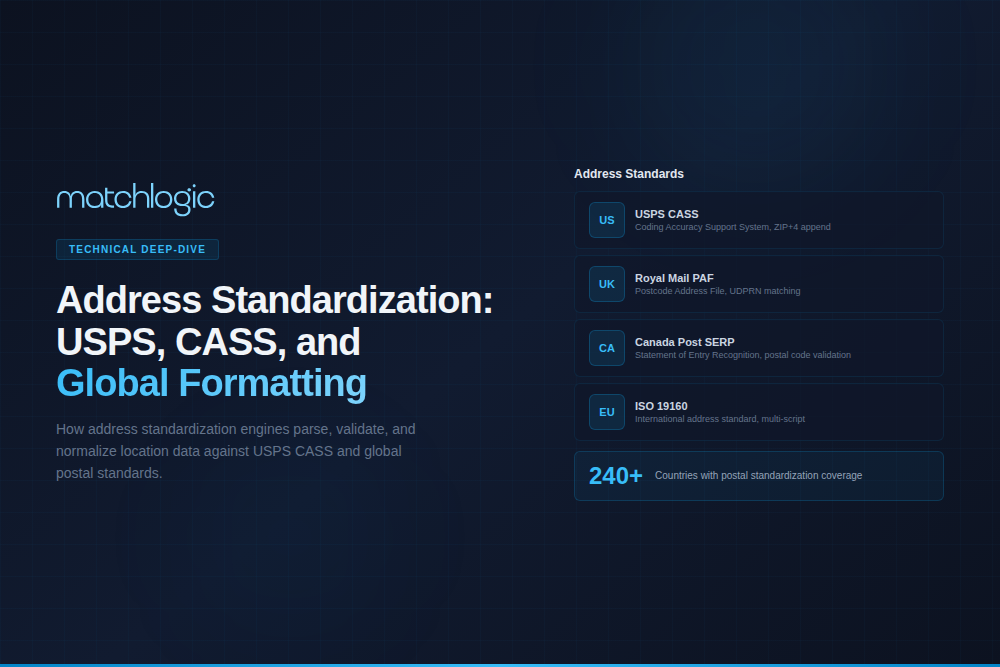
Address Standardization: USPS, CASS, and Global Address Formatting
Key Takeaways
- ✓Address standardization is the process of parsing, normalizing, and validating location data against postal authority reference files to produce consistent, deliverable address formats.
- ✓USPS CASS certification is the U.S. standard for address validation software; it requires Delivery Point Validation (DPV) and LACS processing to confirm deliverability.
- ✓International address standardization requires country-specific parsing rules for 240+ address formats, not a single global template.
- ✓Standardizing addresses before matching improves address-field match accuracy from approximately 70% to over 90%, according to data quality benchmarks.
- ✓Enterprise address standardization must support batch processing, real-time API validation, and field-level audit trails for compliance reporting.
Address standardization (also called address normalization) is the process of parsing raw address strings into discrete components, normalizing those components against postal authority rules, and validating the result against authoritative reference databases such as the USPS ZIP+4 file, Royal Mail PAF, or Canada Post NDC. data standardization guide The goal is to convert inconsistent address entries ("123 Main St, Ste 4B, New York NY" vs. "123 Main Street, Suite 4B, New York, New York 10001") into a single canonical format that postal systems can process and data matching algorithms can compare accurately.
The companion discipline for person records is name standardization — parsing name strings into components and resolving cultural variants before matching.
Address data is among the most error-prone fields in enterprise databases. According to a 2024 analysis by Loqate (a GBG company) covering 3.5 billion transactions, 5.6% of all address entries contain errors significant enough to prevent delivery. For an enterprise with 2 million customer records, that translates to 112,000 undeliverable addresses, each one a failed shipment, a missed communication, or a compliance gap. Standardization eliminates the formatting inconsistencies that cause these failures.
What Are the Three Stages of Address Standardization?
Stage 1: Parsing
Parsing decomposes a raw address string into labeled components. A single-line entry like "123 N Main St Apt 4B Chicago IL 60601-2345" becomes: house number (123), pre-directional (N), street name (Main), street suffix (St), secondary unit designator (Apt), secondary number (4B), city (Chicago), state (IL), ZIP (60601), and ZIP+4 (2345). Parsing logic varies by country. U.S. addresses follow a bottom-up structure (most specific to least specific on each line), while many European and Asian formats follow different conventions.
The parsing challenge is not clean input. It is messy input: concatenated fields, missing components, swapped elements (city in the state field), and free-text entries that mix address data with non-address data ("Ship to loading dock B, 123 Main St"). Enterprise-grade parsers use pattern recognition and postal reference data to resolve ambiguities. Consumer-grade parsers fail on edge cases, which in enterprise datasets can represent 5% to 15% of all records.
Stage 2: Normalization
Normalization converts parsed components into canonical forms defined by the relevant postal authority. For U.S. addresses, USPS Publication 28 defines the standard abbreviations: "Street" becomes "ST," "Avenue" becomes "AVE," "North" becomes "N." State names convert to two-letter FIPS codes. Secondary unit designators follow prescribed formats ("Apartment" becomes "APT," "Suite" becomes "STE").
Normalization also handles data that is correct but non-standard. An address entered as "One Hundred Twenty-Three Main Street" is valid but must normalize to "123 MAIN ST" for postal processing. Company names embedded in address lines ("ATTN: John Smith, Acme Corp") must be separated into attention lines and delivery address lines. PO Box addresses require different formatting rules than street addresses.
Stage 3: Validation
Validation confirms that the standardized address corresponds to a real, deliverable location. In the U.S., validation uses the USPS ZIP+4 database (updated monthly) and Delivery Point Validation (DPV) to confirm that a specific address exists as a mail delivery point. DPV distinguishes between addresses that match a ZIP+4 range (the street exists) and addresses that match a specific delivery point (the apartment or suite number exists). This distinction matters: an address can be CASS-standardized and ZIP+4-assigned but still undeliverable if the secondary unit does not exist.
International validation relies on country-specific reference databases. Royal Mail PAF covers the UK. Canada Post NDC covers Canada. For other countries, validation accuracy depends on the quality and currency of available postal reference data. Countries with well-maintained digital postal databases (Germany, Australia, Japan) support high validation rates. Countries with limited postal infrastructure may only support city-level validation.
What Is CASS and Why Does It Matter for Enterprise Address Data?
CASS (Coding Accuracy Support System) is a USPS certification program that evaluates the accuracy of address-matching software. To achieve CASS certification, software must pass a two-stage test against approximately 150,000 sample addresses, demonstrating the ability to correctly assign ZIP+4 codes, carrier route codes, delivery points, and DPV indicators. CASS certification must be renewed annually.
CASS certification matters for two reasons. First, mailers who process addresses through CASS-certified software qualify for USPS bulk mail discounts, which can reduce postage costs by $0.03 to $0.08 per piece. For an enterprise mailing 5 million pieces per year, that represents $150,000 to $400,000 in annual postage savings. Second, CASS processing is the only USPS-recognized method for confirming address deliverability at the delivery point level.
CASS processing adds two critical capabilities beyond basic standardization. LACS (Locatable Address Conversion System) updates addresses that have been renamed or renumbered by local authorities. An address that was valid three years ago may have a different street name today due to municipal renumbering. SuiteLink appends secondary unit information (suite, apartment, floor) to business addresses using USPS business delivery data. Both processes run automatically as part of CASS-certified address processing.
Beyond CASS, enterprises should also implement NCOA (National Change of Address) processing. The USPS maintains a database of approximately 160 million permanent address changes filed over the prior 48 months. Processing your address file against NCOA updates records for individuals and businesses that have moved. For enterprises with customer databases exceeding 100,000 records, NCOA processing typically updates 8% to 12% of addresses, each one representing a customer who would otherwise receive mail at a former address. USPS requires NCOA processing within 95 days of a mailing to qualify for certain automation discounts.
The cost of skipping CASS and NCOA processing is measurable. The USPS charges a surcharge on mail that is undeliverable as addressed. For first-class mail, undeliverable pieces are returned at no additional cost, but the original postage is wasted. For marketing mail (formerly standard mail), undeliverable pieces are discarded without notification, meaning the sender never learns that the communication failed. A 2023 USPS Office of Inspector General report estimated that undeliverable-as-addressed mail costs the postal system $1.5 billion annually and costs mailers significantly more in wasted printing, postage, and lost customer contact.
How Does Address Standardization Work for International Addresses?
International address standardization is fundamentally different from U.S. standardization because no single global format exists. The Universal Postal Union (UPU) publishes addressing guidelines for 192 member countries, but each country's postal authority defines its own rules. Japanese addresses specify prefecture, city, ward, district, and block number in a structure that has no equivalent in Western addressing. German addresses place the house number after the street name. Brazilian addresses use neighborhood (bairro) as a required component.
| Country | Format Structure | Postal Code Format | Key Parsing Challenge | Reference Database |
|---|---|---|---|---|
| United States | Street, City, State, ZIP | 5-digit + 4 (ZIP+4) | Secondary unit designators (APT, STE, UNIT) | USPS ZIP+4, DPV, CASS |
| United Kingdom | Building, Street, Locality, Town, Postcode | Alphanumeric (e.g., SW1A 1AA) | Locality vs. town distinction; dependent localities | Royal Mail PAF |
| Germany | Street + Number, PLZ, City | 5-digit (PLZ) | House number after street name; umlauts in street names | Deutsche Post PLZ database |
| Japan | Prefecture, City, Ward, District, Block, Building | 7-digit (NNN-NNNN) | No street names; block-based addressing; kanji/romaji transliteration | Japan Post address database |
| Brazil | Street, Number, Complement, Bairro, City, State, CEP | 8-digit (NNNNN-NNN) | Bairro (neighborhood) is required; complement field is free-text | Correios CEP database |
| Australia | Unit, Number, Street, Suburb, State, Postcode | 4-digit | Suburb vs. city distinction; rural addressing (RMB, RSD) | Australia Post PAF |
Enterprise standardization tools that claim "global coverage" should be tested against addresses from your actual operating geographies. A tool that handles U.S. and UK addresses well but fails on Japanese block-based addressing or Brazilian bairro requirements will create data quality gaps in exactly the markets where you need accuracy.
When evaluating international address standardization capabilities, request a test run against a sample of 5,000 addresses from each target country. Measure three metrics: parse rate (percentage of addresses successfully decomposed into components), standardization rate (percentage of parsed addresses converted to postal-authority-compliant format), and validation rate (percentage of standardized addresses confirmed deliverable against a reference database). Accept rates above 90% for countries with mature postal databases (U.S., UK, Germany, Australia, Japan). For developing markets, accept rates above 75% and plan for manual review of unresolved records.
How Does Address Standardization Improve Data Matching Results?
Address fields are one of the most compared attributes in record linkage, and they are also one of the most inconsistent. The same physical location can appear in dozens of formats across systems: abbreviated vs. spelled out, with or without secondary units, with or without country codes, with different postal code granularity. Without standardization, matching algorithms must account for all these variations, which degrades both precision and recall. address matching software
Standardization reduces this variation to a single canonical form per address, which transforms matching from a fuzzy comparison problem into a near-exact comparison problem. In a benchmark study of 1.2 million patient records across four hospital systems, standardizing addresses before matching increased address-field match accuracy from 68% to 91%, according to research published by the American Health Information Management Association (AHIMA). The improvement came almost entirely from resolving formatting differences ("St" vs. "Street," missing apartment numbers, inconsistent state abbreviations) that had nothing to do with whether two records referred to the same person.
For enterprises running MatchLogic or similar data quality platforms, address standardization is a built-in preprocessing step that runs before the matching engine compares records. This integrated approach eliminates the need to export data to a separate standardization tool, re-import it, and then run matching, a workflow that introduces latency and potential data transformation errors at every handoff point.
What Are the Best Practices for Enterprise Address Standardization?
First, standardize at the point of entry, not after the fact. Real-time address validation APIs that check addresses during form submission or data import prevent non-standard data from entering your systems in the first place. Retrofitting standardization across a 10-million-record database is 5 to 10 times more expensive than preventing bad data at ingestion.
Second, maintain separate standardization rules for each geography. Applying U.S. CASS rules to UK addresses destroys valid data. A "flat" in London is not an error to be corrected; it is the UK equivalent of an apartment. Similarly, a four-digit Australian postcode is not a truncated U.S. ZIP code. Enterprise tools should auto-detect the country and apply the appropriate rule set.
Third, preserve the original address alongside the standardized version. Standardization is lossy by design: it discards non-standard formatting in favor of canonical forms. Retaining the original value in a separate field allows audit, rollback, and troubleshooting when standardization rules produce unexpected results. This is especially important for regulatory compliance under GDPR Article 5(1)(d), which requires organizations to demonstrate data accuracy and the ability to rectify inaccuracies.
Enterprise Scenario: Address Standardization for a Multi-National Insurance Group
A European insurance group operating across 14 countries consolidated its policyholder database as part of a Solvency II reporting initiative. The combined dataset contained 6.8 million policyholder records from 14 national systems, each using different address formats, character sets, and postal code structures. Before standardization, a cross-system matching run identified 184,000 potential duplicate policyholder pairs. Manual review of a 1,000-pair sample revealed a 41% false negative rate, driven almost entirely by address formatting differences.
The company implemented country-specific standardization rules across all 14 geographies. German addresses normalized umlauts and expanded abbreviations ("Str." to "Strasse"). French addresses standardized arrondissement notation and cedex codes. UK addresses resolved locality-vs-town ambiguities using Royal Mail PAF. Nordic addresses handled co-care-of conventions and stairwell identifiers. The standardization phase processed all 6.8 million records in 3 hours using parallel execution across 4 on-premise servers.
Post-standardization matching identified 312,000 duplicate pairs with a false positive rate of 2.8%, down from the pre-standardization rate of 18%. The insurer estimated that undetected duplicate policyholders had generated approximately 2.1 million euros in redundant claims payments over the prior three fiscal years. The standardization and deduplication project cost 340,000 euros and delivered a first-year return exceeding 6:1.
What Are the Most Common Address Standardization Pitfalls?
The most frequent pitfall is over-standardization: applying rules that destroy valid address data. A system that strips all periods from addresses will convert "St. Paul, MN" to "St Paul, MN" (correct) but will also convert "100 N. Main St." to "100 N Main St" (also correct). The problem arises when the same rule strips periods from apartment designators ("Apt. 4B" to "Apt 4B") or from abbreviations that carry semantic meaning in international addresses. Test every rule against edge cases before deploying to production.
The second pitfall is assuming U.S. rules work globally. CASS standardization converts "Street" to "ST" and "Avenue" to "AVE" per USPS Publication 28. Applying these same abbreviation rules to UK addresses converts "The Avenue" to "The AVE," which Royal Mail does not recognize. Country detection must happen before any standardization rule fires.
The third pitfall is neglecting address decay. USPS estimates that approximately 6% of U.S. addresses change annually through moves, new construction, and municipal renumbering. An address that was valid and standardized in January may be undeliverable by December. Without regular re-validation against current postal reference files, address quality degrades at a predictable and measurable rate.
Image placement suggestion: Insert the MatchLogic One Engine visual (https://cdn. prod.website-files. com/63d7b3235fa5ca763a4aa170/693fb204ab009a638cbdc77f_One%20engine%20for%20every%20matching%20problem. svg) near the Enterprise Scenario section.
Alt text: "MatchLogic unified platform showing standardization, matching, and deduplication pipeline for multi-national address data processing."
Frequently Asked Questions
What is the difference between address standardization and address validation?
Address standardization formats an address according to postal authority rules (abbreviating "Street" to "ST," normalizing state codes). Address validation confirms that the standardized address corresponds to a real, deliverable location by checking it against a postal reference database. Standardization can produce a correctly formatted address that does not actually exist. Validation catches that gap. Both steps are required for enterprise data quality.
How often should enterprise address data be re-standardized?
USPS updates its ZIP+4 and DPV databases monthly. Streets are renamed, new developments receive addresses, and delivery points change. Enterprise address data should be re-validated at least quarterly against current postal reference files. Organizations with high address churn (retail, e-commerce, direct mail) benefit from monthly processing. NCOA (National Change of Address) processing should run every 90 days to capture individual and business moves.
Is CASS certification required for all address standardization software?
CASS certification is required only for software used to qualify mail for USPS bulk postage discounts. For data quality purposes (matching, deduplication, CRM hygiene), CASS certification is not legally required but is the strongest indicator that the software meets USPS accuracy standards. Non-CASS-certified tools may standardize addresses adequately for internal use but cannot provide DPV-level deliverability confirmation.
Can address standardization handle PO Box and military addresses?
Yes. USPS CASS processing standardizes PO Box addresses (format: "PO BOX [number]"), military addresses (APO/FPO/DPO with overseas ZIP codes), and rural route addresses. Each address type follows different formatting rules defined in USPS Publication 28. Enterprise tools should handle all three types without manual intervention. Military addresses require special handling because they use diplomatic pouch routing, not standard carrier routes.
What happens when an address cannot be standardized?
Addresses that fail standardization fall into three categories: unrecognized (no match in postal reference data), ambiguous (multiple possible matches), and incomplete (missing required components like ZIP code or city). Enterprise tools should flag each category separately and route them to appropriate resolution workflows: automated enrichment for incomplete records, manual review queues for ambiguous records, and exception reports for unrecognized records.
How does address standardization support GDPR compliance?
GDPR Article 5(1)(d) requires that personal data be accurate and kept up to date. Address standardization directly supports this requirement by correcting formatting errors and validating against current postal reference data. The transformation audit trail (original value, rule applied, result, timestamp) provides the documented evidence of accuracy measures that GDPR supervisory authorities expect during compliance reviews.





.svg)