
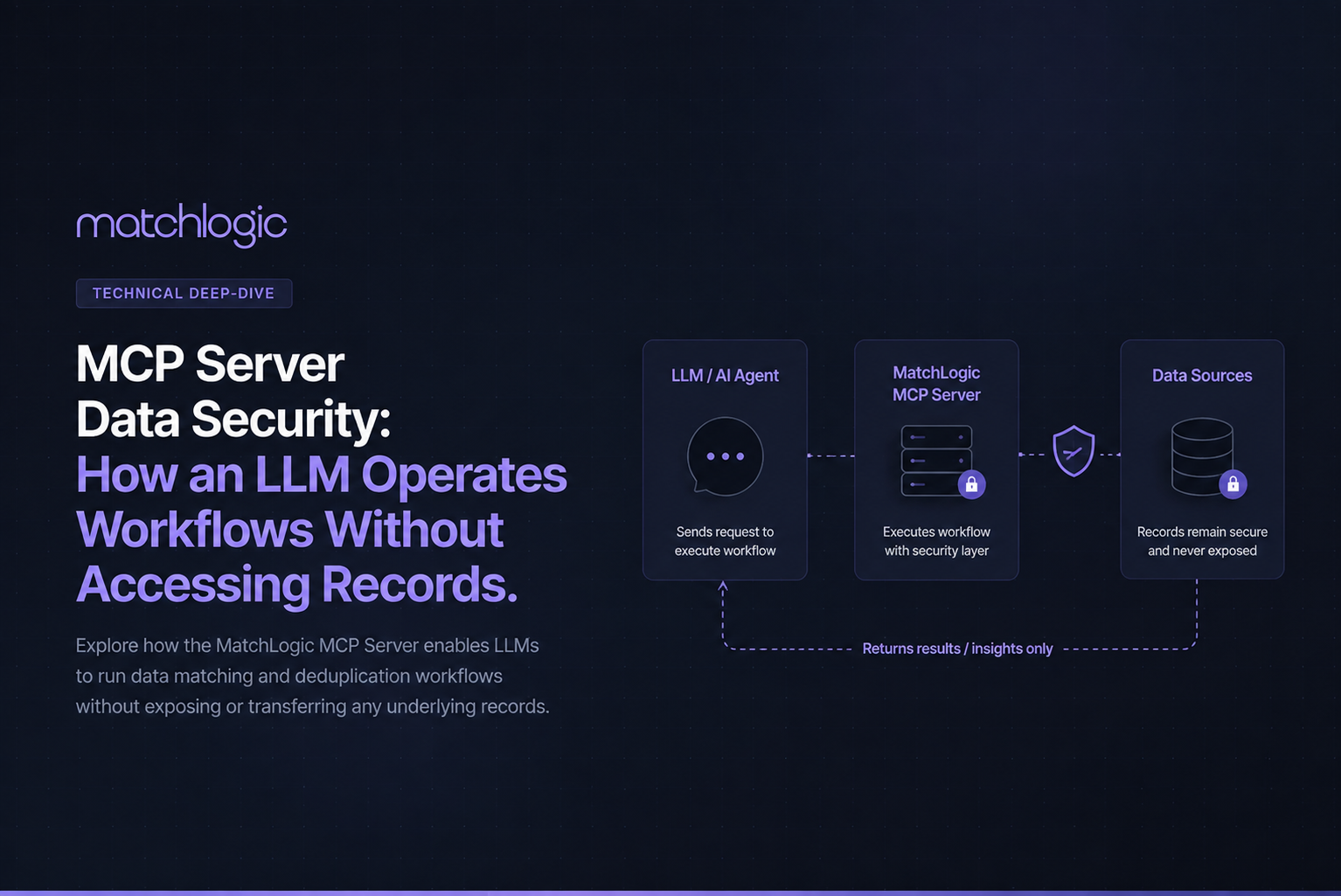
MCP Server Data Security: How an LLM Operates Workflows Without Accessing Records
MCP server data security rests on one architectural decision: whether the model operates the platform or reads its data. In a control-plane design, tool calls carry workflow instructions, identifiers, and status while the records stay inside the platform's environment; the LLM directs the work without ever holding the data. Approval gates, logging, and network posture all build on that separation.
The question matters because agent connectivity is spreading faster than the security review of it. As MCP servers become standard across data tooling, the platforms holding the most sensitive records, including entity resolution and matching systems, are exactly the ones where a wrong design is most expensive.
This blog post lays out the threat model, the layers that contain it, and the checks to run before connecting anything.
What is the Threat Model When You Connect an LLM?
Three risks account for most of the exposure. The first is record leakage: if tool results carry data contents into the model's context, those contents now live wherever the model runs, which for a cloud-hosted model means outside your boundary.
The second is prompt injection. An agent that reads text from files, tickets, or results can be steered by instructions planted in that text, and an agent with execution power turns a steering problem into an operations problem.
The third is the quietest: unaudited change. An agent that can modify production data without a recorded human decision creates changes nobody can later explain, which in a regulated environment is a finding, not a footnote.
What is the Difference Between the Control Plane and the Data Plane?
The control plane is where instructions travel: start this job, use that match definition, report the status. The data plane is where records live and where the engine executes; in a sound design the Model Context Protocol connection stays entirely on the control plane.
The practical test is the payload. If a tool call or its result contains customer rows, the design has already crossed the plane boundary; if it contains job names, workflow identifiers, and summary counts, the wall is holding.
This is why "the LLM never accesses the data" is a verifiable engineering claim rather than a marketing sentence. It can be checked in a demo by inspecting what actually crosses the protocol.
What Do Approval Gates Actually Protect Against?
An approval gate converts every agent intention into a proposal that waits for a human decision. Against prompt injection, that containment is decisive: a manipulated agent can draft a hostile workflow, and it dies at the review step because a person reads it before it runs.
Against audit risk, the gate produces the artifact auditors ask for. Each proposal, confirmation, and tool call is a logged event, so the answer to who authorized a change is a record rather than a reconstruction.
The alternative model, agents that fix data unattended, is genuinely faster. It is also the model in which an injection, a model error, and a legitimate run all look identical in hindsight, because no human decision separates them.
How Do the Security Layers Map to Compliance Frameworks?
Regulated teams do not evaluate agent security in the abstract; they evaluate it against the frameworks they answer to. The table maps each layer to what it addresses.
No single layer carries the design alone. The wall without the gate still permits unaudited change, and the gate without the wall still exposes records; the layers are a set.
What Should You Verify Before Connecting Anything?
Five checks, all runnable in an evaluation, separate a defensible implementation from a risky one.
1. Inspect a tool-call payload
Ask the vendor to show what actually crosses the protocol during a run, request and response. The specification makes the messages inspectable; record contents in either direction end the conversation.
2. Locate execution
Confirm the engine does the work and identify the environment it runs in. For regulated data, execution inside your own infrastructure is the defensible answer.
3. Test the approval gate
Ask the agent to change something and watch what stands in the way. A proposal followed by a confirmation step is the expected behavior; immediate execution is the finding.
4. Read the logs
After a test run, pull the trail: the proposal, the confirmation, and each tool call should be discrete, attributable events. If the log cannot answer who approved the run, neither can you during an audit.
5. Establish the network posture
Decide what may leave your boundary: nothing, or the control conversation only. A self-hosted model closes the loop entirely for environments where even instructions cannot travel outside.
Where Does MatchLogic Stand on These Layers?
MatchCore's MCP server is built as a control-plane design: any LLM of the customer's choice proposes and orchestrates cleansing and matching workflows, a human confirms each one, and the connected model never gets access to the data. Execution stays inside the customer's on-premise deployment, which is the same boundary the rest of the platform already honors; how that compares to other server designs is covered in our guide to agentic entity resolution.
A hospital network illustrates the stakes. Its systems hold 6.1 million patient encounter and admission records, roughly 340,000 unique patients once visit history is separated, and HIPAA governs every one of them; an agent-directed data deduplication program is only possible there because no PHI ever crosses the protocol.
In that design the data steward reviews weekly proposals, confirms the runs, and holds a complete log of every decision. The mechanics of the run sequence itself are in our walkthrough of the MCP server for entity resolution and data matching.
Conclusion
MCP server data security is not a bolt-on to agent connectivity; it is the architecture underneath it. A control-plane design with an approval gate answers the three dominant risks (exposure, injection, unaudited change) structurally, and logging plus network posture make the answers demonstrable.
The evaluation is short because the claims are checkable. Inspect a payload, test the gate, read the log, and the security posture of any MCP server stops being a matter of vendor language.
Frequently Asked Questions
Is it safe to connect an LLM to a data quality platform?
It depends on the server design, and the design is verifiable. If tool calls stay on the control plane, a human confirms every executed change, and actions are logged, the dominant risks are structurally contained. If any of the three is missing, the connection inherits that gap.
Can prompt injection make the agent damage my data?
Injection can steer what an agent proposes, which is why proposals must not equal execution. Behind an approval gate, a manipulated proposal is caught at review, and the log shows exactly what was drafted and rejected. Unattended agent designs lack that firewall.
What data does the LLM see through an MCP server?
In a control-plane design: workflow instructions, identifiers, status, and summary information. Record contents stay inside the platform's environment and never enter the model's context, which can be confirmed by inspecting tool-call payloads during an evaluation.
Does an MCP connection meet GDPR and HIPAA requirements?
The architecture can support compliance, though no protocol makes a deployment compliant by itself. A data wall addresses security of processing, on-premise execution addresses residency, and logged approvals address change control; your assessment still has to cover the full deployment.
What if even the control conversation cannot leave our network?
Use a self-hosted model as the connected LLM. Agent, protocol traffic, and platform then run inside the same boundary, which extends the pattern to air-gapped and high-sensitivity environments.





.svg)