
Best Entity Resolution Software for Regulated, On- Premise Teams (2026)
Entity resolution tools are split by operating model. For on-premise resolution, the shortlist is MatchLogic, Data Ladder, and IBM. Informatica and Reltio make our pick for cloud master data management. Tilores and AWS Entity Resolution are popular options for real-time identity inside applications. Quantexa primarily works with risk and fraud-related use cases, and Splink and Zingg are the better options for open-source control.
This guide compares all ten as entity resolution platforms, on the approach each takes, where it runs, and the use case it fits.
Each tool below has a full entry with balanced pros and cons, and the comparison names a limitation for every one. The numbering groups tools by role; it is not a quality ranking.
What entity resolution software actually does
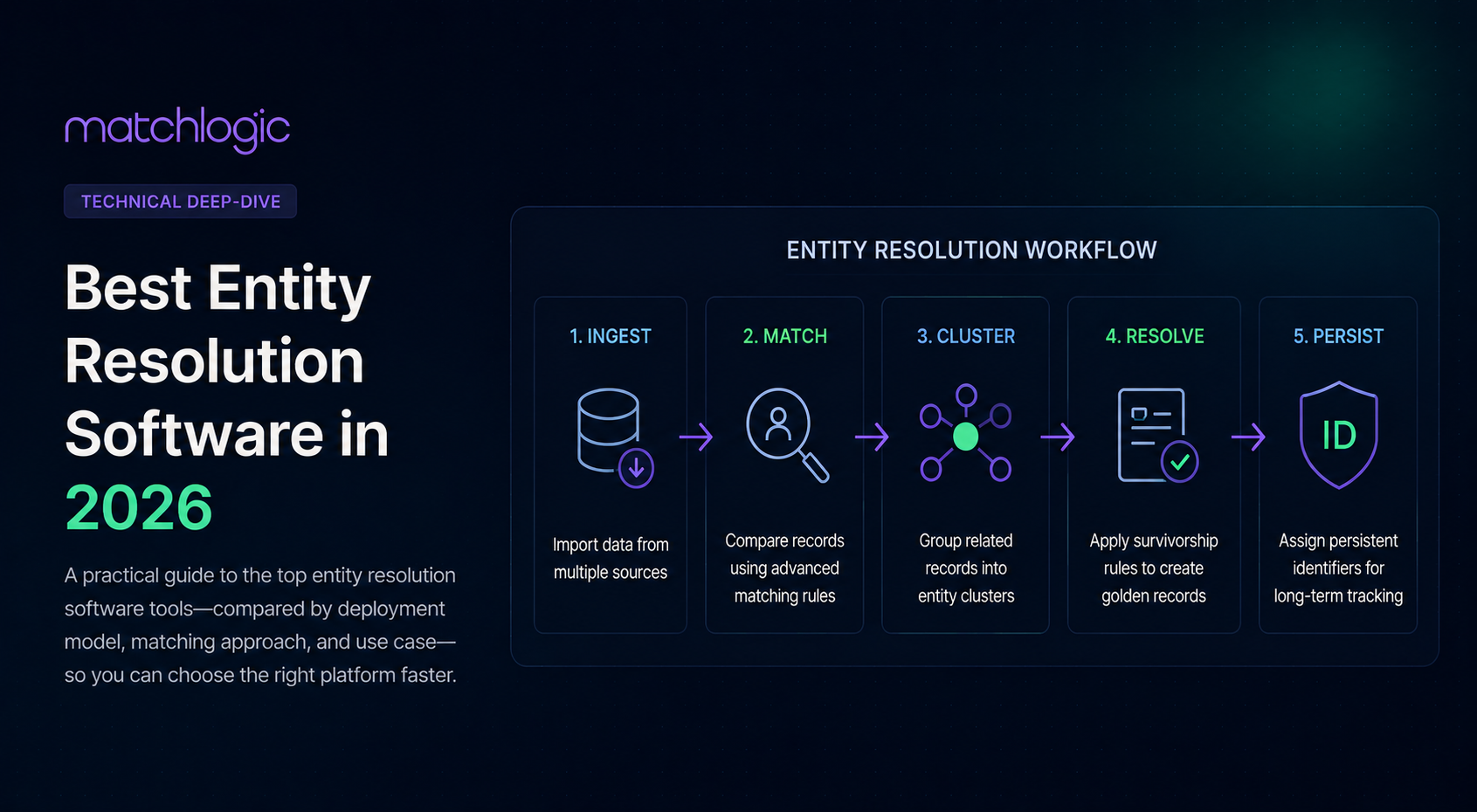
Data matching answers whether two records are similar enough to be the same? Entity resolution answers a much larger question. It takes the pairs that data matching produces, groups them into clusters that each stand for one real-world entity, and resolves each cluster into a single record, even when the source systems share no common identifier.
Three capabilities separate a resolution tool from a matcher. Clustering pulls related records together even when they don't match each other directly. If record A matches B, and B matches C, the system recognizes all three as one entity, not just two separate pairs. Survivorship rules then decide which value wins when those records merge, so the system knows to keep the current phone number over an outdated one, for example. Persistent identifiers then keep that entity recognizable as new records come in later, so a record that arrives next month still gets linked to the same profile instead of starting a new one.
The harder the data, split across systems, inconsistent, and without a shared key, the more these three capabilities matter. A tool that only returns matched pairs has done the first step and left the rest to you.
What to look for in entity resolution software
Six factors separate tools that look similar on a feature grid. Here, we have listed them in the order you should check them, because the first couple tend to eliminate most of the field outright, while the later ones only matter for whatever's left standing.
Deployment and residency: On-premise or cloud is a hard requirement under data residency rules, so settle it first. Most entity resolution leaders are cloud-first, which eliminates them for regulated data before anything else is compared.
Explainability at the match level: When an examiner asks why two records were merged, you need the fields, the confidence, and the rule behind the decision. A resolution you cannot explain is one you cannot defend.
Clustering and survivorship: Confirm the tool clusters records into entities and applies survivorship to build a golden record, not just flags duplicate pairs the way basic deduplication does.
Real-time or batch: Some use cases need a resolved entity at query time inside a live application; others run in nightly batches. Persistent identifiers and latency at the workflow boundary are what to test.
Relationship detection: Risk, fraud, and KYC work needs the network around an entity, not only the entity itself. If that is the use case, weight tools that map relationships between resolved entities.
Ease of use and ownership: Ask whether an analyst or steward can run and tune resolution, or whether every change needs an engineer or a vendor services engagement.
The 10 best entity resolution software tools in 2026
The table below breaks down the field by operating model, so you can see where each tool sits before reading further. Every tool then gets its own entry complete with what it does well, where it falls short, and who it's actually built for. Tamr and Semarchy also compete in this space and are worth knowing about, so we've noted them alongside the closest matching entries rather than giving them separate slots.
1. Informatica MDM and Customer 360
Informatica is the most widely deployed enterprise master data platform, and entity resolution is one function inside its broader governance, quality, and integration suite. Matching combines configurable rules with machine learning, and survivorship models build golden records across domains.
It is the default for organizations that want resolution as part of a full master data program rather than as a standalone capability. However, it can be quite expensive for organizations that are just looking for the entity resolution capability.
Pros
- Comprehensive master data management with governance, survivorship, and hierarchies.
- Scales to large, multi-domain estates across customer, product, and supplier data.
- Deep integration ecosystem and a mature partner network.
Cons
- Heavy licensing and implementation, typically needing dedicated developers.
- Cloud-first direction, which is a constraint for on-premise data residency.
- Overkill when the requirement is entity resolution alone.
Best for: large enterprises standardizing on a full master data management program.
2. IBM InfoSphere MDM and QualityStage
IBM pairs master data management with the QualityStage matching engine, combining probabilistic and deterministic techniques with configurable survivorship. It supports on-premise and hybrid deployment and scales to very large volumes.
Pros
- Mature entity matching and survivorship proven at enterprise scale.
- On-premise and hybrid options, unlike many cloud-only competitors.
- Fits organizations already standardized on IBM infrastructure.
Cons
- Enterprise licensing and a steep learning curve reported by reviewers.
- Probabilistic scoring is harder to explain to an auditor than an inspectable rule.
- Setup and tuning are engineering-heavy.
Best for: large IBM-aligned estates needing governed resolution at scale.
3. Reltio
Reltio is a real-time cloud master data platform known for always-on entity resolution across customer, product, and supplier domains. Its API-driven architecture is built for operational use, resolving entities as records change rather than in scheduled batches.
Pros
- Real-time, always-on resolution suited to operational systems.
- Multidomain coverage in one platform.
- Modern cloud and API architecture with strong scalability.
Cons
- Cloud-only, which is a disqualifier under strict on-premise residency rules.
- Enterprise pricing and an MDM scope wider than pure entity resolution.
- Operational model assumes a cloud-first data strategy.
Best for: enterprises wanting real-time cloud master data across domains.
4. Data Ladder DataMatch Enterprise
Data Ladder resolves entities through a standalone, on-premise data-quality workbench, combining several fuzzy and phonetic algorithms with deterministic rules and configurable survivorship. It emphasizes match-level justification, which suits regulated work.
Pros
- On-premise, with explainable match-level decisions and configurable survivorship.
- Steward-operable multi-algorithm matching, tunable without engineering.
- Profiling and standardization sit in the same tool as resolution.
Cons
- Desktop-oriented workbench instead of a multi-user server platform.
- Setup and threshold tuning fall to the user.
- More matching-centric than a full governance and MDM suite.
Best for: on-premise teams resolving entities through configurable matching.
5. MatchLogic
MatchLogic is an on-premise entity resolution and matching platform for regulated teams that cannot send data to the cloud and must explain every merge. Its MatchCore engine matches records with deterministic logic and named algorithms, and MatchSense resolves matched records into single entities: pre-trained, real-time, and explainable, accurate from day one with no model training or tuning.
The AI layer is what separates it from the cloud platforms above. It recommends the cleansing rules and the match definition from your own data, so setup that normally takes experts days starts from a working draft, and a Talk to Your Data chat interface lets a steward question resolution results in plain language. All of it runs on a custom language model that operates entirely offline, behind your firewall, so data never leaves your environment.
Through an MCP server, an external language model of your choosing can orchestrate full cleansing and resolution workflows for you to confirm, while a hard wall keeps that model from ever accessing the underlying records. Because the matching is deterministic and every rule and score is inspectable, each resolved entity traces back to a readable reason, which is the answer an auditor actually wants.
Pros
- Runs fully on-premise, including air-gapped, so resolution happens where the regulated data lives.
- MatchSense resolves entities pre-trained and explainable, accurate from day one with no training or tuning.
- The AI recommends cleansing and match configuration from your data, and it runs offline with no cloud calls.
- Through its MCP server, an external LLM can orchestrate resolution workflows while a hard wall keeps it from ever touching the records.
- Every merge traces to an inspectable rule and score, so resolution decisions are auditable.
Cons
- Not a full master data management suite with stewardship consoles and hierarchy management.
- On-premise by design, so teams that want a fully managed cloud service should look elsewhere.
Best for: regulated, on-premise teams that need auditable entity resolution with AI that stays inside their walls.
6. WinPure Entity Resolution
WinPure brings entity resolution to the mid-market through a no-code suite that pairs configurable matching with an AI-assisted module, golden-record creation, and persistent identity. It runs on-premise, oriented to Windows, with cleansing and matching in one workflow.
Pros
- No-code resolution with golden-record and persistent-identity features.
- An AI-assisted module for harder resolution cases, on top of rule-based matching.
- On-premise, combining cleansing, profiling, and resolution in one workflow.
Cons
- Deployment is oriented to Windows and to mid-market volumes.
- The AI capability is an add-on layer rather than the core engine.
- Less suited to very large enterprise estates.
Best for: mid-market teams wanting no-code entity resolution with golden records.
7. Tilores
Tilores is an API-first entity resolution service, originally developed inside a European consumer credit bureau, built for real-time deduplication and linking at query time. Its GraphQL API returns a resolved entity, its source records, and the edges between them, with no stated scaling limits.
Pros
- Real-time, API-first resolution that returns a resolved profile at query time.
- Scales to very large record counts without a batch step.
- Strong for embedding a resolved entity into a live application, fraud check, or AI agent.
Cons
- Cloud and API model, not an on-premise deployment.
- Developer-oriented, so it assumes API integration work.
- Focused on real-time identity over batch master data governance.
Best for: teams needing a resolved entity profile at query time inside a live application.
8. AWS Entity Resolution
AWS Entity Resolution is a managed service that matches and links records within the AWS data stack, using rule-based and machine-learning matching. It integrates with AWS storage and analytics services and runs serverless on a pay-as-you-go model.
Pros
- Managed and serverless, with no infrastructure to run.
- Rule-based and machine-learning matching options in one service.
- Native integration with AWS data and analytics services.
Cons
- Bound to the AWS cloud, a residency and lock-in constraint.
- A narrower feature set than mature master data platforms.
- Not an on-premise option.
Best for: teams already on AWS wanting managed resolution inside that stack.
9. Quantexa
Quantexa is a decision intelligence platform that combines entity resolution with network and relationship analytics, aimed at risk, fraud, and financial-crime use cases. It resolves entities and then maps the connections between them, which is what KYC and AML investigations need.
Pros
- Pairs entity resolution with relationship and network detection.
- Strong fit for KYC, AML, and fraud investigation at enterprise scale.
- Handles complex, connected data across many sources.
Cons
- Enterprise cost and a substantial implementation.
- Oriented to risk and financial-crime use cases more than general master data.
- A heavy cloud or hybrid platform, not a lightweight resolver.
Best for: banks and enterprises resolving entities for risk, fraud, and KYC.
10. Splink and Zingg
Splink and Zingg are open-source entity resolution libraries. Splink implements the probabilistic Fellegi-Sunter model at scale on Spark and other backends and produces interpretable match weights. Zingg takes a machine-learning approach from labeled examples and runs natively inside warehouses such as Snowflake and Databricks.
Pros
- Free, with full control over the resolution model.
- Scale on Spark and modern data warehouses.
- Interpretable match weights in Splink, learned matching in Zingg.
Cons
- Engineering-led, with no product, workflow, or audit trail around them.
- Require statistical or machine-learning expertise to run well.
- The team owns operations, review, survivorship, and access control.
Best for: engineering teams wanting open-source entity resolution they fully control.
What to check before you buy entity resolution software
Whether a tool actually resolves your data correctly is hard to tell from a spec sheet, so run these checks before you sign anything.
- Test it on your own records. Load your messiest, most fragmented data and see how it handles false merges and missed links.
- Ask for a merge to be explained. Pick a specific resolved entity and have the vendor walk you through which fields drove the match, the confidence score, and the rule or model behind it.
- Check survivorship and persistence. Make sure the tool builds a golden record with clear survivorship rules, and that it assigns a stable identifier that holds up as new data comes in.
For matching-first tools and categories beyond entity resolution, the best data matching software roundup covers suites, verification, and open source side by side.
Where each type of tool is the wrong choice
Most failed evaluations are the right tool aimed at the wrong problem. Naming the mis-selections is the fastest way to avoid one.
- Cloud MDM suites are wrong when regulated data cannot leave your environment, however strong their resolution.
- Real-time API services are wrong for a governed, batch master data program with stewardship and hierarchies.
- Open-source libraries are wrong without engineering capacity, since they ship no workflow, survivorship, or audit trail.
- MatchLogic is wrong when you need a full MDM suite with stewardship consoles and hierarchy management, or a fully managed cloud service, since it is an on-premise resolution and matching platform.
One patient record across three systems, and a trail to prove it
"We had the same patient split across three systems under slightly different addresses. Resolving them into one record, with a clear reason for every merge, is what finally passed our audit."
Daniel Osei, Data Governance Lead, Brightwater Health System
Choosing the best entity resolution software for your data
The best entity resolution software is the one whose operating model fits your use case and whose resolutions you can explain and defend, which is why this guide groups tools by role and names a limitation for each rather than crowning one. Start from the model, operational identity, governed MDM, data-quality resolution, risk intelligence, or open-source control, and the ten options narrow to two or three.
From there the decision is not about features. Run each candidate on a real extract of your own records, ask to see a specific merge explained, and judge the result on false merges and missed links, not on a headline accuracy number.
If regulated data has to stay on-premise, remove every cloud-only platform first and compare what remains on explainability and audit trail. That single filter usually leaves a short list you can test in a week.
Frequently asked questions
What is the best entity resolution software?
There is no single best entity resolution software, because the right tool depends on the operating model. For on-premise, regulated entity resolution, teams shortlist MatchLogic, Data Ladder, and IBM. For cloud master data management, Informatica and Reltio lead; for real-time identity in applications, Tilores and AWS Entity Resolution; for risk and fraud, Quantexa; and for open-source control, Splink and Zingg.
What is the difference between entity resolution and data matching?
Data matching compares records and scores how similar they are, returning pairs above a threshold. Entity resolution goes further: it clusters those matched pairs into groups that each represent one real-world entity, then builds a single golden record per entity across systems. Matching finds the pairs; entity resolution produces the unified entities.
What is the difference between entity resolution and master data management?
Master data management is the broader program for governing an organization’s critical data, including stewardship, hierarchies, and policy. Entity resolution is the step within it that links and unifies records into single entities. You can run entity resolution on its own without adopting a full MDM suite, which is often a smaller and faster project.
Can entity resolution software run on-premise?
Yes. MatchLogic, Data Ladder, IBM InfoSphere, WinPure, and self-hosted open-source tools such as Splink and Zingg all run inside your own environment. This matters where HIPAA, GDPR, SOX, or DORA make data residency a requirement, because most cloud-first entity resolution platforms cannot process data that is not allowed to leave the organization.
Does entity resolution use AI?
It varies. Some tools use deterministic rules, some probabilistic models, some machine learning, and some pre-trained entity resolution engines. The question that matters for regulated data is whether the AI’s decisions are explainable, so you can show why two records merged, and where the AI runs, since a cloud model processes data outside your environment.
Is there free entity resolution software?
Yes. Splink, Zingg, the dedupe library, and OpenRefine are open source and carry no licence cost. The cost moves to engineering time, because none of them provide vendor support, review workflows, survivorship governance, or audit trails out of the box, all of which a team has to build and maintain.





.svg)