
Entity Resolution Solutions: Build vs. Buy vs. Hybrid Approaches
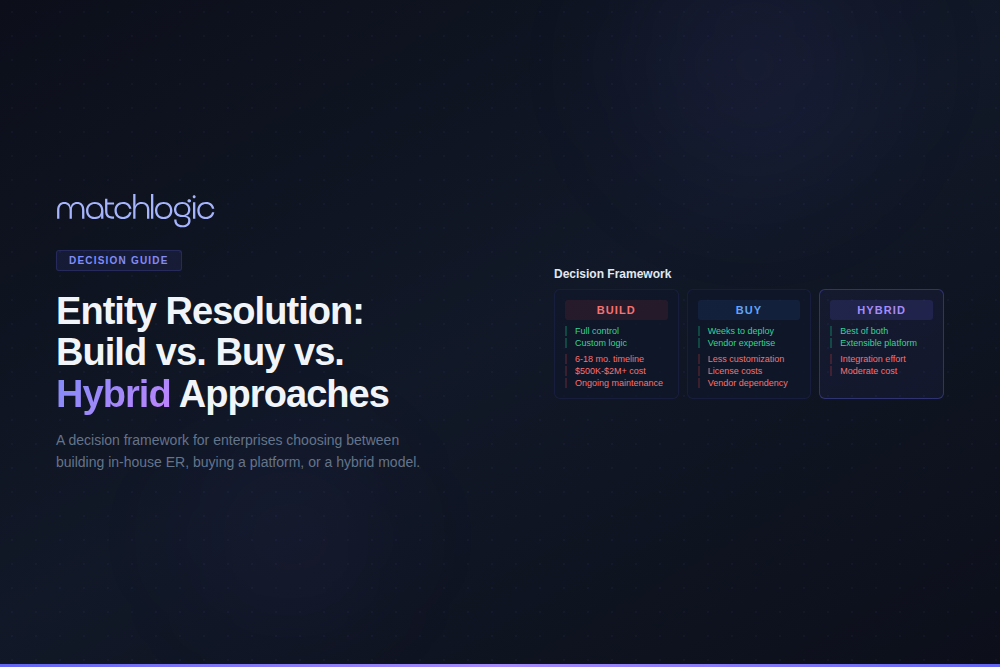
Entity resolution solutions fall into three categories: build (developing matching, clustering, and golden-record logic in-house), buy (licensing a commercial platform), or hybrid (combining open-source components with commercial tools for specific pipeline stages). The right approach depends on your data complexity, engineering capacity, regulatory environment, and timeline. There is no universally correct answer, and the wrong choice can waste hundreds of thousands of dollars or lock a team into a platform that does not fit its architecture.
This guide provides a structured decision framework, concrete cost comparisons, and the trade-offs enterprise data teams should weigh before committing to an entity resolution approach.
What Does It Mean to Build Entity Resolution In-House?
Building means your team develops the entire pipeline from scratch: ingestion and standardization, blocking, pairwise comparison, classification, clustering, survivorship, and golden-record persistence, plus the infrastructure for review queues, audit logging, and API endpoints. The matching engine is the component most decisions hinge on, and the entity matching software layer is where the algorithm-level trade-offs live.
The common starting point is an open-source library. Splink implements the Fellegi-Sunter probabilistic model on SQL and Spark, Zingg uses active learning on Apache Spark, and the dedupe library provides active-learning deduplication in Python. These tools are well-documented and maintained, but they handle only the matching stage, not preparation, orchestration, survivorship, or golden-record management.
When Building Makes Sense
Building is viable when three conditions hold at once: your entity types and sources are narrow and stable, your team includes at least two engineers experienced in record linkage and distributed computing, and the timeline allows 6 to 12 months before production.
The Hidden Costs of Building
The initial matching logic is often the easiest part. The costs that catch teams off guard are ongoing maintenance, scalability engineering as record counts grow, edge cases (multilingual names, cultural name ordering, corporate hierarchies), and audit-trail infrastructure detailed enough for regulatory review. Industry estimates put the cost of building roughly 70 percent of a production-grade system near $1 million, with 90 percent capability costing far more.
What Does It Mean to Buy an Entity Resolution Platform?
Buying means licensing a commercial platform that provides the complete pipeline: ingestion, standardization, matching, clustering, survivorship, golden-record management, and connectors. Vendors in this space include Tamr, Informatica MDM, Reltio (now part of SAP), Quantexa, Semarchy, and MatchLogic, among others. Comparing those platforms is a question of entity resolution software evaluation criteria: accuracy, transparency, scalability, and deployment.
Commercial platforms differ across several dimensions. Matching approach ranges from pre-configured ML models to probabilistic frameworks to configurable rule engines with fuzzy matching. Deployment ranges from cloud-only to on-premise to flexible, pricing ranges from per-record to per-entity to annual or perpetual license, and transparency ranges from full field-level explanations to scores with no exposed logic.
When Buying Makes Sense
Buying is right when time-to-value is critical (production within 2 to 8 weeks), when the data environment is complex (many entity types across dozens of sources), when the organization lacks specialized entity resolution talent, or when regulators demand auditable match logic and certified lineage from day one.
The Risks of Buying
Vendor lock-in is the primary risk: once logic, survivorship rules, and golden records are embedded, migrating means re-implementing the pipeline. Per-record pricing can escalate as volumes grow, cloud-only platforms may not meet data residency rules, and platforms with opaque matching create compliance risk where auditors require explainability.
What Is the Hybrid Approach to Entity Resolution?
The hybrid approach combines open-source or custom components for some pipeline stages with commercial tools for others. It is a deliberate architectural choice that keeps control over matching logic while gaining commercial-grade data preparation, orchestration, and integration.
Common Hybrid Patterns
- Open-source matching with commercial data preparation. Use Splink or Zingg for matching and clustering, paired with a commercial data quality platform for profiling, standardization, and cleansing.
- Commercial platform with custom scoring extensions. License a commercial platform for the core pipeline and extend it with custom similarity functions, domain-specific blocking keys, or models trained on proprietary labeled data.
- Orchestration layer over specialized components. Use Airflow, Dagster, or Prefect to route data through commercial standardization, open-source matching, custom survivorship, and commercial golden-record persistence.
Hybrid works best when the organization has at least one engineer with record-linkage expertise, when no single commercial platform covers every requirement, and when preparation or integration needs exceed what open-source tools handle alone.
Build vs Buy vs Hybrid: A Side-by-Side Comparison
The table below compares the three approaches across the dimensions that most affect the decision. The cost figures are planning estimates, not vendor quotes.
What Is the SDK Trap in Entity Resolution?
Some vendors market software development kits as a “build” option that gives enterprises control over matching logic. In practice, an SDK carries most of the risks of both building and buying, with the benefits of neither.
The matching logic inside an SDK is a vendor-maintained box, while your team writes the orchestration, preparation, and integration around it. When the vendor updates the SDK on their timeline, your code must be retested and sometimes rewritten, and when pricing changes you have little negotiating room because the SDK is embedded throughout your pipeline. If you want build-level control, use genuinely open-source tools where you own the code; if you want vendor-supported matching, buy a complete platform; the SDK middle ground is rarely optimal.
How Should You Decide Between Build, Buy, and Hybrid?
The decision is less about technology than about organizational capability, regulatory constraints, and the urgency of the business problem. Evaluate your organization on the five dimensions below, each rooted in the wider data matching discipline.
- Data complexity: One entity type across two or three well-structured sources favors building; many entity types across 10 or more inconsistent sources favors buy or hybrid.
- Internal engineering capacity: Building needs engineers experienced in string similarity, blocking, probabilistic matching, and distributed systems. If your team focuses on ETL and dashboards, budget 6 to 12 months of ramp-up.
- Regulatory requirements: Where auditors require field-level match explanations, opaque ML platforms do not qualify. Build and transparent-buy options such as MatchCore's configurable rule engine do.
- Time-to-value pressure: A hard deadline (migration, audit, M&A integration) almost always rules out building, since commercial platforms deliver in 2 to 8 weeks and hybrid in 3 to 6 months.
- Three-year total cost: Model cost over three years, not one. Building is front-loaded, buying is more even but watch per-record escalation, and the lowest first-year cost is rarely the lowest three-year TCO.
What Does the Decision Look Like in Practice?
Consider a mid-market insurer with 4.2 million policyholder records across three underwriting systems acquired through two mergers, needing a unified policyholder view for a portal launching in 9 months, with a six-engineer team that has no prior entity resolution experience. This is a common pattern in regulated entity resolution for financial services.
Building is immediately problematic, because a 9-month deadline leaves no margin for the 6 to 12 months a custom system needs while the team also maintains existing ETL and reporting. A full commercial buy is viable: a platform with connectors for the three systems, pre-configured matching for person entities, and on-premise deployment could deliver production results within 8 weeks. A hybrid path using Splink for matching plus a commercial platform for preparation and golden records would work only if the timeline were closer to 18 months.
Choosing the Right Entity Resolution Approach
The build, buy, or hybrid decision is a function of data complexity, engineering maturity, regulatory environment, and timeline, not a preference for open-source or commercial software. Assess your position on the five dimensions, model three-year TCO for each, and run a proof of concept on your actual data. The same diligence applies to broader data matching software evaluation.
For enterprises that need production-ready entity resolution with transparent matching, integrated data preparation, and on-premise deployment, MatchCore delivers the rule-based and fuzzy engine with full explainability, and MatchSense adds pre-trained, explainable AI entity resolution on the same on-premise footprint. No data leaves your infrastructure, and every match decision is auditable from profiling through golden-record creation.
Frequently Asked Questions
Should I build or buy entity resolution?
It depends on data complexity, engineering capacity, regulatory requirements, timeline, and three-year budget. Building suits narrow, well-structured datasets with experienced engineers and flexible timelines. Buying suits complex, multi-source environments where time-to-value and auditability are critical, and hybrid suits teams with some expertise that still need commercial-grade preparation or integration.
How much does it cost to build entity resolution in-house?
Industry estimates place the cost near $500,000 to $1 million to build about 70 percent of a commercial platform's capability, assuming 2 to 5 engineers over 6 to 18 months, with 90 percent capability costing far more. These figures exclude ongoing maintenance, scalability engineering, and the opportunity cost of diverting engineers from other work.
What open-source tools are available for entity resolution?
The most widely used are Splink (probabilistic matching on SQL and Spark), Zingg (active learning on Apache Spark), and dedupe (active learning in Python). They handle the matching stage well but do not include data preparation, golden-record management, or enterprise connectors, so teams typically pair them with separate data quality and orchestration tools.
What is the hybrid approach to entity resolution?
Hybrid entity resolution combines open-source or custom matching logic with commercial tools for preparation, orchestration, or golden-record management. Common patterns include Splink for matching paired with a commercial platform for standardization, or a commercial platform extended with custom similarity functions. It balances flexibility with operational maturity.
How long does it take to implement entity resolution?
Commercial platforms can deliver production results in 2 to 8 weeks, custom builds typically take 6 to 18 months, and hybrid falls in between at 3 to 6 months. The main variables are data complexity, the number of sources, the availability of engineers with entity resolution experience, and whether real-time or batch processing is required.
What is the SDK trap in entity resolution?
Some vendors market SDKs as a build option, but an SDK combines the vendor dependency of buying (the matching logic is a vendor-maintained box) with the engineering overhead of building (your team writes the surrounding pipeline). Genuinely open-source tools give real build-level control, and complete platforms give real vendor support, so the SDK middle ground rarely serves either goal.





.svg)