
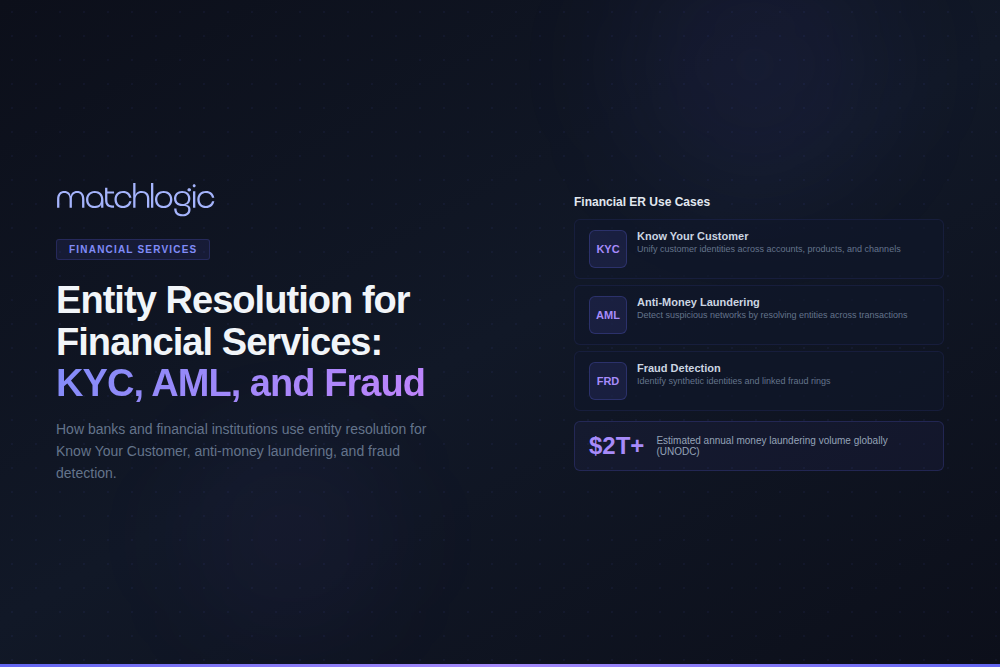
Entity Resolution for Financial Services: KYC, AML, and Fraud Detection
Entity resolution for financial services is the process of linking customer, account, and transaction records that refer to the same person or organization, so a bank can treat each customer, counterparty, and beneficial owner as a single verified identity across every system. It underpins know your customer (KYC) onboarding, anti money laundering (AML) screening, sanctions and politically exposed person checks, and fraud detection. When records are fragmented across core banking, cards, lending, and wealth platforms, the same person looks like several customers, and the institution cannot see its true risk.
The stakes are financial and regulatory. Financial institutions spend an estimated $206.1 billion a year on financial crime compliance, according to the LexisNexis Risk Solutions True Cost of Financial Crime Compliance report, and data silos, legacy systems, and fragmented records are a leading driver of that cost. The discipline behind the fix is entity resolution, applied to the specific identity problems of banking and capital markets.
Why Does Entity Resolution Matter in Financial Services?
A single customer at a large bank can hold a checking account opened in person, a credit card applied for online, a mortgage from an acquired lender, and a brokerage account under a slightly different name. Without entity resolution, those appear as four customers, so the bank cannot calculate true exposure, screen the customer correctly, or detect when activity across the accounts signals risk.
The cost of getting this wrong is concrete. Compliance spending is large and rising, and a meaningful share of it is avoidable rework driven by poor data quality and disconnected systems. On the enforcement side, AML and sanctions failures carry penalties that reach into the hundreds of millions or billions for major institutions, and a missed link during screening is one of the most common root causes.
Entity resolution addresses the problem at its source by deciding which records belong to the same customer, counterparty, or beneficial owner before any screening or monitoring runs. That single resolved identity becomes the input to KYC, AML, fraud, and risk reporting, so each of those processes works from a correct picture rather than a fragmented one.
How Is Entity Resolution Used Across KYC, AML, and Fraud?
Entity resolution sits underneath every major financial crime compliance function. The table maps the main use cases to the resolution work each one depends on.
KYC and Customer Onboarding
At onboarding, entity resolution checks whether an applicant already exists in the bank, which prevents duplicate customer records and flags applicants attempting to open accounts under variant identities. Resolving the applicant to existing relationships also supports customer due diligence by surfacing the full history the bank already holds, rather than treating a known customer as a stranger.
Sanctions and PEP Screening
Screening customers and counterparties against sanctions, watchlist, and politically exposed person data is fundamentally a name-matching problem, because the same individual appears under aliases, transliterations from non-Latin scripts, and inconsistent spellings. This is the domain of fuzzy name matching software, which scores phonetic and orthographic similarity so a match is not missed because a name was spelled differently on a list.
The trade-off is false positives. Loose matching floods analysts with alerts that are not real hits, and the overwhelming majority of screening alerts at most institutions are false positives that consume analyst time. Tunable, explainable thresholds let a team raise precision without hiding the matching logic from examiners.
AML Transaction Monitoring
Transaction monitoring only works when every transaction is attributed to the correct resolved customer. If a customer's activity is split across several unlinked records, structuring and layering patterns that should trigger an alert stay below the threshold on each fragment. Resolving accounts to one customer view restores the complete behavioral picture that BSA and FATF expectations assume.
Fraud-Ring and Synthetic Identity Detection
Graph-based entity resolution treats shared attributes as links, so accounts that use the same device, phone number, or address are connected even when the names differ entirely. This exposes fraud rings and mule networks that look like unrelated customers in a flat database, and it helps surface synthetic identities, one of the fastest-growing financial crime typologies, which are assembled from a mix of real and fabricated attributes.
Beneficial Ownership and UBO Resolution
Beneficial ownership rules, including the Corporate Transparency Act in the United States and FATF recommendations internationally, require institutions to identify the real people behind corporate customers. Entity resolution links corporate entities, directors, and owners across filings and internal records to reconstruct ownership chains, so the ultimate beneficial owner behind a layered structure is identified rather than hidden.
What Should Financial Institutions Look For in an Entity Resolution Platform?
Banking has requirements that general-purpose tools rarely meet, and comparing options against them matters more than headline accuracy claims. The criteria below are the ones that decide fit, and they sit alongside the broader evaluation in the entity resolution software guidance.
- Auditability: Every match and cluster decision should be logged with the scores and rules applied, because examiners expect to see why two records were linked or kept apart.
- On-premise deployment: Account and transaction data processed inside the bank's network, which BSA recordkeeping and data residency expectations favor over sending regulated data to a managed service.
- Real-time and batch: Real-time resolution at onboarding and payment screening, plus batch runs for portfolio remediation and periodic review.
- Watchlist ingestion: Native handling of OFAC, UN, EU, and PEP lists with scheduled refreshes, so screening always runs against current data.
- Explainable scoring: Transparent, tunable thresholds rather than a black box, so false positives can be reduced without hiding the logic from regulators.
- Scale: Tens of millions of customers and far more transactions, with predictable performance as volumes grow.
The build-versus-buy question is as consequential here as in any sector, since an in-house identity layer competes for the same engineers a bank needs elsewhere. That trade-off is laid out in the entity resolution solutions guidance, which compares time to value, total cost, and the ongoing tuning that financial crime models demand.
Why On-Premise Entity Resolution for Banks?
Entity resolution in a bank processes the most sensitive data the institution holds: identifiers, account numbers, transaction histories, and beneficial ownership records. The question is not whether to resolve identities, but where the data is processed and who controls the audit trail.
An on-premise architecture keeps all of it inside the bank's secured infrastructure. Match decisions, cluster assignments, and resolved customer records are generated and stored on the bank's own servers, the audit trail stays under its control for examiners, and no customer or transaction data is transmitted to an external service for processing. For institutions subject to BSA recordkeeping, GDPR, and local data residency rules, that control is the point.
Building a Trusted Identity Layer for Financial Crime Compliance
Entity resolution is the identity layer beneath every financial crime control. Get it right and KYC, sanctions screening, transaction monitoring, fraud detection, and beneficial ownership all run on a single accurate view of each customer and counterparty. Get it wrong and every one of those controls inherits the same fragmented, error-prone picture.
MatchCore provides the transparent matching engine for this work, with the fuzzy name matching that sanctions and PEP screening depend on, tunable thresholds an examiner can inspect, and no training period. For the clustering that turns matched records into persistent customer and beneficial-owner identities, MatchSense adds explainable AI entity resolution, and both run on-premise so account and transaction data never leaves the bank's secured environment.
Frequently Asked Questions
What is entity resolution for financial services?
It is the process of linking customer, account, and transaction records that refer to the same person or organization into a single verified identity. Banks use it for KYC onboarding, AML transaction monitoring, sanctions and PEP screening, fraud detection, and beneficial ownership. It ensures each financial crime control works from one accurate view of a customer rather than fragmented records.
How does entity resolution support KYC and AML compliance?
For KYC, it resolves a new applicant to any existing records so the bank avoids duplicate profiles and sees the full relationship history. For AML, it attributes every transaction to the correct resolved customer, so monitoring detects structuring and layering patterns that would stay hidden if the activity were split across unlinked records.
How does entity resolution improve sanctions screening?
Sanctions and PEP screening is a name-matching problem, since the same individual appears under aliases, transliterations, and spelling variants. Fuzzy name matching scores phonetic and orthographic similarity so a true hit is not missed, while tunable, explainable thresholds keep false positives down without hiding the logic from regulators.
What is graph-based entity resolution and how does it detect fraud rings?
Graph-based resolution treats shared attributes as links between records, so accounts using the same device, phone, or address are connected even when names differ. This exposes fraud rings and mule networks that look like unrelated customers in a flat database, and it helps surface synthetic identities assembled from real and fabricated attributes.
How does entity resolution support beneficial ownership requirements?
Rules such as the Corporate Transparency Act and FATF recommendations require identifying the real people behind corporate customers. Entity resolution links companies, directors, and owners across filings and internal records to reconstruct ownership chains, so the ultimate beneficial owner behind a layered structure is identified rather than obscured.
Why should entity resolution run on-premise at a bank?
On-premise deployment keeps identifiers, account numbers, and transaction histories inside the bank's secured network, with the audit trail under its own control for examiners. This addresses BSA recordkeeping, GDPR, and data residency expectations, since no regulated customer or transaction data is sent to an external service for processing.
What is the difference between entity resolution and identity verification?
Identity verification confirms that a person is who they claim to be at onboarding, usually against documents or external data. Entity resolution determines whether records across the bank's systems refer to the same already-known person or organization. Verification answers “is this real,” while resolution answers “is this the same as what we already have.”
How does entity resolution reduce false positives in AML screening?
By resolving customers to a single identity first, screening runs against one clean record instead of several fragments, which removes duplicate alerts for the same person. Tunable, explainable matching thresholds then let analysts raise precision on name matches, reducing the volume of alerts that are not genuine hits while keeping the decision logic auditable.





.svg)