
How Much Do Duplicate Records Actually Cost?
The cost of a duplicate record is the sum of the direct, operational, and strategic waste it creates as it moves through marketing, sales, service, compliance, and analytics systems, which is almost always far higher than the storage it consumes.
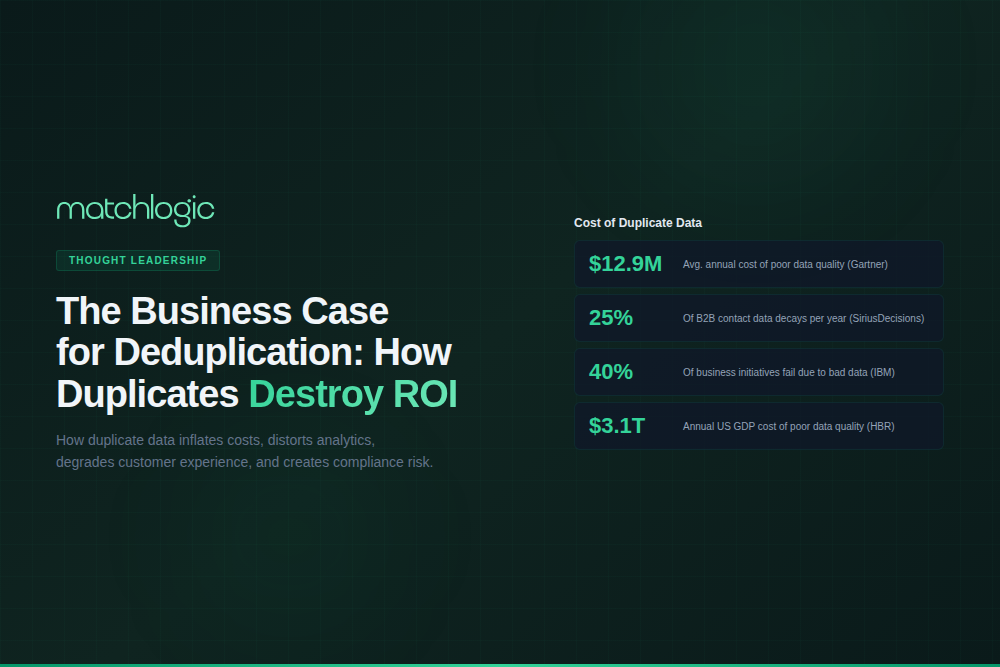
Poor data quality costs U.S. businesses an estimated $3.1 trillion a year, according to research IBM published through Harvard Business Review, and duplicate records are one of its most common and measurable forms. A single customer stored three times does not just take three rows; it distorts every count, campaign, and model built on top of it.
Understanding that cost is the first step in building the business case for data deduplication, because the expense is distributed across departments and rarely shows up as one line item that a budget owner can point to.
Why Are Duplicate Records So Expensive?
The expense is hard to see because it rarely appears at the point of failure. A duplicate created at data entry surfaces later as a wasted mailing, a misrouted lead, a failed compliance request, or a skewed forecast.
That delay is what makes duplicates dangerous. By the time the symptom appears, the cost has already spread across several systems, so no single owner feels the full weight of it and the root cause goes unfunded.
What Is the 1-10-100 Rule for Data Quality?
The 1-10-100 rule, originally articulated by quality management researchers and widely cited in data governance literature, quantifies the cost escalation of data quality problems over time. It costs approximately $1 per record to prevent a data quality issue at the point of entry. It costs $10 per record to find and fix the issue after it has entered the system. It costs $100 per record (or more) to absorb the business consequences of the unfixed issue: the lost sale, the compliance fine, the misrouted patient, the failed AI prediction.
Applied to duplicate records at enterprise scale, the math becomes significant. An organization with 5 million records and a 10% duplicate rate (a conservative estimate per Edgewater Consulting) carries 500,000 duplicates. At $1 per record for prevention, the proactive cost is $500,000. At $10 per record for remediation, the reactive cost is $5 million. At $100 per record for absorbed business impact, the cost of inaction is $50 million. The actual cost per record varies by industry and use case, but the ratio holds: prevention is 10x cheaper than correction, and correction is 10x cheaper than consequence.
Where Do Duplicate Records Cost Money? A Department-by-Department Breakdown
Duplicate records do not create a single, obvious expense. They create a tax on every function that touches data. The following table maps the specific cost mechanisms across six enterprise functions.
The compliance cost is the most binary of the group. When a person is split across records, a deletion or access request can miss copies, and incomplete fulfillment can draw administrative fines of up to 4% of global annual revenue under the GDPR.
The customer-experience cost is the least visible and often the largest. PwC's research found that 32% of customers will walk away from a brand they love after a single bad experience, and duplicate records are a direct cause when the same person receives conflicting messages or has to repeat information that one record already holds. That figure comes from PwC's Experience is Everything study.
How Does the Cost Escalate Over Time?
The later a duplicate is caught, the more it costs to resolve. The widely used 1-10-100 rule captures the pattern: it costs roughly 1 unit to prevent a bad record at entry, 10 units to correct it later, and 100 units to absorb the downstream cost of leaving it in place.
Applied to duplicates, prevention at the point of entry is the cheapest control, batch correction through deduplication or a full merge purge is more expensive, and the failure cost, a lost customer or a compliance penalty, is the most expensive of all.
Case Scenario: Calculating the Cost of Inaction at a B2B SaaS Company
A B2B SaaS company with $80 million in annual recurring revenue maintains a CRM database of 420,000 accounts. A data quality audit reveals a 15% duplicate rate: approximately 63,000 accounts are duplicates. The duplicates create the following measurable costs:
Marketing
The company's marketing automation platform charges $0.015 per contact per month. 63,000 duplicate contacts cost $11,340 per year in excess license fees. Beyond licensing, the marketing team sends 24 email campaigns per year. With a 15% duplicate overlap, each campaign reaches approximately 9,450 duplicate recipients. At an industry-average cost-per-email of $0.03 (including content production allocation), duplicate sends cost $6,804 per year.
Sales
The company employs 45 account executives. Duplicate accounts cause an estimated 2 territory conflicts per rep per quarter, each requiring 30 minutes of investigation and manager involvement. That is 360 conflict incidents per year at an average fully loaded cost of $75/hour per rep, totaling $13,500 in lost productivity.
Finance
Duplicate customer records cause the finance team to overstate unique customer counts by 15%, which inflates the company's reported customer lifetime value (CLTV) and distorts cohort retention analysis. The CEO presents a board deck showing 420,000 customers with a CLTV of $190. The actual figure: 357,000 customers with a CLTV of $224. Decisions about expansion, hiring, and product investment are based on the wrong numbers.
Total quantifiable annual cost
Approximately $31,644 in direct waste, plus an unquantifiable (but potentially much larger) cost in misallocated strategic resources. A deduplication project costing $50,000 to $75,000 would pay for itself within the first year on direct savings alone, before accounting for improved forecasting accuracy and customer experience.
How Do You Build the Business Case for Deduplication?
The following framework translates duplicate record costs into a format that finance teams and executive sponsors can evaluate. Use it to calculate the ROI of a deduplication investment at your organization.
Step 1: Measure Your Duplicate Rate
Run a data profile across your primary systems (CRM, ERP, marketing automation, data warehouse). Count unique entities using fuzzy matching, not just exact-match comparison. Most organizations are surprised: the duplicate rate is almost always higher than expected. A conservative enterprise benchmark is 10% (Edgewater Consulting), but rates of 15% to 30% are common in CRMs that ingest data from multiple channels. For tool options to run this assessment, see our guide to dedupe software.
Step 2: Calculate Direct Costs
Multiply your duplicate count by the per-record costs specific to your environment. Common direct cost categories: excess SaaS license fees (per-contact pricing on CRM and marketing automation platforms), wasted campaign spend (cost per email/mail piece multiplied by duplicate volume), duplicate vendor payments (procurement audits can identify these), and labor costs for manual duplicate resolution (hours per incident multiplied by fully loaded hourly rate).
Step 3: Estimate Downstream Impact
This is where the business case becomes compelling. Downstream costs include: inaccurate pipeline forecasting (overstatement leads to under-delivery against board targets), compliance penalties (GDPR fines can reach 4% of annual global revenue), clinical errors from duplicate patient records (average $1,950 per duplicate inpatient stay per Black Book Research), and AI model degradation (duplicates in training data produce biased or inaccurate outputs that affect every downstream decision).
Step 4: Compare Against Deduplication Investment
Enterprise deduplication software typically costs $50,000 to $250,000 annually depending on record volume, deployment model, and feature requirements. Implementation requires 4 to 16 weeks of project time. The break-even calculation: if the annual cost of duplicates exceeds the annual cost of the deduplication platform plus implementation and maintenance, the investment has a positive ROI. In practice, most enterprise deduplication projects achieve ROI within 6 to 12 months on direct cost savings alone.
Why Do Organizations Delay Deduplication Despite the Clear ROI?
Three organizational dynamics explain why deduplication investment lags behind the obvious financial case.
Distributed cost ownership
No single department owns the full cost of duplicates. Marketing absorbs the license inflation. Sales absorbs the territory conflicts. Finance absorbs the forecast distortion. Compliance absorbs the regulatory risk. Because the cost is distributed, no individual budget holder feels the full impact, and no individual executive has the incentive to fund the fix. The business case for deduplication must aggregate costs across departments to demonstrate the total organizational burden.
The "good enough" illusion
When CRM reports show 420,000 customers, and the sales team is hitting quota, and marketing is generating leads, the data appears to be working. The 15% error margin is invisible until someone runs a cohort analysis that does not reconcile, or a compliance audit reveals records that should have been consolidated. Deduplication investments are often triggered by a crisis (failed audit, botched migration, AI project failure) rather than by proactive planning.
Underestimating the compounding effect
Duplicate records accumulate over time. A 10% rate today becomes 18% in two years if new duplicates are created faster than old ones are resolved. The cost compounds because every downstream system, report, and model built on the duplicated data inherits the error. Organizations that delay deduplication do not face a static cost; they face an accelerating one. For a broader perspective on how data accuracy affects business intelligence, see our article on data accuracy.
How Do Duplicates Undermine Analytics and AI?
Every metric built on duplicated data is wrong in a predictable direction: customer counts run high, per-customer averages run low, and segmentation blurs. When that data trains a model, the errors compound, because the model learns from fragmented and repeated examples.
This is now a board-level risk. Gartner projects that organizations will abandon 60% of AI projects through 2026 because the underlying data is not AI-ready, a standard that requires deduplicated, consistent, governed inputs rather than raw extracts. Gartner published that projection in its analysis of AI-ready data.
The remedy is upstream. An on-premise platform such as MatchLogic runs deduplication through MatchCore before data reaches the warehouse, so counts, dashboards, and models are built on one record per entity rather than several. Sustained accuracy then depends on the same discipline applied to data accuracy across every system, not a one-time cleanup.
Frequently Asked Questions
How much does a single duplicate record cost?
There is no universal figure, because the cost depends on how many functions the record touches. A duplicate that only wastes storage costs pennies, while one that drives a duplicate mailing, a misrouted lead, and a broken compliance request can cost tens of dollars a year across systems.
What is the average duplicate rate in enterprise databases?
A conservative benchmark is around 10%, but CRMs that have never undergone deduplication commonly reach 20% or higher. The only reliable figure is the one a profiling pass produces on your own data, since rates vary widely by source and data-entry discipline.
Do duplicate records affect compliance?
Yes. When a person exists as several records, a GDPR or CCPA deletion or access request may only reach one of them, leaving the organization non-compliant. Incomplete fulfillment can draw regulatory penalties, which under GDPR reach up to 4% of global annual revenue.
How do duplicates affect AI and machine learning?
Duplicates corrupt training data, so a model can learn that one customer is several people and produce skewed predictions. Gartner projects that 60% of AI projects will be abandoned through 2026 for lack of AI-ready data, and deduplication is part of meeting that standard.
Is deduplication worth the investment?
In most cases the distributed annual cost of duplicates exceeds the one-time cost of removing them. Building the case means estimating duplicate volume, assigning a per-record cost across affected functions, and comparing the total against the price of deduplication.
What is the difference between deduplication and merge purge?
Deduplication removes duplicates within one dataset. Merge purge combines several source files first, then deduplicates and suppresses across all of them, which is the standard approach when consolidating lists from multiple systems.





.svg)