
What Is CRM Deduplication?
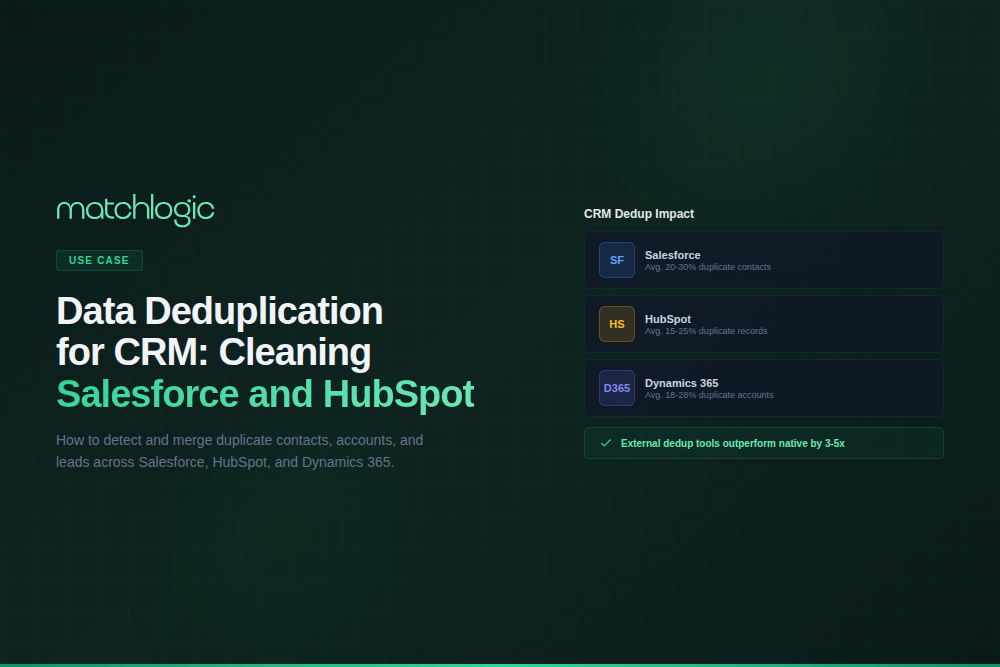
CRM deduplication is the process of finding and merging duplicate leads, contacts, and accounts inside a CRM so that each customer, prospect, or company is represented by one accurate record instead of several conflicting ones.
Duplicates accumulate in every CRM through manual entry, bulk imports, web form fills, and integrations that write records without checking whether the entity already exists. Left alone, they split account history, misroute leads, inflate reporting, and undermine every downstream system that reads from the CRM.
CRM deduplication is one applied form of the broader practice of data deduplication, focused on the specific structure and sync behavior of platforms like Salesforce, HubSpot, and Dynamics 365.
Why Do CRMs Accumulate Duplicates?
Every CRM has several paths that create records, and few of them check for existing matches before writing. Understanding these paths is the first step in controlling them.
- Manual entry. A rep who does not find a contact on the first search creates a new one, so the same person accumulates under slight name and email variations.
- Bulk imports. List uploads from events, webinars, and purchased data rarely match against existing records, so every import layers new duplicates on top of old ones.
- Web forms. A returning visitor who uses a different email or a nickname generates a fresh lead rather than updating an existing record.
- Integrations. Sync connectors that push records from marketing tools or an ERP can write duplicates when the two systems disagree on what counts as the same entity.
Contact data also decays, which multiplies the problem. HubSpot's analysis of MarketingSherpa research puts B2B contact decay at about 22.5% a year, so a person who changed jobs or email often reappears as a new record rather than matching the old one.
The pattern is consistent: each platform handles exact matches on its primary identifier (email for contacts, domain for companies) and struggles with everything else. "Robert Smith" and "Bob Smith" at the same address remain two separate contacts in all three platforms using native tools alone. For a deeper comparison of matching algorithms and capabilities, see our guide to dedupe software.
Where Do Native CRM Deduplication Tools Fall Short?
No Fuzzy or Phonetic Matching
The most significant limitation across all three CRMs is the absence of true fuzzy matching. "Catherine" and "Cathy," "Acme Corp" and "ACME Corporation," "123 Main St" and "123 Main Street" are all non-matches for native tools. Enterprise data consistently contains these variations because records are created by different people, through different channels, at different times. Without fuzzy matching, 30% to 40% of real duplicates go undetected.
No Cross-System Deduplication
Native tools operate within a single CRM instance. An organization running Salesforce for sales, HubSpot for marketing, and Dynamics 365 for customer service has three separate duplicate problems, each invisible to the other platforms. The same customer exists as a Salesforce contact, a HubSpot contact, and a Dynamics 365 account, and no native tool links them.
Limited Survivorship Logic
When merging duplicates, native CRM tools offer coarse survivorship: choose a master record, and the secondary record's data fills in blank fields. Enterprise scenarios demand field-level control: use the phone number from the most recently updated record, the email from the CRM record (not the marketing automation record), and the company name from the record with the longest value. None of the three CRMs provide this granularity natively.
Sync-Created Duplicates
In multi-CRM environments, platform-to-platform syncs create a unique category of duplicates. When HubSpot and Salesforce are synced, merging two Salesforce contacts does not automatically merge the corresponding HubSpot contacts. The HubSpot record that was synced with the now-deleted secondary Salesforce contact becomes an orphan, potentially re-creating a duplicate on the next sync cycle. Managing this requires sync-aware deduplication logic that native tools do not provide.
What Does Enterprise CRM Deduplication Require?
Enterprise-grade CRM deduplication adds capabilities that native tools and plugins do not, especially fuzzy matching, cross-system reconciliation, and governance. The table compares the three tiers.
Cross-system reconciliation is where the two approaches diverge most. Native CRM dedup treats data matching software as a single-system feature, while an enterprise platform matches the same entity across every system and writes back one agreed record.
Governance is the other gap. When a customer exists as several records, a GDPR right-to-erasure request can miss copies, which turns a single golden record and its audit trail into a compliance control rather than a convenience.
How Do You Deduplicate a CRM Step by Step?
A reliable CRM deduplication project follows an ordered sequence. Rushing straight to merge, before profiling and standardizing, is the most common cause of bad merges.
Step 1: Profile the CRM
Measure the true duplicate rate across leads, contacts, and accounts before changing anything. Profiling shows which fields are populated, where formatting varies, and how large the cleanup actually is, which sets realistic expectations for stakeholders.
Step 2: Standardize Before Matching
Normalize names, company suffixes, phone formats, and addresses so the matcher compares like with like. Turning Corp and Corporation into one form, and standardizing addresses, prevents the false negatives that unstandardized data produces.
Step 3: Configure Fuzzy Match Rules per Object
Leads, contacts, and accounts need different rules, because they carry different identifying fields. Contacts might match on email plus fuzzy name, while accounts match on standardized company name plus domain, each with its own threshold. The underlying comparison methods, Jaro-Winkler, Levenshtein, and phonetic encoding, come from the established record-linkage literature.
Step 4: Review and Merge With Survivorship Rules
Auto-merge the high-confidence groups and route the borderline ones to review. Field-level survivorship rules decide which values win, so the merged record keeps the most recent phone, the most complete address, and the highest-priority source. This is the same survivorship logic used in merge purge across multiple lists.
Step 5: Prevent New Duplicates
A one-time cleanup decays quickly if nothing changes at the point of entry. Add duplicate checks to forms and integrations, and run a scheduled dedup pass so new duplicates are caught early. Lightweight dedupe software can cover a single CRM, while an enterprise platform maintains hygiene across every connected system.
What Is the Right Approach to CRM Deduplication?
Effective CRM deduplication operates on three layers, each addressing a different phase of the duplicate lifecycle.
Layer 1: Prevention at the Point of Entry
Configure the CRM to check for duplicates before a new record is committed. In Salesforce, this means activating Duplicate Rules with appropriate matching rules and setting the action to "Alert" or "Block." In HubSpot, the automatic email-based deduplication handles this for contacts but not for companies without a domain. In Dynamics 365, configure Duplicate Detection rules to fire on record creation. Prevention catches 50% to 60% of potential duplicates before they enter the system.
For organizations with web forms, API integrations, or third-party data imports feeding the CRM, prevention must extend beyond the CRM's native capabilities. An external matching engine, called via API before the record is created, can check the incoming record against the full CRM database using fuzzy matching and return a match/no-match decision in real time.
Layer 2: Periodic Batch Cleanup
Prevention does not catch everything. Records imported in bulk, created through integrations, or entered with incomplete data bypass prevention checks. A scheduled batch deduplication run (weekly, monthly, or quarterly depending on data velocity) scans the full database using fuzzy matching and flags or auto-merges duplicates that escaped prevention.
For single-CRM environments with fewer than 500,000 records, a CRM-native plugin (Cloudingo for Salesforce, Dedupely for HubSpot, DeDupeD for Dynamics 365) may be sufficient. For multi-CRM environments, high volumes, or regulated industries, an external enterprise platform provides the matching depth, cross-system deduplication, and audit trails that plugins cannot.
Layer 3: Ongoing Monitoring and Governance
Deduplication is not a one-time project. New duplicates accumulate continuously through data imports, form submissions, manual entry, and system integrations. Monitoring involves tracking the duplicate rate over time (measured monthly), setting alerting thresholds (for example, flag if the monthly duplicate creation rate exceeds 2%), and assigning data stewardship responsibilities to specific team members or roles.
Case Scenario: Multi-CRM Deduplication at a B2B Technology Company
A B2B technology company with $120 million in annual revenue operates Salesforce (65,000 accounts, 280,000 contacts) for sales, HubSpot (310,000 contacts) for marketing, and a legacy Dynamics 365 instance (140,000 contacts) inherited from an acquisition two years prior. The HubSpot-Salesforce sync had been active for 18 months. The Dynamics 365 data had never been formally integrated.
A data quality audit revealed the following: Salesforce contained an 11% within-system duplicate rate (approximately 30,800 duplicate contacts). HubSpot contained a 9% duplicate rate (approximately 27,900 duplicates), plus an additional 22,000 "orphan" records created by sync mismatches with Salesforce. The legacy Dynamics 365 instance contained a 24% duplicate rate (approximately 33,600 duplicates) reflecting two years of unmanaged data accumulation. Cross-system analysis identified 48,000 contacts that existed in two or more systems under different record IDs.
The company implemented a three-phase deduplication project. Phase 1 (Weeks 1 to 3): Paused the HubSpot-Salesforce sync, ran batch deduplication on Salesforce using an external matching engine with Jaro-Winkler name matching and address normalization, reducing Salesforce duplicates from 30,800 to 2,100 (93% automated resolution). Phase 2 (Weeks 4 to 5): Ran the same matching rules against HubSpot, resolving 27,900 within-system duplicates and linking 22,000 orphan records to their correct Salesforce counterparts before re-enabling the sync. Phase 3 (Weeks 6 to 8): Migrated 140,000 Dynamics 365 records through the matching engine, deduplicating against both the clean Salesforce and HubSpot datasets, and resolved 33,600 within-system duplicates plus 48,000 cross-system matches.
Post-project, the company's actual unique contact count across all three systems dropped from a reported 730,000 to 518,000, a 29% reduction. HubSpot license costs decreased by $14,400 annually (eliminated 75,000 duplicate contacts at $0.016/contact/month). Salesforce data storage costs decreased proportionally. The sales team reported a 40% reduction in territory assignment conflicts within the first quarter.
When Should You Use Native Tools, CRM Plugins, or an Enterprise Platform?
Match Logic operates at the enterprise platform level, providing cross-system deduplication with fuzzy matching, configurable survivorship, and on-premise deployment for regulated industries. It processes CRM data alongside ERP, data warehouse, and flat file sources in a single matching operation, producing a unified golden record that feeds back into each CRM. For a broader evaluation framework, see our guide to data matching software.
Should You Prevent or Clean Up CRM Duplicates?
The two are not alternatives; a mature program does both. Cleanup resolves the accumulated backlog, while prevention keeps the duplicate rate from climbing straight back.
For cross-system deduplication, an on-premise platform separates the work cleanly. MatchCore profiles, standardizes, and fuzzy-matches the records, and MatchSense resolves them across Salesforce, HubSpot, and Dynamics into one golden record with a full audit trail. Because it runs on-premise, regulated customer data never leaves the network.
Frequently Asked Questions
What is CRM deduplication?
CRM deduplication is the process of finding and merging duplicate leads, contacts, and accounts inside a CRM so each entity is represented once. It combines matching to identify duplicates with survivorship rules that decide which values survive in the merged record.
Why does Salesforce still have duplicates if it has duplicate management?
Salesforce duplicate management relies mostly on exact or near-exact matching, so it catches identical records but misses variations like Bob versus Robert or Acme Corp versus Acme Corporation. It also works inside Salesforce only, so it cannot reconcile the same customer across other systems.
Can I deduplicate across Salesforce, HubSpot, and Dynamics at once?
Not with native tools, which each operate inside their own system. Cross-system deduplication requires an external platform that matches records across all three, builds one golden record per entity, and writes it back so every system references the same account.
What is the difference between deduplication and merge purge in a CRM?
Deduplication removes duplicates within one CRM. Merge purge combines several sources first, such as a CRM export and imported lists, then deduplicates and suppresses across all of them, which is the standard approach when consolidating lists from multiple systems.
How often should I run CRM deduplication?
Run an initial full cleanup, then a scheduled pass on a regular cadence, monthly or quarterly depending on data-entry volume. Without recurring runs and entry-point controls, a CRM tends to return to its pre-cleanup duplicate rate within a year.
Will merging duplicate records break my CRM automations?
It can if merges are done carelessly, since open opportunities, active cases, and ownership assignments depend on record IDs. A safe process previews every merge, applies survivorship rules, and preserves related records so automations continue to function.





.svg)