
Entity Resolution for Healthcare: Patient Matching, Compliance, and Data Quality
Entity resolution for healthcare is the process of identifying, linking, and unifying patient records across clinical, billing, and operational systems so that every record referring to the same patient resolves to one trusted profile. It determines when records scattered across EHR systems, lab systems, pharmacy databases, and health information exchanges describe the same person, then merges them into a single golden record.
For hospitals managing millions of patient records across dozens of source systems, entity resolution underpins patient safety, regulatory compliance, revenue-cycle integrity, and clinical decision support. This guide covers the healthcare-specific challenges, the regulatory framework, and how to evaluate platforms that bring entity resolution to patient data.
Why Is Patient Matching the Central Data Quality Challenge in Healthcare?
Healthcare is unique in the severity of consequences from unresolved identities. In retail, a duplicate customer record wastes a marketing impression; in healthcare, a duplicate patient record can mean a missed drug allergy, a repeated procedure, or a delayed diagnosis.
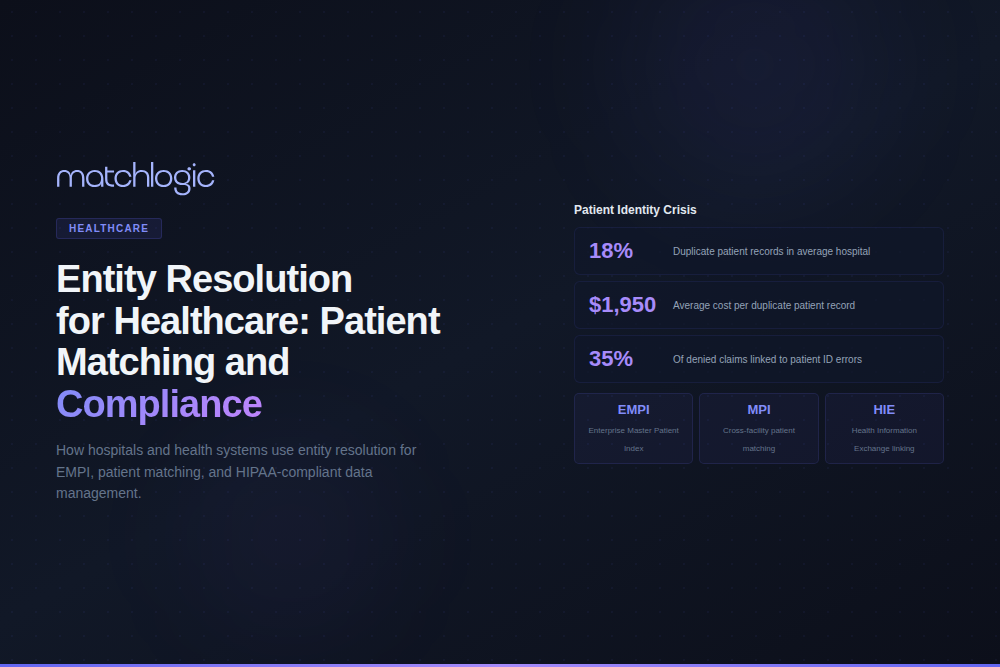
The average healthcare organization's EHR carries an 8 to 12 percent duplicate record rate, according to the Journal of AHIMA, and a RAND Corporation report places the rate near 8 percent for the average US hospital and 15 to 16 percent for large health systems.
These numbers translate into cost and clinical risk. The 2021 Black Book survey found that duplicate records add about $1,950 per inpatient stay and $1,700 per emergency-department visit in redundant tests, and the Ponemon Institute attributes roughly 35 percent of denied claims to inaccurate patient identification, costing the average hospital about $17.4 million a year.
The clinical risk is just as real. A study of 398,939 patient records with confirmed duplicates found the middle-name field had the highest mismatch rate (58.3 percent of duplicate pairs), followed by Social Security number (53.5 percent). Even within one hospital, patients routinely exist as several incomplete records, each holding fragments of their history.
How Does Entity Resolution Work for Patient Matching?
Patient matching follows the same pipeline as other industries (standardization, blocking, comparison, classification, clustering, golden-record creation) but with healthcare-specific constraints. The underlying entity matching software mechanics apply directly to demographic fields.
Healthcare-Specific Data Challenges
Demographic fields are entered manually at registration, often under time pressure without verification documents. Name variations are pervasive (“Katherine,” “Catherine,” “Kathryn,” “Kathy”), addresses change as patients move, and even date of birth can be transposed or entered in different formats.
Healthcare also lacks a universal patient identifier. Despite decades of advocacy, including the MATCH IT Act of 2025, Congress has maintained a ban on federal funding for a national patient ID since 1998. Without one, patient matching relies on probabilistic comparison of demographic fields, which makes the matching algorithm's accuracy the decisive factor in data quality.
The Enterprise Master Patient Index
The EMPI is the layer that operationalizes entity resolution for patient data, maintaining a registry of unique identities and linking each to its records across every connected system. When a patient presents at registration, it searches for matches in real time and either links the encounter or creates a new identity, drawing on entity resolution data linkage techniques across EHR, lab, and pharmacy sources.
Hospitals with EMPI tools report about 93 percent correct identification at registration and 85 percent for externally shared records, according to Black Book, while hospitals without EMPI support reported match rates of only 17 to 24 percent when exchanging records externally. The Sequoia Project has reported that one large health system initially achieved only a 10 percent success rate matching records across organizational boundaries.
How Do Regulations Shape Entity Resolution in Healthcare?
Healthcare data quality is governed by a dense regulatory framework, and each rule has a direct entity resolution implication. The table summarizes the main ones.
What Are the Primary Entity Resolution Use Cases in Healthcare?
1. Enterprise Master Patient Index (EMPI) Management
The foundational use case. Entity resolution creates and maintains the EMPI by continuously matching new registrations against existing identities, merging confirmed duplicates, and flagging potential matches for HIM staff review. For a 500-bed hospital system processing 2 million patient records, reducing the duplicate rate from 12% to 2% eliminates approximately 200,000 duplicate records, saving an estimated $19.2 million in redundant care costs (at $96 per duplicate, per the Children’s Medical Center Dallas study published in hfm magazine).
2. Health Information Exchange (HIE) Matching
When patient records are exchanged between organizations via HIE networks or TEFCA, the receiving organization must match incoming records against its own EMPI. Without accurate cross-organizational matching, clinical data from an external provider may be filed under the wrong patient or left unmatched entirely. The ONC’s Project US@ (Unified Specification for Address in Healthcare) is working to standardize address formatting to improve cross-organizational match rates, but address standardization alone is insufficient without multi-field probabilistic matching.
3. M&A and System Consolidation
Healthcare mergers and acquisitions require combining patient populations from multiple EHR systems into a unified EMPI. A health system acquiring a 200-physician medical group with 1.5 million patient records must resolve overlap: many patients in the acquired group are already in the acquiring system’s EHR. Entity resolution identifies these overlaps, merges the records, and produces a unified patient population without creating new duplicates or losing clinical history.
4. Clinical Research and Population Health
Population health analytics and clinical research require accurate patient cohorts. If a diabetic patient exists as three separate records, they may be counted three times in prevalence calculations or excluded from a research cohort because no single record contains their complete clinical profile. Entity resolution produces the unified patient view that makes cohort identification and longitudinal analysis reliable.
5. Revenue Cycle Integrity
Duplicate records directly cause denied claims. When a claim is submitted under one patient identity but the payer’s records reference a different identity for the same person, the claim is denied for identity mismatch. Entity resolution aligns patient identities across the provider’s billing system, the EHR, and the payer’s member file, reducing the 35% denial rate attributable to patient identification errors (per Black Book Research).
The savings are tangible. For a 500-bed system processing 2 million patient records, cutting the duplicate rate from 12 percent to 2 percent removes roughly 200,000 duplicate records, an estimated $19.2 million in redundant care at about $96 per duplicate from the Children's Medical Center Dallas study.
Why Does On-Premise Entity Resolution Matter for Healthcare?
Healthcare entity resolution processes the most sensitive category of personal data: protected health information including names, dates of birth, Social Security numbers, diagnoses, and treatment histories. For many health systems, sending PHI to a cloud-based platform adds compliance complexity that on-premise deployment avoids entirely.
On-premise entity resolution keeps all patient data, match rules, confidence scores, and audit logs inside the hospital's security perimeter, so no PHI traverses an external network during matching. This is not theoretical: the HHS Office for Civil Rights logged 725 healthcare data breaches affecting 133 million individuals in 2023, so minimizing the attack surface is a risk-mitigation strategy, not just a compliance checkbox.
Both MatchLogic products were built for this requirement. MatchCore runs transparent probabilistic and fuzzy patient matching with field-level explanations, and MatchSense adds pre-trained, explainable AI entity resolution for higher-accuracy matching. Both execute entirely within the organization's infrastructure, support HL7 and FHIR exchange, and give compliance officers the audit documentation they require.
Healthcare-specific requirements narrow the field of suitable platforms. Evaluate vendors against these six criteria, which sit inside the wider set of data quality in healthcare practices.
- Matching accuracy on healthcare data: Request a proof of concept on your own patient demographics, since healthcare name variations, address formats, and date-of-birth entry patterns differ from other industries.
- HIPAA-compliant deployment: On-premise or private-cloud deployment that keeps PHI within your perimeter, with no patient data transmitted to the vendor during matching.
- HL7 and FHIR integration: Native support for HL7 v2 ADT registration messages and FHIR Patient resources for API-based interoperability.
- Real-time matching. Sub-second evaluation of new registrations against the EMPI at the point of registration, not only in overnight batch runs.
- Match transparency and auditability: Field-level explanations for every link, merge, and rejection, so HIM staff and compliance officers can review why records were or were not linked.
- Survivorship rules for clinical data: Configurable rules for which source populates each field, such as legal name from the latest verified registration and allergies from the primary-care EHR.
How Should Healthcare Organizations Measure Entity Resolution Success?
Measuring impact requires both direct and indirect metrics. Direct measures include the duplicate record rate, the match accuracy rate verified by HIM review of a random sample, and the false-positive rate of auto-matched records that needed manual correction.
Indirect measures capture downstream impact: the denied-claims rate tied to identification errors before and after EMPI rollout, weekly HIM time spent on manual reconciliation, and the number of duplicate lab orders and imaging studies per quarter. A system that cuts its duplicate rate from 12 percent to 3 percent should see measurable improvement within 90 days of steady state. The 2025 Healthcare Data Quality Report from Clinical Architecture found that most professionals still have concerns about the quality of information received from external organizations, which reinforces tracking cross-organizational match accuracy as TEFCA exchange expands.
Choosing Entity Resolution for Your Health System
Patient matching is the foundation of compliant, financially sound healthcare data, and the matching engine's accuracy and transparency decide the outcome. Start with your regulatory requirements and demographic data, insist on a proof of concept on your own records, and evaluate platforms against the six criteria above. The same six criteria carry over to broader entity resolution software selection.
Frequently Asked Questions
What is an Enterprise Master Patient Index (EMPI)?
An EMPI is a centralized database that creates and maintains a unique identity for each patient across all connected clinical, billing, and operational systems. It uses entity resolution algorithms (probabilistic matching, fuzzy matching, phonetic comparison) to link records from multiple sources to one patient identity. Hospitals with EMPI tools report about 93 percent correct identification at registration.
How many duplicate patient records does the average hospital have?
The average US healthcare organization has an 8 to 12 percent duplicate patient record rate, according to the Journal of AHIMA and a RAND Corporation report, and large systems report 15 to 18 percent. For a hospital with 1 million records, that represents 80,000 to 180,000 duplicates, each costing roughly $96 in direct operational overhead.
How much do duplicate patient records cost hospitals?
The 2021 Black Book survey found duplicate records add about $1,950 per inpatient stay and $1,700 per emergency-department visit in redundant tests. The Ponemon Institute attributes roughly 35 percent of denied claims to patient identification errors, at about $17.4 million a year for the average hospital. Costs compound across clinical and revenue-cycle operations.
Why is there no universal patient identifier in the United States?
Since 1998, Congress has maintained a ban on federal funding for a unique patient identifier, citing privacy concerns. The MATCH IT Act of 2025 would establish a framework for patient matching without creating a single national ID number. Until legislation passes, organizations rely on probabilistic matching of demographic fields through EMPI systems.
Does entity resolution for healthcare need to be on-premise?
For most organizations handling protected health information, on-premise or private-cloud deployment is strongly preferred. HIPAA requires administrative, physical, and technical safeguards over electronic PHI, and sending PHI to a cloud platform adds Business Associate Agreements, encryption, and external-processing audit requirements. On-premise deployment keeps all data within the organization's perimeter.
What matching accuracy should healthcare organizations target?
Healthcare entity resolution should target high precision to avoid incorrectly merging different patients, which creates clinical safety risk, and high recall to catch the vast majority of true duplicates. Black Book data shows EMPI-equipped hospitals reach about 93 percent correct identification at registration and 85 percent for externally shared records, with borderline records routed to HIM staff for review.





.svg)