
Match fragmented person and company records across inconsistent systems. MatchLogic supports configurable deterministic and fuzzy matching when you need rule-level control, plus pre-trained entity resolution when you want identity matching without customer model training.
Records matched
Match accuracy
Time to first profile

.png)
.png)





MatchLogic supports two approaches to entity matching: configurable rules and thresholds when you need direct control, or pre-trained entity resolution when you want to avoid customer model training. Choose the approach that fits the data, use case, and governance requirements.
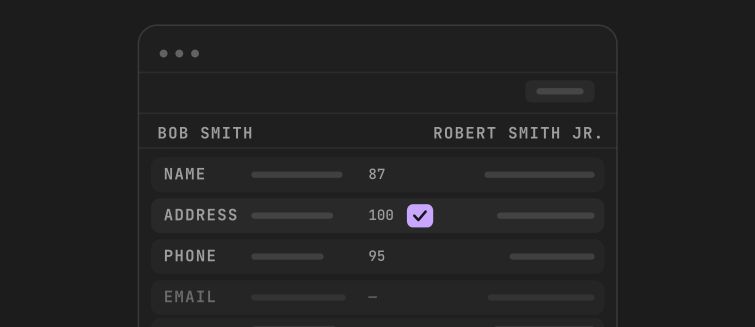
Connect records that belong to the same person or organization even when names, identifiers, and other attributes vary between systems.

Spend less time comparing records across CRM, billing, operational, and legacy systems to work out which identities belong together.

Give reviewers transparent matching logic or explainable resolution outcomes so questionable matches can be assessed without guessing how the decision was made.
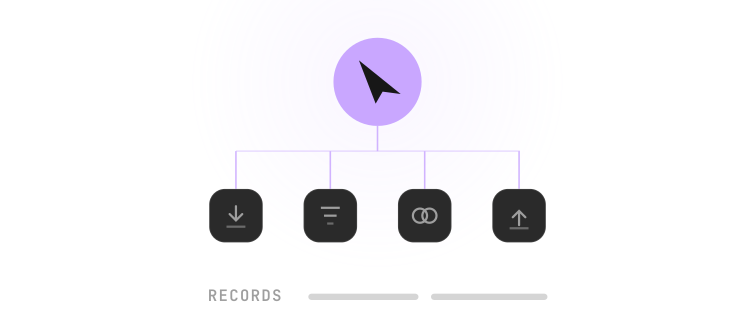
Use AI-assisted matching where appropriate, then extend automation through MCP so an approved LLM can operate cleansing and matching workflows without accessing the underlying records.
Choose the matching approach, connect or resolve the records, review the result, and send trusted entity output downstream without losing visibility into how the outcome was produced.

Match records that refer to the same customer, member, supplier, or organization across inconsistent source data.
Use exact, fuzzy, phonetic, and configurable comparisons when your team needs direct control over rules and thresholds.
Resolve identity without customer model training or tuning when a pre-trained approach fits the use case.
Review rule-level evidence for configurable matching and explainable outcomes for pre-trained entity resolution.
Keep matching and entity-resolution processing inside infrastructure your organization controls, including air-gapped entity-resolution environments.

Bring records from the systems you need to connect. See how MatchLogic handles inconsistent attributes, identifies related entities, and gives your team visibility into the resulting matches.


 1,204 duplicate pairs
 96.4% confidence
 312 master records
 18 fields compared
The same shipper kept calling about a different invoice each week, but the system showed her as a brand-new customer every time. When we dug in, this ‘new’ customer had moved 1,200 shipments through us in 18 months, just split across four party records.
Director of Commercial Operations, JA Frate

Configurable matching lets your team define the fields, rules, algorithms, and thresholds used to determine a match. Pre-trained entity resolution uses purpose-built AI to resolve identities without customer model training or tuning.
Yes. Depending on the approach, MatchLogic can compare available identity attributes even when a shared unique identifier is missing or inconsistent.
Yes. Configurable matching exposes the rules and evidence behind the result, while pre-trained entity resolution produces explainable outcomes.
Yes. MatchLogic supports on-premise processing, and entity resolution can also run in air-gapped environments.
MCP can support broader cleansing and matching workflows through an approved LLM without giving that LLM access to the underlying records.
Yes. Bring a representative person or organization dataset, and the walkthrough can focus on which approach better fits your data and control requirements.

.svg)


