
Match records across systems with transparent, configurable logic. MatchLogic uses offline AI to recommend cleansing and matching rules, while you stay in control of every decision.
Records matched
Match accuracy
Time to first profile

.png)
.png)





MatchLogic uses offline AI to recommend how your data should be cleaned and matched. You review the logic before transparent, deterministic matching rules are applied, so AI speeds up configuration without turning your match decisions into a black box.
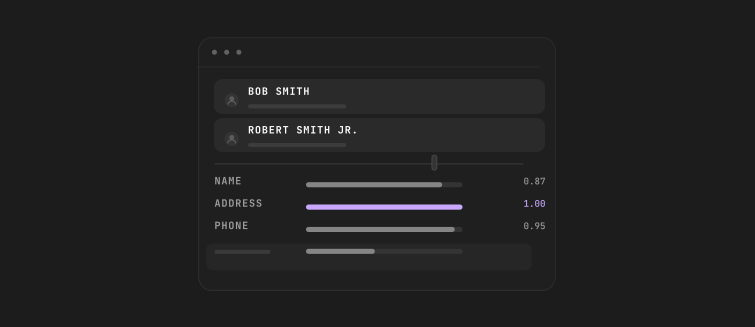
Catch duplicates and related records that exact matching misses because of spelling differences, formatting inconsistencies, missing values, or variations across systems.

Spend less time manually profiling data, experimenting with matching logic, and reviewing unclear results before your team can use the output.
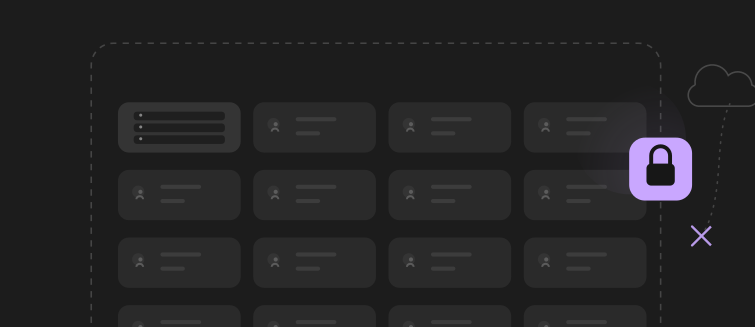
Give data owners, compliance teams, and other stakeholders clear evidence for why records were linked instead of asking them to trust an unexplained score.

Use offline AI to speed up matching configuration, then extend automation through MCP so an approved LLM can operate cleansing and matching workflows without accessing the underlying records.
Everything the enterprise version offers, shown live on your demo.

Identify patterns, inconsistencies, and fields that matter before matching.
Prepare inconsistent values so poor data quality doesn't weaken match results.
Use exact, fuzzy, phonetic, and configurable rules, with AI recommendations where appropriate.
Review the rules, fields, scores, and evidence behind matching results.
Run matching through scheduled, API, or agentic workflows using MCP.

Bring a representative dataset or matching scenario. See how MatchLogic handles inconsistent values, identifies matching records, and shows the evidence behind each result.


 1,204 duplicate pairs
 96.4% confidence
 312 master records
 18 fields compared
“Finding 850 high-value households we had never properly identified was humbling. These were not new prospects. These were people who had been banking with us for ten or twenty years, and we had been treating them as four different small relationships instead of one big one.”
Vice President of Operations, Midwest Community Bank

Its offline AI analyzes your data and recommends cleansing rules and match definitions. You review the recommendations before the matching logic is applied.
No. AI helps configure the process, while transparent deterministic and fuzzy matching logic produces the results you review.
Yes. It can compare records across files, databases, and systems even when values are inconsistent or identifiers do not line up cleanly.
Yes. The offline AI can run behind your firewall with no cloud calls, keeping the matching workflow inside your environment.
Yes. Bring a representative sample or your matching scenario, and the walkthrough can focus on the records and variations you actually work with.
The Docker-based install runs on any infrastructure in under 5 minutes, entirely inside your own network. You can connect SQL Server, PostgreSQL, MySQL, Oracle, or flat files, or load a CSV directly.

.svg)


