
Fuzzy Matching Software: How It Works and What to Look For
Fuzzy matching software identifies records that are similar but not identical by applying string similarity algorithms to compare field values and produce a match confidence score. Unlike exact matching (which requires identical field values to declare a match), fuzzy matching catches typographical errors, nickname variations, abbreviation differences, and formatting inconsistencies that make the same real-world entity appear as multiple different records. It is the core technology behind enterprise data deduplication, customer record unification, and entity resolution.
The fuzzy matching software market spans open-source libraries (FuzzyWuzzy, RapidFuzz), Excel add-ins, and enterprise platforms (Informatica, IBM QualityStage, MatchLogic, Data Ladder). The gap between these categories is not just features; it is the difference between a matching experiment and a production-grade data quality pipeline. This guide covers how fuzzy matching works, what separates enterprise tools from scripts and libraries, the evaluation criteria for selecting a platform, and where fuzzy matching fits in the broader [INTERNAL LINK: Pillar 1, data matching process].
Key Takeaways
- Fuzzy matching software uses string similarity algorithms (Jaro-Winkler, Levenshtein, Soundex) to find records that are similar but not identical.
- Enterprise fuzzy matching tools combine multiple algorithms, support threshold tuning, and integrate with profiling, cleansing, and merge/purge workflows.
- Open-source libraries (FuzzyWuzzy, RapidFuzz) work for prototyping but lack blocking, scalability, and production pipeline integration.
- Key evaluation criteria: algorithm variety, threshold configurability, blocking strategies, scale (10M+ records), auditability, and deployment model.
- Standardizing data before fuzzy matching improves accuracy by 40-50% by eliminating format variations that create unnecessary fuzzy comparisons.
- On-premise fuzzy matching addresses data residency requirements for industries processing PII, PHI, or regulated financial records.
How Does Fuzzy Matching Software Work?
Fuzzy matching software operates in four stages: preprocessing, blocking, comparison, and classification. Each stage is essential; skipping any one degrades accuracy or performance.
Preprocessing: Standardize Before You Compare
Before any comparison begins, the software standardizes input data: converting case, expanding or contracting abbreviations, parsing compound fields, and normalizing formats. This step is often underestimated, but it has the single largest impact on fuzzy matching accuracy. When "123 North Main Street" and "123 N. Main St." are standardized to the same format before comparison, the match becomes exact rather than fuzzy, eliminating uncertainty entirely. MatchLogic customer benchmarks show that preprocessing improves fuzzy matching accuracy by 40–50%.
Blocking: Reduce the Comparison Space
Comparing every record to every other record is computationally prohibitive at enterprise scale (10 million records produce 50 trillion pairwise comparisons). Blocking partitions records into subsets that share a common attribute (ZIP code, last name prefix, first letter of company name), then compares records only within blocks. This reduces comparisons by 99%+ while preserving high recall. Enterprise fuzzy matching tools provide configurable multi-pass blocking; scripts and libraries typically require you to implement this yourself.
Comparison: Apply Similarity Algorithms
The core of fuzzy matching: the software applies one or more string similarity algorithms to each field and produces a similarity score between 0 and 1. Different algorithms are optimal for different field types. For a detailed comparison of Jaro-Winkler, Levenshtein, Soundex, and Cosine similarity algorithms, see our [INTERNAL LINK: 1C, fuzzy matching techniques guide].

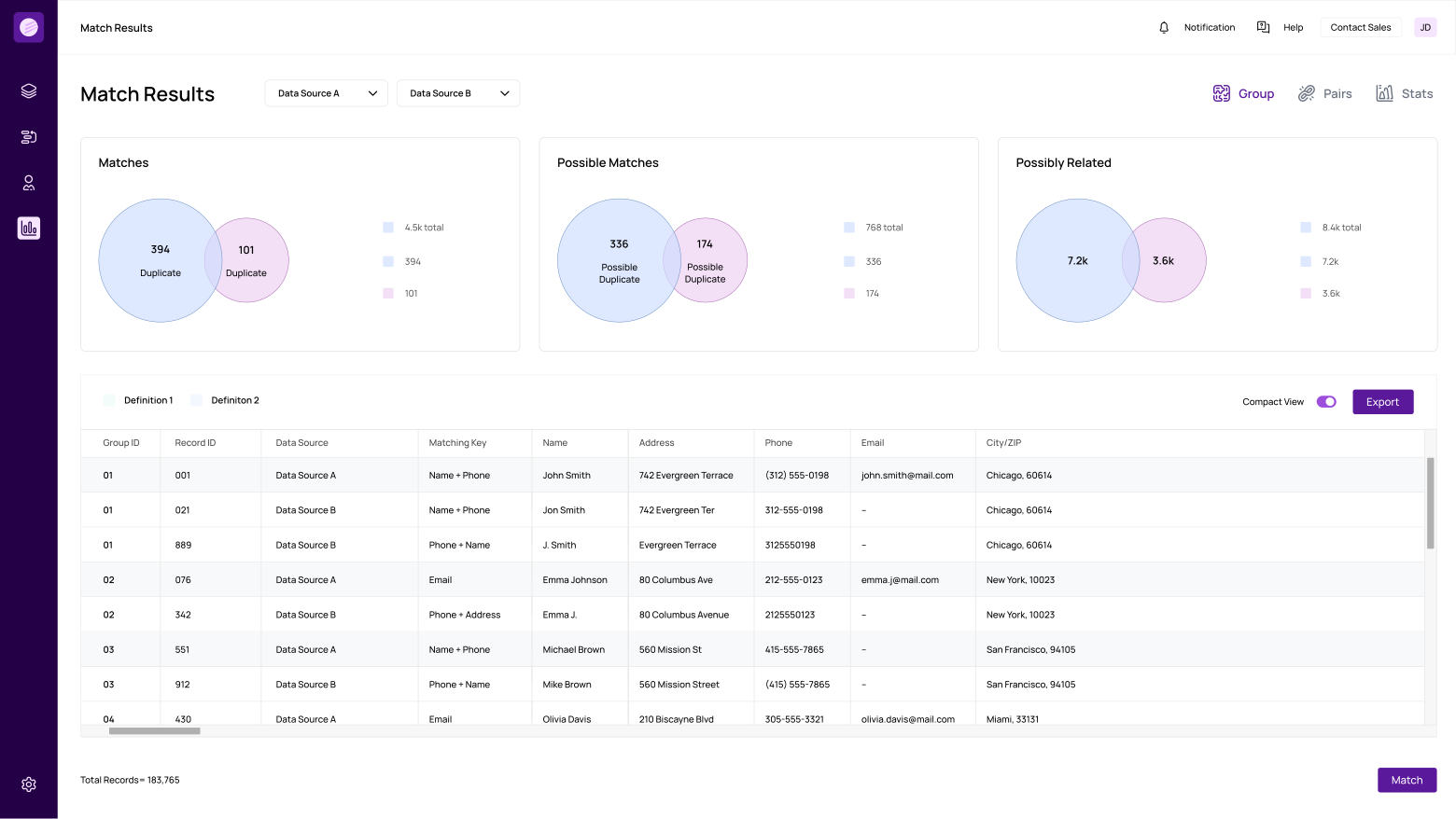
MatchLogic scores every potential match from 0-100% confidence, showing exactly which algorithms contributed and which fields drove the score.
Classification: Threshold-Based Decisions
Combined similarity scores are compared against configurable thresholds. Pairs above the upper threshold are auto-classified as matches. Pairs below the lower threshold are classified as non-matches. Pairs between the thresholds enter a manual review queue. The threshold setting is the primary control for the precision/recall trade-off: lower thresholds increase recall (catch more true matches) at the cost of precision (more false positives).
What Separates Enterprise Fuzzy Matching Software from Open-Source Libraries?
Algorithm Support
- Open-Source Libraries (FuzzyWuzzy, RapidFuzz, dedupe.io): Typically one algorithm per library. Combining methods requires custom code.
- Enterprise Platforms (MatchLogic, Informatica, IBM): Multiple algorithms (fuzzy, phonetic, probabilistic, ML) configurable per field in a single workflow.
Blocking
- Open-Source Libraries (FuzzyWuzzy, RapidFuzz, dedupe.io): Must be implemented manually. No built-in multi-pass blocking.
- Enterprise Platforms (MatchLogic, Informatica, IBM): Built-in configurable blocking with multi-pass strategies and sorted neighborhood options.
Scale
- Open-Source Libraries (FuzzyWuzzy, RapidFuzz, dedupe.io): FuzzyWuzzy: slow above 100K records. dedupe.io: memory-limited at 2M+ records.
- Enterprise Platforms (MatchLogic, Informatica, IBM): MatchLogic: 1M records in <8 seconds. 10M+ without performance degradation.
Threshold Tuning
- Open-Source Libraries (FuzzyWuzzy, RapidFuzz, dedupe.io): Manual code changes required. No test-and-learn workflow.
- Enterprise Platforms (MatchLogic, Informatica, IBM): Visual threshold configuration with real-time preview of precision/recall impact.
Preprocessing Integration
- Open-Source Libraries (FuzzyWuzzy, RapidFuzz, dedupe.io): Separate step using different tools. No integrated profiling or standardization.
- Enterprise Platforms (MatchLogic, Informatica, IBM): Built-in profiling, cleansing, and standardization feed directly into matching.
Merge/Survivorship
- Open-Source Libraries (FuzzyWuzzy, RapidFuzz, dedupe.io): Not included. Separate code or tool required for golden record creation.
- Enterprise Platforms (MatchLogic, Informatica, IBM): Integrated merge purge with per-field survivorship rules and before/after preview.
Audit Trail
- Open-Source Libraries (FuzzyWuzzy, RapidFuzz, dedupe.io): Must be built custom. No default logging of match decisions.
- Enterprise Platforms (MatchLogic, Informatica, IBM): Every match decision logged: algorithms applied, scores produced, threshold used, reviewer actions.
Deployment
- Open-Source Libraries (FuzzyWuzzy, RapidFuzz, dedupe.io): Cloud or local Python environment. No enterprise deployment support.
- Enterprise Platforms (MatchLogic, Informatica, IBM): On-premise, cloud, or hybrid. Air-gapped environment support for regulated industries.
Algorithm Support
- Open-Source: One algorithm per library. Combining requires custom code.
- Enterprise Platform: Multiple algorithms configurable per field in one workflow.
Blocking
- Open-Source: Must implement manually.
- Enterprise Platform: Built-in configurable multi-pass blocking.
Scale
- Open-Source: Slow above 100K. Memory-limited at 2M+.
- Enterprise Platform: 1M in <8 sec. 10M+ without degradation.
Threshold Tuning
- Open-Source: Manual code changes. No test-and-learn.
- Enterprise Platform: Visual config with real-time precision/recall preview.
Preprocessing
- Open-Source: Separate tools. No integrated profiling.
- Enterprise Platform: Built-in profiling, cleansing, standardization.
Merge/Survivorship
- Open-Source: Not included. Separate code required.
- Enterprise Platform: Integrated merge purge with per-field rules.
Audit Trail
- Open-Source: Must build custom.
- Enterprise Platform: Full logging of every match decision.
Deployment
- Open-Source: Cloud or local Python only.
- Enterprise Platform: On-premise, cloud, or hybrid.
Open-source libraries are excellent for prototyping, proof-of-concept work, and small datasets (under 100,000 records). For production enterprise matching at scale, with integrated preprocessing, auditability, and ongoing automation, enterprise platforms are the appropriate choice.
"Configurable matching rules let us set different thresholds by entity type. False positive rate dropped from 28% to under 2%."
— Michael Chen, VP Data Governance, Global Logistics Inc.
28% → 2% false positive rate reduction
What Should You Look For in Fuzzy Matching Software?
When evaluating fuzzy matching tools for enterprise use, assess these criteria. For a broader vendor evaluation framework, see our [INTERNAL LINK: 1I, data matching software guide].
Algorithm Variety and Configurability
The tool should support multiple fuzzy algorithms (Jaro-Winkler, Levenshtein, Soundex/Metaphone, cosine similarity) plus exact and probabilistic matching. You should be able to assign different algorithms to different field types: Jaro-Winkler for names, Levenshtein for addresses, phonetic for transliterated names. A tool that offers only one algorithm forces you to use the wrong method for some field types.
Threshold Tuning with Test-and-Learn
The similarity threshold is the single most important configuration in fuzzy matching. Setting it requires experimentation: run matching at different thresholds against a labeled validation set and measure precision and recall at each level. Enterprise tools provide visual threshold tuning with immediate feedback on how many matches and false positives each setting produces. Tools that require manual code changes for threshold adjustment slow the tuning process dramatically.

MatchLogic tracks confidence score distributions over time, letting you tune thresholds based on actual match quality data.
Blocking Strategy Support
At enterprise scale, the tool must provide configurable blocking to make fuzzy matching computationally feasible. Look for multi-pass blocking (different blocking keys per pass), sorted neighborhood algorithms, and blocking key recommendations based on data profiling results.
Integration with Preprocessing and Post-Processing
Fuzzy matching is one stage in a pipeline. The tool should integrate with data profiling (to understand input quality), standardization (to reduce unnecessary fuzzy comparisons), and merge/purge (to act on match results). Tools that require data export between each stage introduce errors and friction.
Scale and Performance
Test the tool against your actual data volume. Many tools perform well at 100,000 records but degrade at 1 million or 10 million. MatchLogic processes 1 million records in under 8 seconds while maintaining 95%+ accuracy, with no performance degradation at 10 million or higher.
Auditability and Compliance
For regulated industries (healthcare, financial services, government), every fuzzy match decision must be traceable. The tool should log which algorithms were applied, what scores they produced, which threshold classified the pair, and whether a human reviewer confirmed or overrode the decision. This audit trail is required under HIPAA for patient matching and SOX Section 404 for financial data integrity.
Deployment Model
On-premise deployment ensures that sensitive records never leave your secured infrastructure during the matching process. MatchLogic is built specifically for on-premise deployment in regulated enterprise environments, processing all data within your network with full audit trail control.
Where Is Fuzzy Matching Software Most Valuable?
Fuzzy matching delivers the highest ROI in scenarios where data quality is inconsistent and exact matching misses a significant percentage of true duplicates.
Customer Record Deduplication
CRM systems accumulate records like "Robert Smith," "Bob Smith," "R. Smith," and "SMITH, ROBERT" for the same person. Exact matching catches none of these. Fuzzy matching with Jaro-Winkler on names, Levenshtein on addresses, and phonetic comparison on pronunciation variants identifies them as the same entity with confidence scores that indicate match quality.
Post-Merger Data Consolidation
When two companies merge, their customer databases overlap. Fuzzy matching identifies the overlap even when the two systems used different formatting conventions, different name abbreviation styles, and different address structures. A financial services firm used fuzzy matching to identify 34% customer overlap between two acquired institutions, preventing 150,000 duplicate records from entering the consolidated system.
"Matched 1.8 million records across three systems with under 2% false positives. Finally have a single source of truth we actually trust."
— Robert Tanaka, Director of Data Operations, Summit Financial Group
1.8M records fuzzy-matched across three legacy systems
Vendor and Supplier Matching
"IBM Corp," "International Business Machines," and "IBM Corporation" are the same vendor. Fuzzy matching with token-based comparison and corporate dictionary lookup identifies these variations. Without matching, the same vendor receives multiple payments under multiple records.
Choosing Fuzzy Matching Software That Fits Your Data
Fuzzy matching software is the foundational technology for identifying duplicates that exact matching misses. The right tool depends on your data volume, quality, regulatory requirements, and existing infrastructure. For prototyping or small datasets, open-source libraries provide a cost-effective starting point. For production enterprise matching at scale, an integrated platform that combines fuzzy matching with profiling, standardization, and merge/purge delivers the best accuracy and the most defensible audit trail.
MatchLogic provides fuzzy matching within a unified on-premise platform: multiple algorithms configurable per field, visual threshold tuning, built-in blocking, integrated preprocessing, and complete audit trails. For organizations where matching accuracy and regulatory compliance are non-negotiable, it addresses every requirement in a single deployment.
Frequently Asked Questions
What is fuzzy matching software and how does it differ from exact matching?
Fuzzy matching software uses string similarity algorithms to identify records that are similar but not identical, producing a confidence score between 0 and 1. Exact matching requires identical field values to declare a match. Fuzzy matching catches typos, nickname variations, abbreviation differences, and formatting inconsistencies that exact matching misses entirely.
What algorithms does fuzzy matching software use?
Common algorithms include Jaro-Winkler (optimized for short strings like names), Levenshtein distance (counts character edits, good for addresses), Soundex and Metaphone (phonetic encoding for pronunciation variants), and cosine similarity (token-based comparison for long strings and company names). Enterprise platforms apply multiple algorithms simultaneously, choosing the best one per field type.
How accurate is fuzzy matching software?
Accuracy depends on the algorithm, threshold configuration, and input data quality. With proper standardization before matching and threshold tuning against a labeled validation set, fuzzy matching typically achieves F1 scores between 0.88 and 0.95. Combining fuzzy matching with probabilistic weighting pushes accuracy higher. MatchLogic maintains 95%+ match accuracy at scales of 1 million to 100 million records.
Can fuzzy matching software run on-premise?
Yes. MatchLogic is built for on-premise deployment, processing all data within your secured infrastructure. Match scores, algorithms, and audit trails are generated locally, ensuring PII, PHI, and regulated data never leave your network.
What is the difference between fuzzy matching and probabilistic matching?
Fuzzy matching measures string similarity between individual field values. Probabilistic matching assigns statistical weights to multiple field comparisons and calculates an overall match probability. In practice, enterprise tools combine both: fuzzy algorithms provide the per-field similarity scores, and probabilistic logic combines those scores into an overall match decision.





.svg)