
Entity Resolution: The Definitive Guide to Identifying, Linking, and Unifying Records
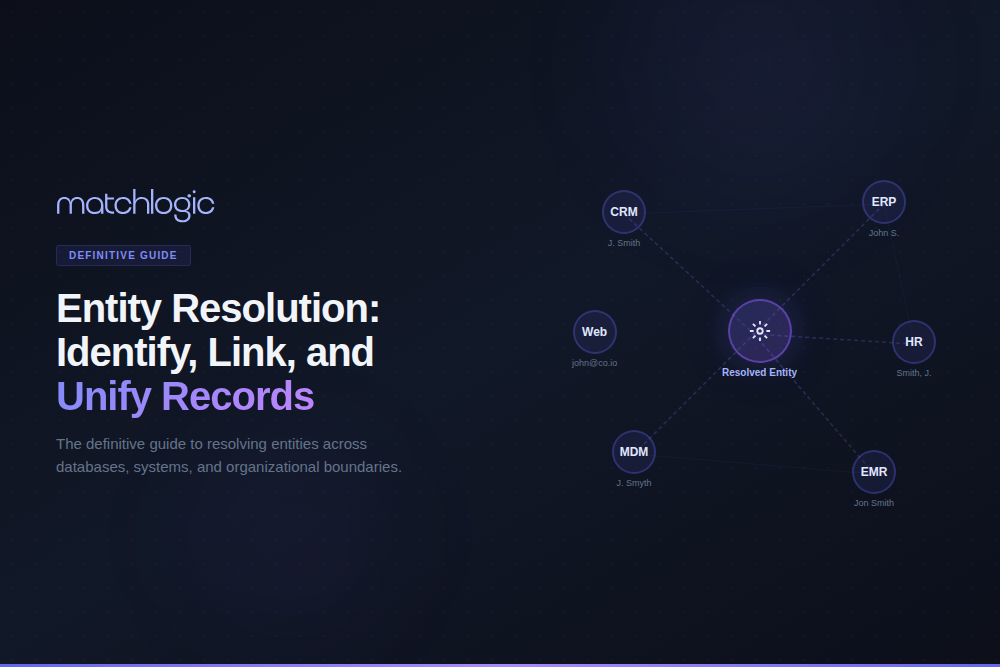
Entity resolution is the process of determining when different data records refer to the same real-world entity, such as a person, organization, product, or location, and linking those records into a unified, canonical profile. It goes beyond simple data matching by adding clustering (grouping all records that belong to the same entity) and canonicalization (creating a single golden record from multiple fragments). Entity resolution is the foundation of master data management (MDM), Customer 360 initiatives, fraud detection systems, and regulatory compliance programs.
While data matching identifies candidate pairs of similar records, entity resolution answers a harder question: across all your systems, how many distinct entities do you actually have, and which records belong to each one? According to Gartner, poor data quality costs organizations an average of $12.9 million per year, and entity fragmentation is one of the most persistent contributors. This guide covers the core approaches to entity resolution, the full ER pipeline, the build vs. buy decision, industry-specific applications, and evaluation criteria for [INTERNAL LINK: 2A, entity resolution software].
Key Takeaways
- Entity resolution determines when different records refer to the same real-world entity, going beyond matching to include clustering and canonicalization.
- The four core ER approaches are rule-based, probabilistic, graph-based, and ML-based; enterprise implementations typically combine multiple approaches.
- The ER pipeline has six stages: preprocessing, blocking, pairwise comparison, classification, clustering, and canonicalization.
- Build vs. buy decisions depend on data volume, match complexity, team expertise, and time-to-value requirements.
- On-premise entity resolution is critical for regulated industries (healthcare EMPI, financial services KYC/AML) where data residency is mandated.
- MatchLogic resolves 1 million records into entity clusters in under 7 seconds with full audit trail transparency.
Why Does Entity Resolution Matter for Enterprises?
Every enterprise accumulates records about the same entities across multiple systems. A single customer might exist as "Robert Smith" in the CRM, "Bob Smith" in billing, "R. Smith" in the support portal, and "Robert J. Smith Jr." in the loyalty program. Without entity resolution, that one customer appears as four separate people, distorting every metric, model, and decision built on that data.
The consequences scale with the organization. A mid-size retailer with 2 million customer records and 35% entity fragmentation (the average discovered in first-time ER scans, per MatchLogic customer benchmarks) is actually tracking 1.3 million unique customers, not 2 million. Marketing costs are inflated, churn calculations are wrong, lifetime value estimates are meaningless, and personalization efforts target fragments instead of people.
In regulated industries, the stakes are higher. Healthcare organizations that cannot resolve patient identities across systems risk medication errors, redundant testing, and HIPAA violations. Financial institutions that cannot link entity records across accounts miss fraud patterns and fail KYC/AML obligations. Government agencies that cannot connect citizen records across departments overpay benefits and miss fraud. Entity resolution is not a data quality luxury; it is an operational and regulatory necessity.
"As part of the journey we've gone through with MatchLogic, we're becoming more data-first, moving from assumption to assurance around data quality."
— Daniel Hughes, VP of Analytics, Finverse Bank
What Is the Difference Between Entity Resolution, Data Matching, and Deduplication?
These three processes are related but distinct, and understanding the differences is essential for choosing the right tools and approaches. Data matching is the foundation: it compares records to calculate similarity scores. [INTERNAL LINK: Cluster 1 Pillar, Our data matching guide] covers matching techniques in depth.
Core Question
- Data Matching: Are these two records similar?
- Entity Resolution: Which records represent the same real-world entity?
- Deduplication: Which records within this dataset are duplicates?
Scope
- Data Matching: Pairwise comparison
- Entity Resolution: Full dataset clustering
- Deduplication: Single-dataset cleanup
Output
- Data Matching: Match scores and candidate pairs
- Entity Resolution: Entity clusters and golden records
- Deduplication: Deduplicated dataset with merged records
Techniques
- Data Matching: Deterministic, probabilistic, fuzzy, ML
- Entity Resolution: Matching + graph clustering + canonicalization
- Deduplication: Matching + merge/purge survivorship rules
Use Case
- Data Matching: Finding candidate pairs for review
- Entity Resolution: Building Customer 360, EMPI, MDM
- Deduplication: Cleaning CRM, mailing lists, databases
Think of it as a progression: matching identifies pairs, entity resolution groups pairs into clusters and builds canonical profiles, and [INTERNAL LINK: Cluster 3 Pillar, deduplication] applies merge/purge logic to eliminate redundant records. Each layer depends on the quality of the layer below it.
What Are the Core Approaches to Entity Resolution?
Entity resolution systems use four primary approaches, and most enterprise implementations combine two or more in a hybrid architecture. For a detailed comparison of entity resolution software options, see our [INTERNAL LINK: 2A, entity resolution software guide].
Rule-Based Entity Resolution
Rule-based ER uses explicit, human-defined logic to determine matches. If two records share the same SSN and last name, they are the same entity. If they share the same email and phone number, they are the same entity. Rules are transparent, auditable, and fast to execute. They work well for clean, well-structured data with reliable identifiers.
The limitation is brittleness. Rules that work for one dataset fail when applied to another with different data quality patterns. A healthcare system that matches on SSN + last name will miss patients who changed their name after marriage, or whose SSN was entered incorrectly in one system. Rule-based ER requires constant maintenance as data sources and quality evolve.
Probabilistic Entity Resolution
Probabilistic ER extends the Fellegi-Sunter framework by assigning agreement and disagreement weights to each field comparison, then combining them into an overall match likelihood. The model accounts for field reliability (rare names are more discriminating than common ones), missing data, and partial agreement. This approach handles real-world data messiness far better than pure rules.
The output is a probability score for each record pair, which is classified against thresholds into match, non-match, or review categories. Probabilistic ER is the standard approach in government record linkage programs, healthcare EMPI systems, and large-scale customer deduplication. It is auditable (weights and scores are transparent) and performs well without requiring labeled training data.
Graph-Based Entity Resolution
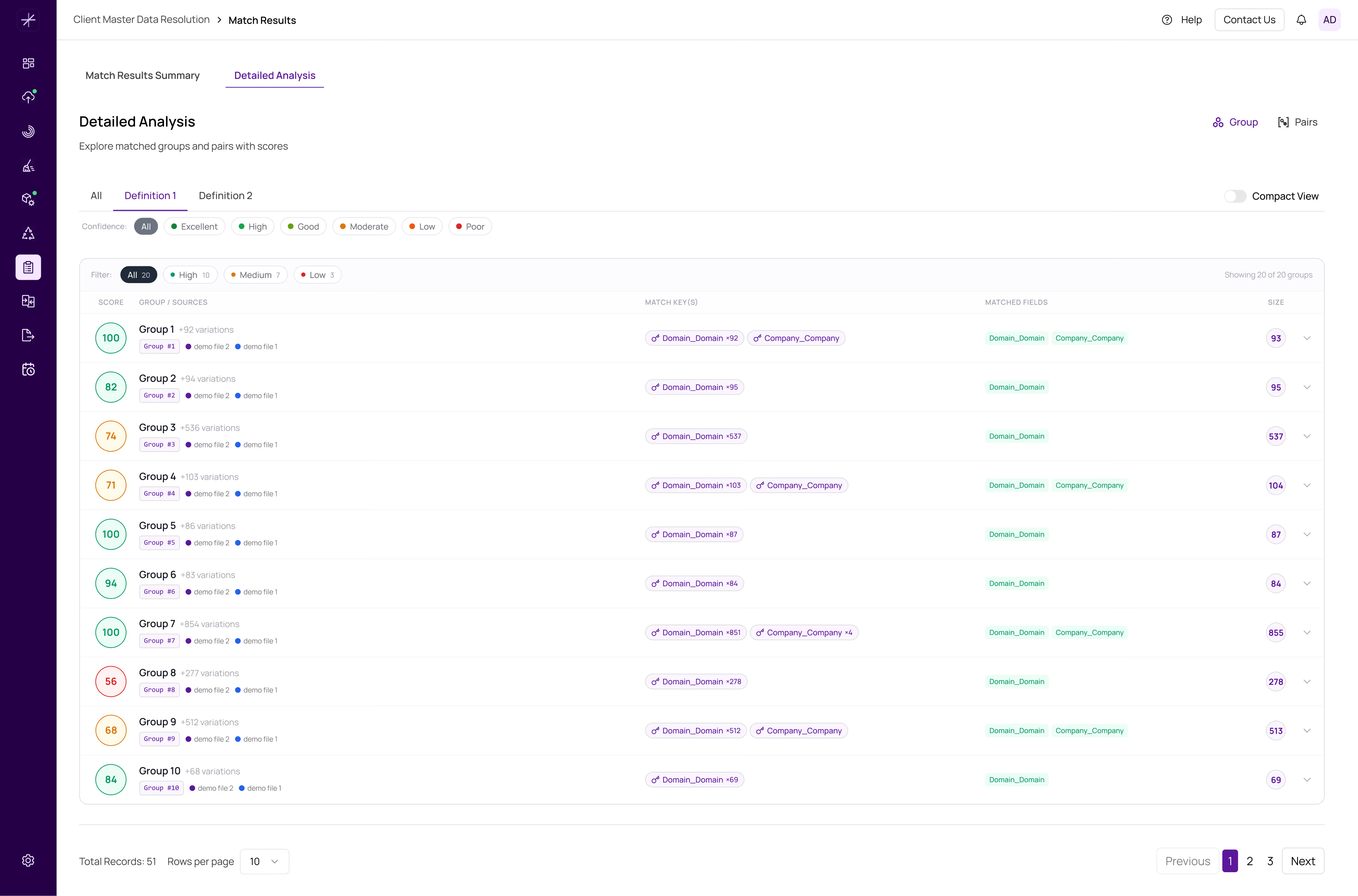
Graph-based ER treats pairwise match decisions as edges in a graph, where each node is a record. Connected components in the graph form entity clusters. This approach is powerful because it captures transitive relationships: if Record A matches Record B, and Record B matches Record C, then A, B, and C all belong to the same entity, even if A and C would not have matched directly.
Graph-based clustering also enables relationship discovery: two entities that share an address, phone number, or employer are linked even if their names differ entirely. This capability is critical for fraud detection (identifying fraud rings through shared attributes) and intelligence analysis. The challenge is controlling false positives: a single incorrect match can cascade through the graph, merging entities that should remain separate.

MatchLogic's entity resolution engine builds graph-based clusters from pairwise matches, showing exactly which records connect and why each cluster represents a single real-world entity.
ML-Based Entity Resolution
Machine learning ER trains models on labeled record pairs to learn complex matching patterns. Deep learning approaches (such as transformer-based models) can capture semantic similarities that string-based methods miss: "IBM" and "International Business Machines" are the same entity, but no fuzzy matching algorithm would catch that without a reference dictionary.
ML-based ER achieves the highest accuracy in academic benchmarks, but requires substantial labeled training data (typically 1,000+ labeled pairs) and ongoing model maintenance. For regulated industries where every match decision must be explainable, pure ML approaches face auditability challenges. The most practical enterprise implementations use ML for candidate scoring within a larger pipeline that includes rule-based and probabilistic components.
How Does the Entity Resolution Pipeline Work?
The ER pipeline extends the data matching process with additional stages for clustering and record consolidation. Each stage builds on the previous one.
Stage 1: Preprocessing and Standardization
Raw data from source systems is profiled, cleansed, and standardized before any comparison begins. Name parsing (splitting "Dr. Robert J. Smith Jr." into salutation, first, middle, last, suffix), address standardization (converting "123 N Main St Apt 4B" into structured components), and format normalization (phone numbers, dates, identifiers) all happen here. MatchLogic's built-in [INTERNAL LINK: data cleansing features] handle this stage automatically, reducing format variations by 40% on average before matching begins.
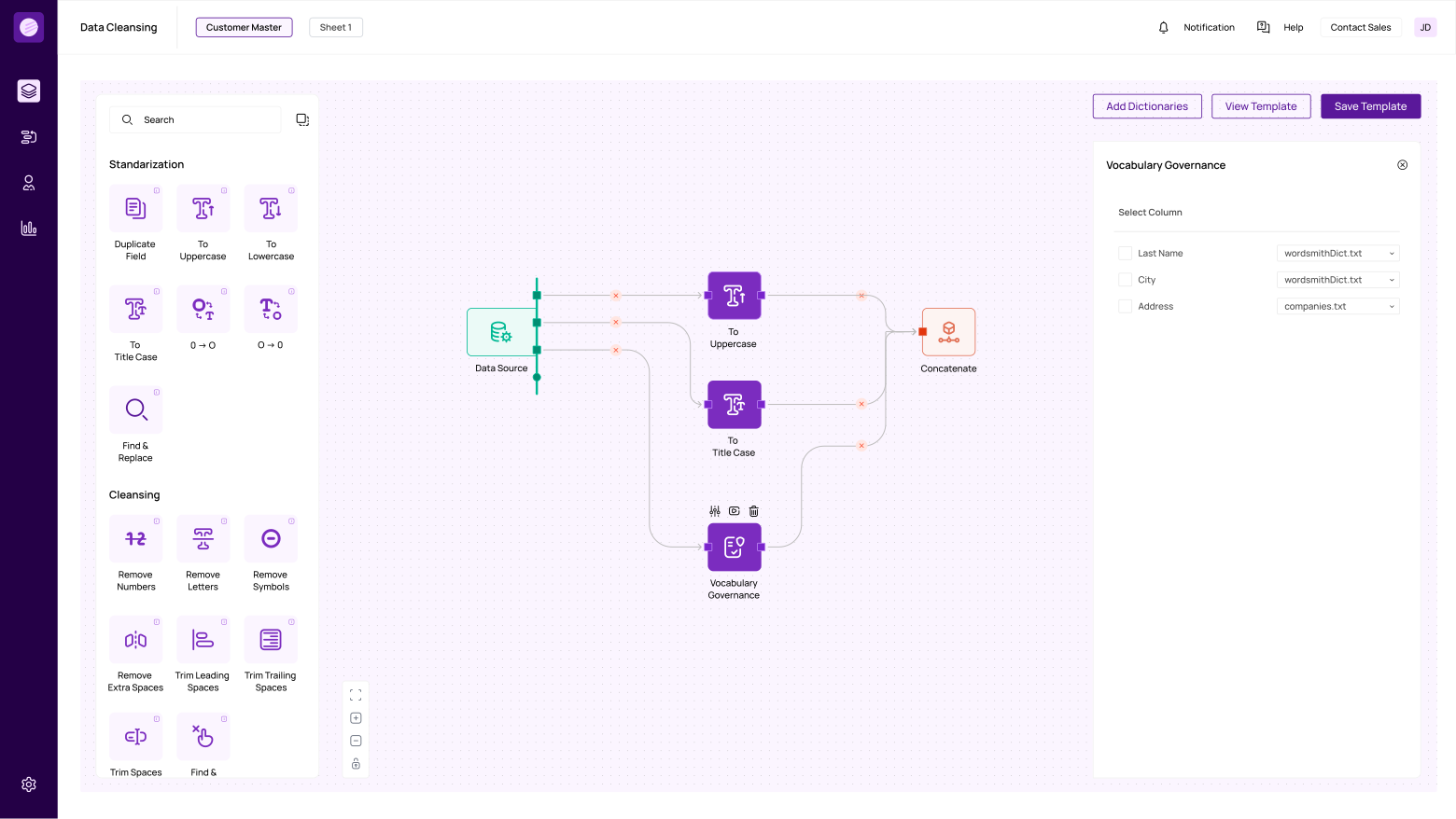
MatchLogic's cleansing engine standardizes formats, fixes abbreviations, and normalizes patterns before entity resolution begins, improving downstream match accuracy by 40-50%.
Stage 2: Blocking
Blocking partitions records into subsets that share a common attribute to avoid the O(n²) comparison problem. For entity resolution at enterprise scale (10M+ records), effective blocking is non-negotiable. Multi-pass blocking with different keys (name + DOB, ZIP + phone, email domain + last name) catches entities whose primary blocking key is corrupted.
Stage 3: Pairwise Comparison
Within each block, every record pair is compared across multiple fields using the appropriate similarity functions. Name fields use Jaro-Winkler or phonetic algorithms; addresses use token-based comparison after standardization; dates use exact or windowed comparison; identifiers use exact match. The output is a feature vector of similarity scores for each pair.
Stage 4: Classification
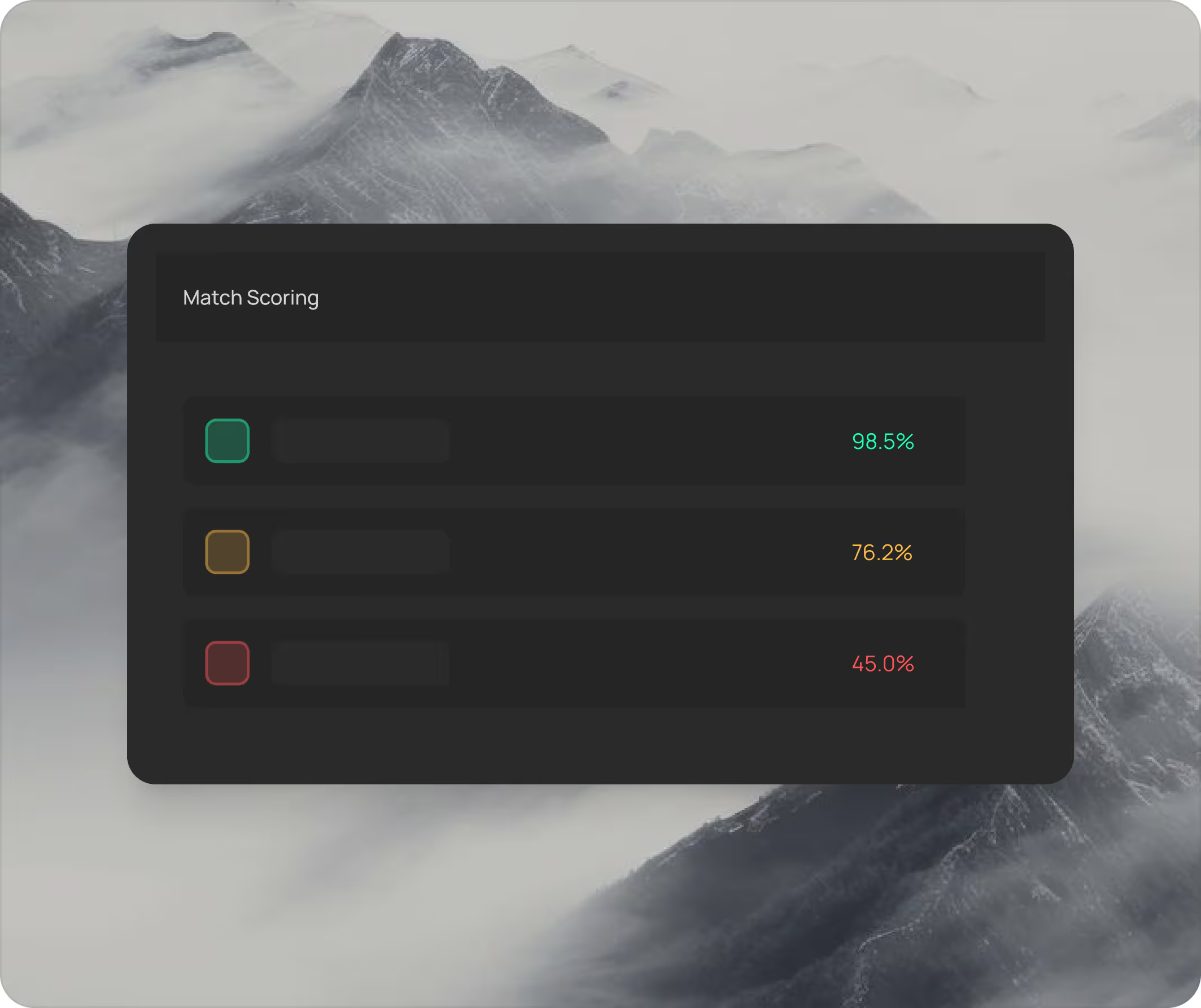
Each pair's feature vector is classified as match, non-match, or possible match. Classification can be rule-based (threshold on weighted score), probabilistic (Fellegi-Sunter), or ML-based (trained classifier). The classification threshold directly controls the precision/recall trade-off: lower thresholds catch more true matches but increase false positives.
Stage 5: Clustering
Pairwise match decisions are aggregated into entity clusters. The simplest approach treats matches as edges in a graph and finds connected components. More sophisticated methods use community detection algorithms or correlation clustering to handle noisy match decisions. A single false positive match can merge two entities that should remain separate (a problem called "cluster drift"), so cluster validation is critical.
For a deeper exploration of how entity resolution connects records across databases, see our [INTERNAL LINK: 2B, entity resolution and data linkage article].
Stage 6: Canonicalization (Golden Record Creation)
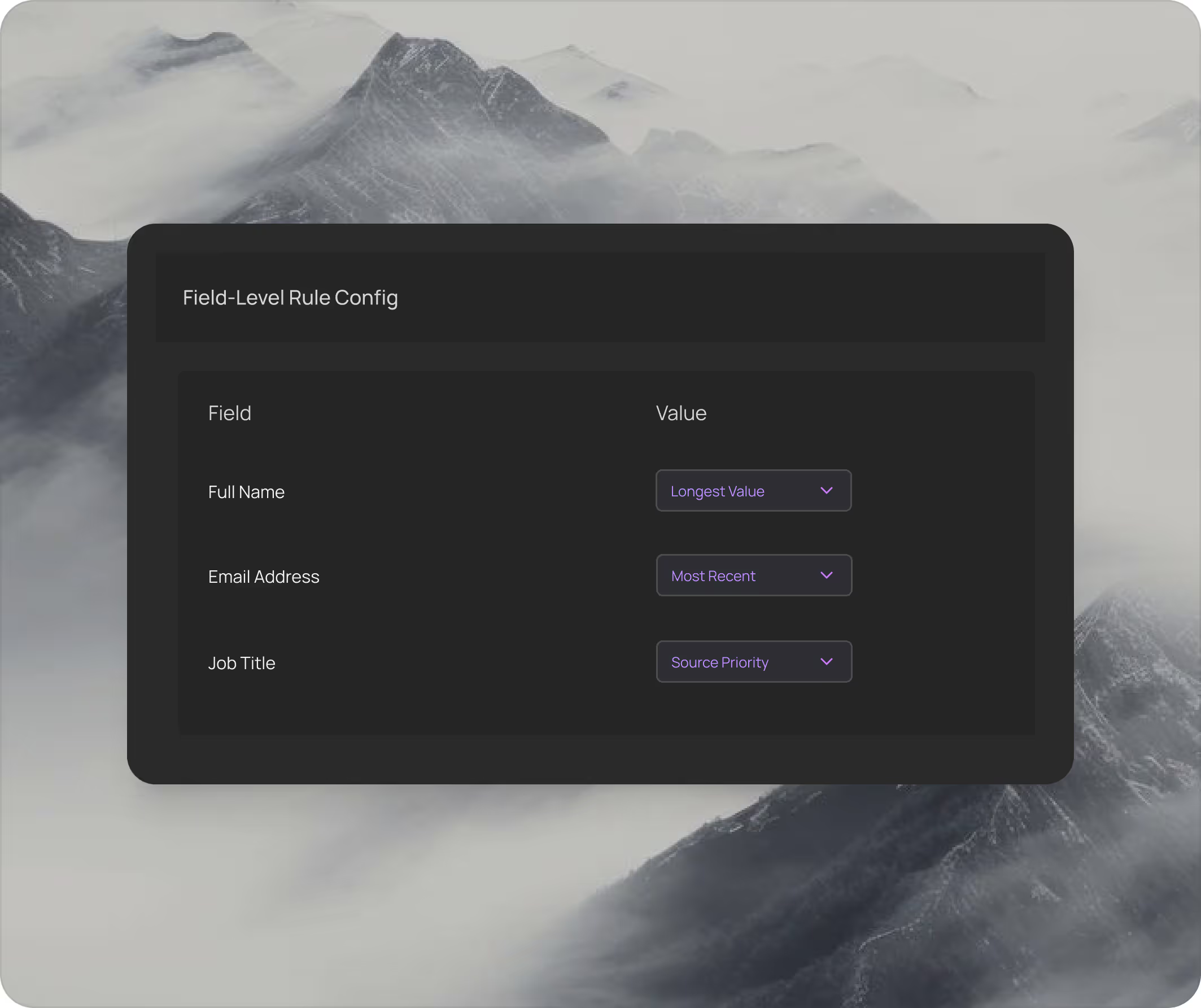
Each entity cluster is consolidated into a single canonical record (the "golden record") using survivorship rules. The most recent address, the most complete name, the highest-priority source system's phone number. MatchLogic's survivorship engine allows field-level rule configuration: names use the longest value, dates use the most recent, addresses use the most complete source.
$2.3M
Average savings from unified entity views
<7 sec
To resolve 1 million records into clusters
35%
Average entity fragmentation found in first scan
Should You Build or Buy Entity Resolution?
This is one of the most consequential decisions in an ER project. The answer depends on data volume, match complexity, team expertise, and time-to-value requirements. For a detailed decision framework, see our [INTERNAL LINK: 2C, entity resolution solutions: build vs. buy guide].
Time to Value
- Build (In-House): 6–18 months for production-grade system. Custom blocking, scoring, clustering, and UI all require development.
- Buy (Vendor Platform): Days to weeks for initial results. Pre-built algorithms, UI, and APIs accelerate deployment.
Team Required
- Build (In-House): Dedicated team of 5–20+ engineers with expertise in NLP, distributed systems, and data quality.
- Buy (Vendor Platform): 1–3 data engineers for configuration and integration. Vendor handles algorithm maintenance.
Accuracy at Scale
- Build (In-House): Achievable but requires significant investment in labeling, testing, and iteration. Accuracy plateaus without ongoing tuning.
- Buy (Vendor Platform): Production-tested algorithms with enterprise benchmarks. Continuous improvement from vendor R&D.
Total Cost (3 Year)
- Build (In-House): $500K–$2M+ in engineering time, infrastructure, and ongoing maintenance. Hidden costs compound.
- Buy (Vendor Platform): Predictable licensing cost. Lower TCO at scale when factoring in maintenance and opportunity cost.
Customization
- Build (In-House): Full control over every algorithm, threshold, and workflow. Can optimize for specific domain requirements.
- Buy (Vendor Platform): Configurable within the platform's capabilities. Less flexibility for edge cases.
Best For
- Build (In-House): Organizations with unique ER requirements, large engineering teams, and long time horizons.
- Buy (Vendor Platform): Organizations that need results in weeks, lack specialized ER expertise, or operate in regulated industries requiring vendor support.
Where Is Entity Resolution Used Across Industries?
Healthcare: Enterprise Master Patient Index (EMPI)
Patient identity resolution is the foundation of every healthcare data initiative. When "Robert J. Smith" visits his primary care physician, "Bob Smith" gets labs at a diagnostic center, and "R.J. Smith" fills prescriptions at a pharmacy, entity resolution must recognize all three as the same patient. According to a 2023 Pew Charitable Trusts study, patient misidentification rates range from 8% to 12% in typical hospital systems, contributing to medication errors, redundant tests, and an estimated $6 billion in unnecessary costs annually.
A 500-bed hospital system processing 2 million patient records used MatchLogic's probabilistic ER with three blocking passes and reduced its duplicate rate from 11.2% to 0.8% within 90 days, running entirely on-premise to maintain HIPAA compliance. For a deep dive into healthcare-specific ER, see our [INTERNAL LINK: 2E, entity resolution for healthcare guide].
Financial Services: KYC, AML, and Fraud Ring Detection
Entity resolution in financial services goes beyond simple deduplication. It must detect when seemingly unrelated accounts are controlled by the same entity (fraud ring detection), link customer records against sanctions and PEP lists for regulatory screening, and maintain a unified view of customer relationships for risk assessment. Missing a true entity link during AML screening can result in regulatory penalties exceeding $100 million for major institutions.
Graph-based ER is particularly valuable here because it reveals non-obvious relationships: two accounts at different branches that share a phone number, or three applications submitted from the same IP address with slight name variations. For financial services ER applications, see our [INTERNAL LINK: 2F, entity resolution for financial services guide].
"Matched 1.8 million records across three systems with under 2% false positives. Finally have a single source of truth we actually trust."
— Robert Tanaka, Director of Data Operations, Summit Financial Group
1.8M records resolved across three systems
Government: Benefits Administration and Fraud Prevention
Government agencies use entity resolution to link citizen records across departments and detect benefits fraud. The classic example: the FAA matched 40,000 Northern California pilot records against Social Security disability records, finding 40 pilots who claimed to be both medically fit to fly and disabled enough to receive benefits.
Retail: Customer 360 and Personalization
Retailers use ER to merge customer records from point-of-sale, e-commerce, loyalty, and marketing systems. Without resolution, the same customer who buys in-store and online appears as two people, and personalization engines cannot deliver relevant recommendations across channels.
Why Does On-Premise Entity Resolution Matter for Regulated Industries?
Entity resolution processes the most sensitive data an organization holds: personal identifiers, financial records, health information, and government IDs. For regulated industries, the question is not whether to do entity resolution, but where and how the data is processed.
HIPAA requires that protected health information (PHI) be processed in controlled environments with documented access controls. GDPR Article 5 requires data accuracy and minimization, with processing documented and auditable. SOX Section 404 requires internal controls over financial data integrity. None of these frameworks prohibit cloud processing, but all of them create significant compliance overhead when sensitive data leaves your network.
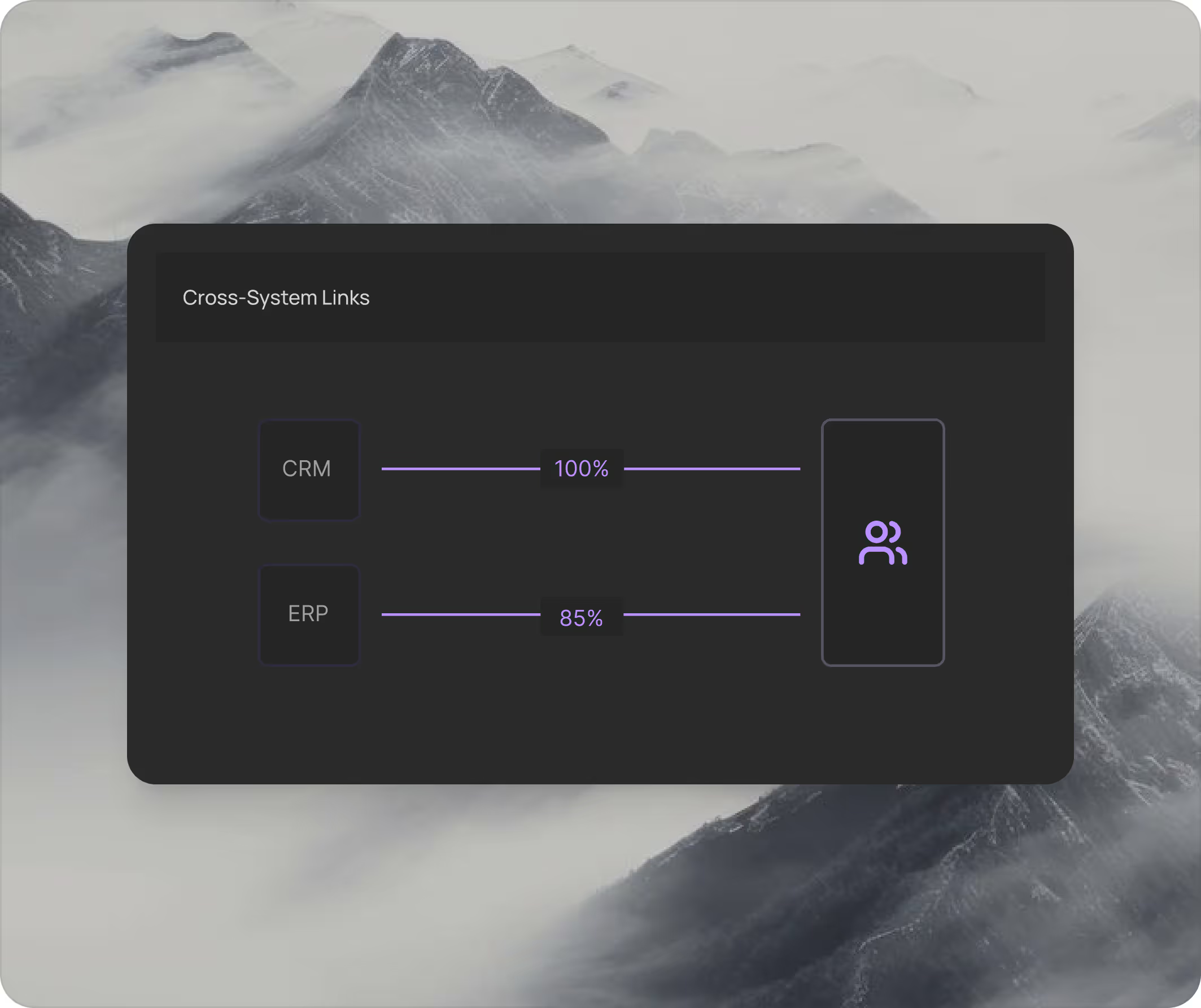
MatchLogic's on-premise architecture addresses these requirements directly. All entity resolution processing occurs within your secured infrastructure. Match decisions, confidence scores, cluster assignments, and golden records are generated and stored on your servers. Audit trails documenting every match decision remain under your control. No data is transmitted to external servers for processing.
How Should You Evaluate Entity Resolution Software?
When evaluating ER platforms, assess these criteria in the context of your specific use case, data volume, and regulatory requirements. See our [INTERNAL LINK: 2A, entity resolution software evaluation guide] for a detailed vendor comparison.
Clustering Quality
- What to Assess: Does the system produce clean entity clusters? Can it handle transitive closure without cluster drift? What controls exist for over-merging?
- Why It Matters: Cluster quality is the core output of ER. Poor clustering creates more problems than it solves.
Scale
- What to Assess: Can it resolve 10M+ records? 100M+? Does performance degrade linearly or exponentially with volume?
- Why It Matters: Enterprise ER datasets grow continuously. A platform that works at 1M but fails at 50M is a dead end.
Auditability
- What to Assess: Can you trace every match decision? Are cluster assignments, confidence scores, and survivorship decisions logged?
- Why It Matters: HIPAA, SOX, GDPR all require documented evidence of data processing decisions.
Deployment
- What to Assess: On-premise, cloud, or hybrid? Air-gapped support? Infrastructure dependencies?
- Why It Matters: Regulated industries require on-premise processing. MatchLogic is built for this requirement.
Real-Time Capability
- What to Assess: Can it resolve entities on new records as they arrive, or is it batch-only?
- Why It Matters: Fraud detection and customer onboarding require real-time ER, not weekly batch runs.
Golden Record Quality
- What to Assess: How complete and accurate are the canonical records? Can survivorship rules be configured per field?
- Why It Matters: The golden record is the final output that downstream systems consume. Quality here is everything.
Building an Entity Resolution Strategy That Scales
Entity resolution is the bridge between fragmented data and trustworthy intelligence. It determines whether your organization operates on a single, accurate view of each customer, patient, supplier, and citizen, or on contradictory fragments scattered across dozens of systems.
The ER pipeline (preprocessing, blocking, comparison, classification, clustering, canonicalization) is well-established, but getting each stage right at enterprise scale requires purpose-built tooling, careful threshold tuning, and ongoing monitoring. The build vs. buy decision should be grounded in honest assessment of your team's ER expertise, your timeline, and the regulatory requirements of your industry.
MatchLogic provides entity resolution infrastructure built for enterprises that cannot afford to move sensitive data outside their network. With transparent matching logic, configurable survivorship rules, and complete audit trails, it addresses the requirements of healthcare, financial services, and government organizations where every entity resolution decision must be explainable and defensible.
"Merge purge eliminated 60,000 duplicate records from our mailing list. Cut direct mail costs by 34% in the first quarter."
— Sarah Caldwell, VP Marketing Operations, Beacon Health Partners
34% cost reduction in first quarter
Frequently Asked Questions
What is entity resolution and how is it different from data matching?
Entity resolution is the process of determining when different data records refer to the same real-world entity and creating a unified profile for that entity. While data matching compares record pairs and produces similarity scores, entity resolution adds clustering (grouping all records belonging to the same entity) and canonicalization (creating a golden record from multiple fragments). Matching is a component within entity resolution, not a substitute for it.
What industries benefit most from entity resolution?
Healthcare (patient matching across EHR systems, EMPI), financial services (KYC/AML compliance, fraud ring detection), government (benefits administration, cross-agency record linkage), and retail (Customer 360 profiles) are the primary verticals. Any industry where the same entity appears in multiple systems with inconsistent identifiers benefits from ER.
How does graph-based entity resolution work?
Graph-based ER treats match decisions as edges in a graph where nodes are records. Connected components form entity clusters. This approach captures transitive relationships: if Record A matches B, and B matches C, then A, B, and C belong to the same entity, even if A and C would not match directly. It also reveals non-obvious relationships through shared attributes like addresses or phone numbers.
Can entity resolution run on-premise for regulated industries?
Yes. On-premise ER platforms process all data within your secured infrastructure. MatchLogic is built specifically for on-premise deployment, ensuring that sensitive records (patient data, financial records, government identifiers) never leave your network. All match decisions, cluster assignments, and golden records are generated and stored on your servers with complete audit trails.
What is the difference between entity resolution and identity resolution?
Identity resolution is a subset of entity resolution focused specifically on unifying records that represent individual people. Entity resolution is broader: it covers people, organizations, products, locations, devices, and any other entity type. The techniques are largely the same, but entity resolution applies to a wider scope of use cases including supplier deduplication, product catalog cleanup, and asset management.
How long does it take to implement entity resolution?
Timeline depends on the approach. Building in-house typically takes 6 to 18 months for a production-grade system. Buying a platform like MatchLogic can deliver initial results within days to weeks, with production deployment in 4 to 8 weeks. The most significant variable is data preparation; organizations with well-profiled, standardized data deploy faster than those starting from raw, unstructured sources.





.svg)